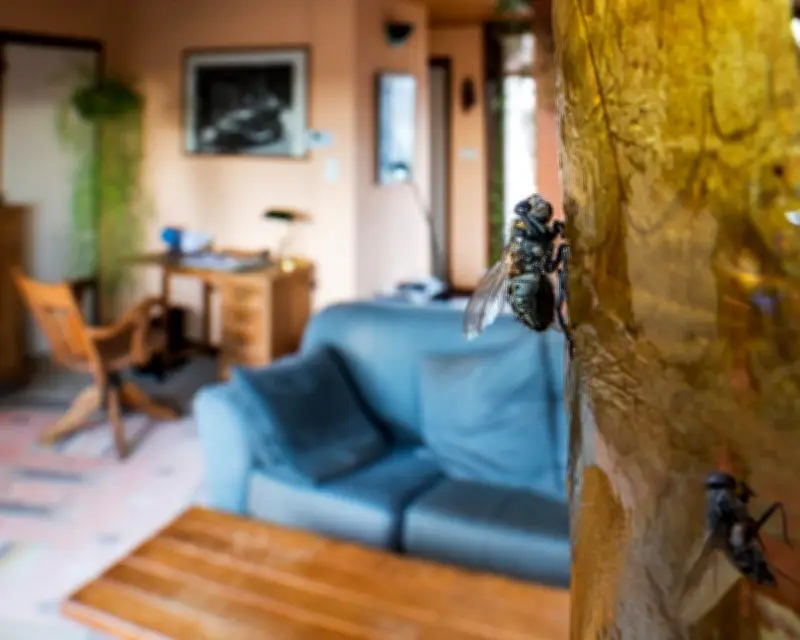
Francesca Davies’s living room is teeming with flies. Entering her home in West Heath, a suburb of Congleton, Cheshire, means a cluster of insects rises from the sofa or floor. Davies and her husband, Alex Andrew, bought a new-build here in 2019 via shared ownership, but every summer swarms of flies descend on their neighbourhood, a problem that is “getting worse,” Davies says.
Daily Battle Against Flies
Davies, 27, swats flies out of her young daughters’ bedroom every night before bed and keeps doors and windows closed or covered with fly nets. She and Andrew bought an industrial fly killer for their kitchen, as cooking attracts even more insects. The sound of flies “getting zapped throughout the night” has become normal, Davies says. The family has considered moving, but Davies is reluctant to give up her “pride and joy.” Andrew notes they would have to sell in winter, as summer viewings would be off-putting. Davies started a petition with over 1,000 signatures urging the council and Environment Agency to investigate.
Neighbours Share Struggles
Neighbour Bryan Stahl, 54, says his house is the worst affected. He has spent about £500 on a gazebo and fly screens and is considering permanent fly shutters. “It makes you feel like you’ve got a really dirty house,” he says. Another neighbour orders takeaways daily to avoid cooking, and a family draped their newborn’s cot in a mosquito net. “They’ve all had enough,” Stahl says.
Flies: Essential Pollinators
Despite their reputation, flies are vital. Andrew Whitehouse of Buglife says flies are pollinators, and some plants, like cacao, are only pollinated by flies. “So if you didn’t have flies, you wouldn’t have chocolate.” Fly larvae eat dead organic material, recycling nutrients and preventing disease spread. Flies are also a key food source for birds, bats, and amphibians.
Erica McAlister, a fly expert at the Natural History Museum, notes there are over 7,000 fly species in the UK. Houseflies are important pollinators, and a cousin of the common housefly is the dominant pollinator in the Arctic. “People are stuck on bees being the most important pollinators – and they are good,” she says, but fly larvae are “out there already helping clean up our environment.” She urges people to “go and look up a bee-fly,” which is “arguably one of the cutest species in the UK.”
Flies as Indicators
McAlister says flies are not inherently dirty; they are “exceptionally clean because they are sometimes in a bad environment.” She advises against killing flies en masse, especially via “horrible and inhumane” methods like fly tape. Instead, creating fly-friendly environments like ponds invites predators that eat flies. When infestations occur, “find out why that’s happened. Because the flies are an indicator that maybe something else is going on.”
Davies and neighbours believe their fly problem is linked to a local recycling plant run by Tandom. In a statement, Tandom says it has “implemented a range of additional precautionary measures” and is working with the Environment Agency and Cheshire East council, but “there is currently no evidence that flies are breeding on our site.” The Environment Agency says it has instructed Tandom “to take immediate steps to tackle the issue” and “will not hesitate to take appropriate enforcement action if required.”
Broader Decline of Insects
McAlister stresses that insects, including flies, are largely in decline. UK local species are “suffering badly” as the country becomes less accommodating to wildlife. “We need our politicians to really work at encompassing all of their decisions with an ecological framework,” she says. “If insects die, we are pretty much on a very downward spiral very quickly” due to reliance on pollination services.