National Gallery's 'Dear America' Exhibition Offers Critical Reflection on US at 250
Stepping into the National Gallery of Art's exhibition commemorating America's 250th birthday reveals a profound departure from anticipated patriotic displays. This showcase, titled Dear America: Artists Explore the American Experience, positions the United States as "a living idea that's shaped by many voices," according to chief curatorial officer E Carmen Ramos.
Reimagining National Symbols
The exhibition opens with familiar American icons reinterpreted through diverse artistic lenses. The Statue of Liberty appears not as a tourist landmark but through Zanele Muholi's portrait of a Black woman and Roy Lichtenstein's geometric screenprint. Similarly, the Oval Office and Lincoln Memorial are transformed—Lichtenstein renders the presidential space in cartoon blues and yellows, while Carrie Mae Weems' 2014 photograph places a haunting silhouette on the memorial steps, honoring Black contralto Marian Anderson.
Gordon Parks' iconic American Gothic features the Stars and Stripes as backdrop to Ella Watson, an African American government worker with her cleaning tools. This opening room establishes America's dual capacity for monumental self-celebration and rigorous self-critique, echoing Walt Whitman's declaration of containing multitudes.
Curatorial Vision and Structure
Drawing from the gallery's permanent collection of over 160,000 works, the exhibition presents more than 100 works on paper by 95 artists. Ramos describes the show as years in development, aiming to capture "the fullness of the American experience" across different historical moments and regions.
The exhibition organizes around three thematic sections:
- Land: Contrasting Thomas Moran's idealized 19th-century western watercolors with Thomas H Johnson's stark 1860s photograph of Pennsylvania's cleared landscape, highlighting tension between natural majesty and destructive development.
- Community: Featuring Richard Avedon's 1976 portrait series The Family alongside John Wilson's tender sketches of teenagers, exploring different social strata.
- Freedom: Examining historical and contemporary struggles through works ranging from Paul Revere's Boston Massacre print to Kara Walker's slavery-themed silhouettes.
Notable Artistic Dialogues
Several powerful juxtapositions create provocative conversations. Thomas Hart Benton's 1939 lithograph Departure of the Joads hangs beside Arthur Rothstein's 1936 photograph of Dust Bowl refugees, both addressing displacement during the Great Depression.
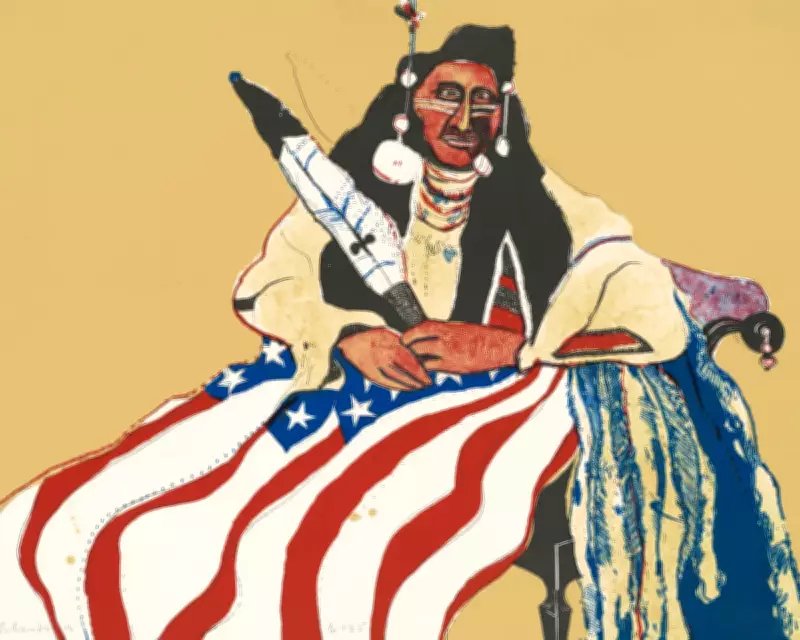
In the Community section, Tom Jones' 2002 mixed-media piece Dear America—which inspired the exhibition title—overlays Indigenous imagery with patriotic lyrics, interrogating Native American representation in popular culture. The Ho-Chunk Nation artist incorporates traditional beadwork and porcupine quills into this critical work.
Freedom Examined
The final section presents complex explorations of liberty. Faith Ringgold's 2007 screenprints illustrate Martin Luther King's Letter from Birmingham Jail, positioned near Gordon Parks' 1963 photograph of a Harlem rally where raised hands suggest both political and religious significance.
Martha Rosler's photomontage series House Beautiful: Bringing the War Home splices Vietnam War combat imagery into magazine spreads of American interiors, challenging perceptions of distance from conflict. Visitors exit past Robert Indiana's Liberty '76, a screenprint connecting 1776 and 1976 in what Ramos calls "the ongoing pursuit of freedom."
Dear America: Artists Explore the American Experience continues at the National Gallery's West Building through September 20, offering a multifaceted reflection on American identity at the nation's 250-year milestone.