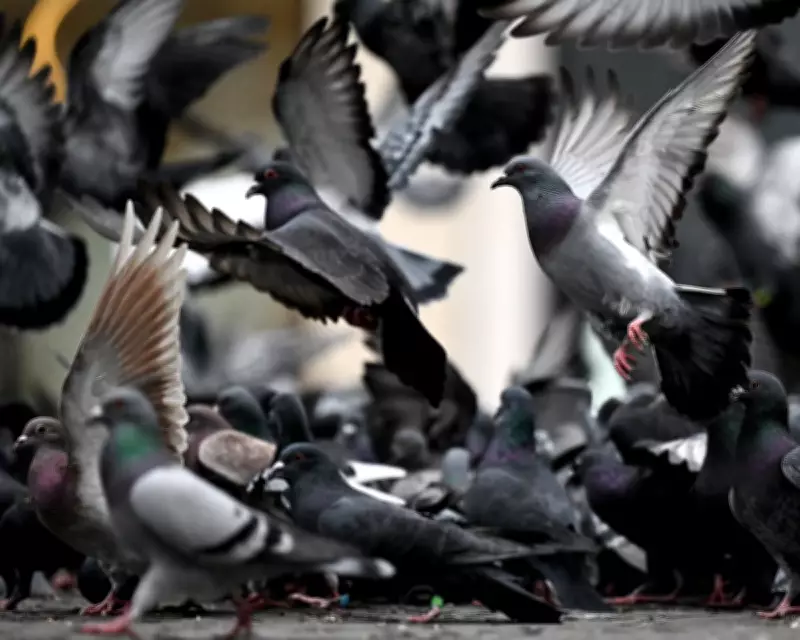
By some estimates, there are almost 3 million pigeons residing in London, which has the highest pigeon population in the country. Known as "rats with wings", "flying ashtrays", and "gutter birds", pigeons do not have popular sentiment on their side. Cities in the UK have an extensive history of attempted pigeon pest control, having tried everything short of an exorcism to remove them, to no avail.
Costly and Ineffective Methods
London's best-known victory in the war against pigeons was self-declared after an operation in Trafalgar Square in the early 2000s. Ken Livingstone's city government flew two Harris hawks around the area to "deter" pigeons, although the hawks went further than that, killing 121 pigeons in what ended up being a years-long bloodbath. The blitz cost the city £226,000. Wildlife activists deemed it an act of unimaginable cruelty, and it did little to permanently cut down pigeon populations.
Last year in Manchester, at least 81 pigeons were shot and killed by pest control services employed by Northern Trains in early morning offensives at Manchester Victoria station. The event is known to some as the Manchester Victoria pigeon massacre. Across the UK, councils use bird spikes, wire netting, glue on roosting ledges, deterrent laser systems, and occasionally electric wire, traps, shooting, poisoning, and hired hawks.

After decades of this, we have to ask: if these methods of pest control were going to be effective, wouldn't they have worked by now? Perhaps it's time to deploy a tried-and-true method of pigeon-population control that has curtailed flocks around the world without hurting, harming, or bothering the birds.
The Humane Alternative: The German Method
I've been spending time with the National Pigeon Advocacy Association (NPAA) and its president, Sue Joyce, also known as Sue the Pigeon Lady. She has a vision of an avian utopia where the pigeon "problem" is solved for good. The vision looks like this: in an empty council flat above a Boots, Sainsbury's, or Greggs, in each of the UK's major cities, a haven for feral pigeons is constructed. Rows of shelving mimic the look of a cliff's edge, the habitat where pigeons lived before humans domesticated them. The shelves contain side-by-side plywood roosting boxes for the birds. No need for twigs or shredded paper, just a steady food supply to keep them coming back.
Every few days, a volunteer stops by to replace recently fertilised eggs, which they will then destroy, with plastic ones. The pigeons will continue to sit on the decoy eggs until they realise hatching is unlikely, at which point they'll kick them out of their nests and try again. Fewer squabs are born, and the mother pigeons are none the wiser. Over time, the pigeon flock decreases to a manageable size, for which there is plenty of appropriate food to go around. The townspeople are happy, their parks are no longer overrun, and no more pigeons need to be shot, trapped, poisoned, starved, or hunted by hawks.
Proven Success Abroad
Groups that have used what is known as the "German method" of swapping fertilised eggs for plastic decoys in pigeon lofts have seen huge success, even with a single roosting room. According to the UK Pigeon Control Advisory Service (PiCAS), an adult pair of pigeons produces about 14 young a year, meaning that one loft with 50 pairs of roosting pigeons could prevent more than 1,000 young pigeons from being born. The strategy was first used in Basel, Switzerland, in 1988 and reduced the city's pigeon population by 50% over four years. It was then popularised in the German city of Augsburg a decade later. Now, other groups in Germany, Belgium, and the Czech Republic report effective population pruning using the same method.
As for the bottom line, the only cost to councils would be the donation of an empty property, of which the UK has plenty. Other countries that use this method, such as the Czech Republic, have largely volunteer-run operations.

Barriers to Adoption in the UK
So what's the holdup? Joyce believes it comes down to UK councils seeing the pitch as a fantasy from animal rights activists, rather than a proven, low-cost, humane, and sustainable strategy backed by feral-pigeon experts. Norwich city council, which was shown an NPAA proposal, told us: "We are looking at a range of humane, legal and proportionate measures to manage the pigeon population while continuing to work on our priorities in redevelopment and home-building."
The public seem to want humane treatment for pigeons now, too. More people are adopting pigeons as pets, and the birds are even serving as opalescent inspiration for haute couture, nail art, and hair colouring. It couldn't be a better time to push for a compassionate solution to the pigeon "problem".
Moral Imperative
It's the least we can do to get on board with a humane, sustainable population-management strategy, since it's our fault pigeons are in this crisis. When humans domesticated pigeons thousands of years ago, we bred them to rely on human care before promptly abandoning them, and some of their natural instincts dwindled with their autonomy. This means they've lost the sensibility to ever stop mating, causing them to breed constantly and rely on a sparse, not to mention injurious, diet of street crumbs. "They are all suffering, when you really look at it," says Joyce.
It's time to usher in a new status quo, in which our pigeons live among us in urban harmony in small flocks, properly fed and respected like any other animal, and cities get the solution they've been seeking, too.