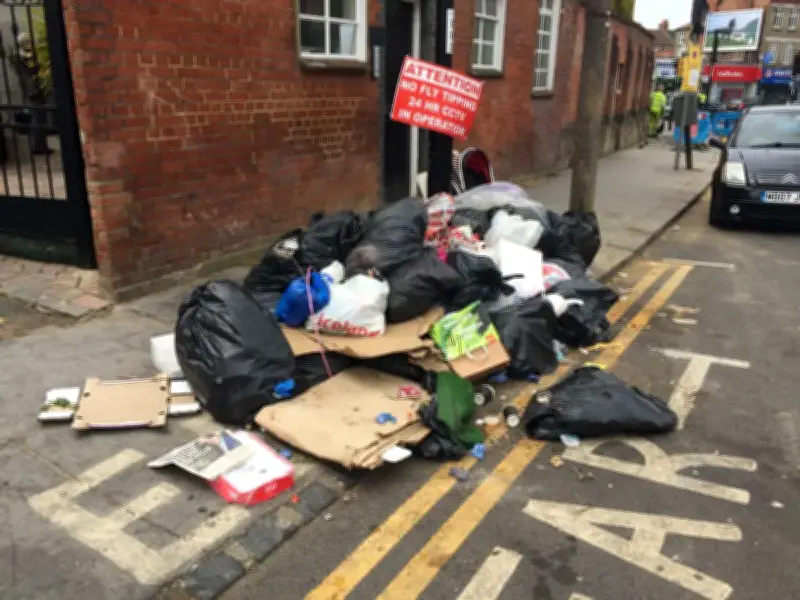
Croydon Council has defended its “zero tolerance” approach to fly-tipping as new figures show the borough recorded thousands of incidents but issued only one fly-tipping-related fine in a year. Bensham Manor ward topped the list with 8,774 reported incidents between January and July 2026, with Brigstock Road the most affected street.
However, local resident and activist Graham Mitchell argues the figures do not tell the full story about how waste is reported in Croydon and the apparent lack of enforcement. The data was published ahead of Croydon Council’s Streets and Environment Scrutiny Sub-Committee meeting on Monday, September 14.
Ward-by-ward breakdown and street hotspots
Bensham Manor recorded significantly more reports than second-placed Norbury and Pollards Hill, which had 5,027 incidents, while West Thornton recorded 4,510. Brigstock Road, which falls within Bensham Manor, saw 750 reports of waste dumping between January and July, making it the borough’s most reported street for fly-tipping.

Other streets with high report numbers include Bensham Manor Road with 463 reports, Melfort Road with 375, Langdale Road with 346, and Bensham Lane with 343. Mitchell, who recently stood as an independent candidate for the Bensham Manor ward in the 2026 local elections, said he was “disappointed and shocked” that his home ward regularly tops the list.
Why Bensham Manor’s numbers are inflated
Mitchell explained that the high numbers could be due to the local housing context. “It's a different housing situation in the north, there are a lot of rentals, probably more private properties in the south and people might have a bit more pride the area and don’t indulge in fly-tipping,” he told the Local Democracy Reporting Service (LDRS). He also pointed to the concentration of small shops with flats above them, particularly around Brigstock Road.
In Croydon, residents living in flats above shops use black bin bags for waste, which are left at designated points for collection by contractor Veolia. These collection points are often on pavements outside properties, and Mitchell believes piles of bin bags can be mistaken for fly-tipping. “They are inflating the numbers and fly-tipping begets fly-tipping,” he said. “If you see a black bag, some one will put another one beside it.”
Mitchell also noted that residents lack clear guidance on when to put bags out. “People also don’t know when they need to put their bags out. They can look up on the website about when they are collected but there is no guidance as to when they can actually put them out. If people put them out on a Tuesday before the Thursday collection, the guidance says to report that as a fly-tip,” he added.
Only one fine in a year raises enforcement concerns
Mitchell questioned the council’s enforcement record, citing its own fixed penalty notice (FPN) data. Between April 2025 and March 2026, the council submitted 319 environmental FPNs, but only one was classified as “Illegal depositing waste (fly-tipping)”. That £1,000 fine was issued in February 2026 in the Woodside ward after an officer witnessed someone fly-tipping, according to the figures.
“That is a hopeless ratio, it doesn’t say to me that they are set up right to catch fly tippers,” Mitchell said. He also challenged the council’s “zero tolerance” stance, calling it “just a slogan” and “words on paper”.
In response, Councillor Alasdair Stewart, Cabinet Member for Streets and Enforcement, told the LDRS that high reporting levels in wards like Bensham Manor “significantly distort” the figures. He added: “A very small number of exceptionally prolific individuals in this community submit hundreds of reports often daily, including duplicates and incidents that are plainly routine street-cleaning issues rather than fly-tipping.”
Stewart defended the council’s approach: “Zero tolerance is not a slogan: we make reporting easy, clear waste quickly and pursue offenders wherever the evidence allows. Croydon has deliberately made reporting quick and easy through the Love Clean Streets app, unlike many councils that put residents through lengthy forms or email processes. This helps us clear 90% of reported fly-tips within 24 hours, but it also pushes our reported numbers higher.”

Caught on Camera scheme and next steps
Croydon’s Conservative administration is advancing its Caught on Camera scheme, which uses CCTV to identify suspected fly-tippers. However, Mitchell remains sceptical, citing an example shown at a recent local meeting where footage captured an individual leaving folded cardboard boxes at a spot where waste had already been dumped. He questioned why that person was caught on camera when many others had also left waste there.
Mitchell said the response given to residents was unclear and did little to inspire confidence. He called for greater enforcement and clearer communication. “What people want to see is action,” he said. “Fining people and, in the right situation, publicising it. It's up to the council to solve the problem, not up to the residents of Bensham Manor. They can do better by showing some pride, but we need an expectation of what people can and can’t do and we need a deterrent.”
Stewart outlined ongoing efforts: “We can only prosecute or issue an FPN where there is evidence identifying an offender. We are stepping up targeted enforcement through our Caught on Camera website, extra Parkguard patrols, mobile CCTV and focused action at hotspots including this part of the borough.”