For nearly two decades, American military bases have hosted an unusual form of theatre where soldiers and civilians transform into Afghan villagers, Iraqi shoppers, and even Taliban fighters. Boston-based photographer Claire Beckett captured this surreal world of military role-playing between 2006 and 2023, revealing how the United States prepares its troops for deployments in conflict zones.
The Cast of Military Training Exercises
Beckett's project, titled 'Defense Language', explores how Arabs and Muslims are depicted during counterinsurgency training for postings to Iraq and Afghanistan. The participants include military veterans playing enemy combatants, immigrants from Iraq or Afghanistan, and local American civilians hired to populate artificial villages.
As Beckett explains, "Those portrayed in the photographs include military personnel – often veterans playing the role of enemy combatants, or immigrants from Iraq or Afghanistan. Local American civilians are hired to populate the artificial villages."

Creating Realism in Artificial Environments
The photographs were taken at bases across America, from New York to South Carolina to California. They include formal portraits, landscapes featuring makeshift buildings, and informal images of people interacting during training exercises.
Some civilian role players were specifically recruited from Iraqi or Afghan communities in the US to enhance realism through their appearance, language skills, and cultural knowledge. Howeida Abdelrahman, shown playing the role of an Iraqi civilian in 2007, represents those hired for paid positions to populate simulated villages and perform basic actions like pretending to sell vegetables at a market.
Playing Both Sides: The Role-Player Experience
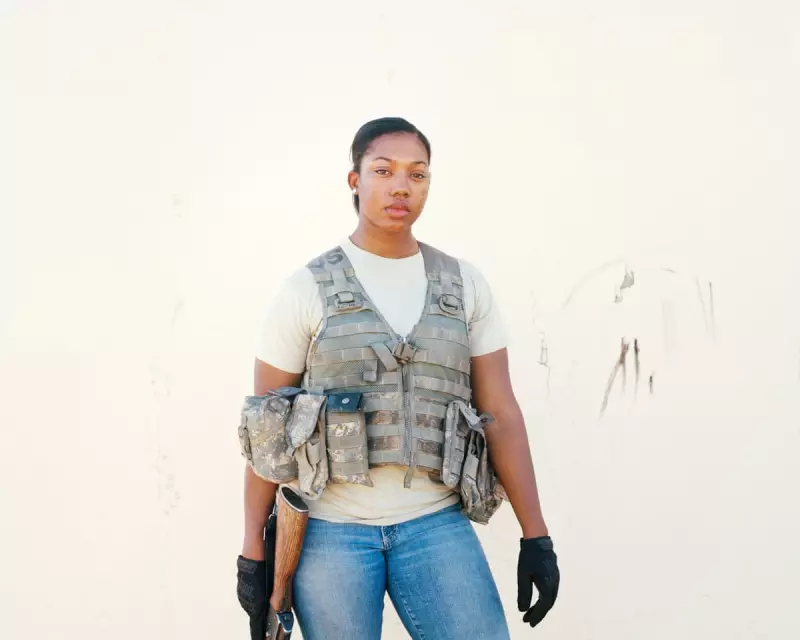
Ariel Combs, a truck driver at Fort Irwin in California, occasionally took on the role of lead insurgent. In 2017, she described her character's fate: "I'm the bad guy. I shoot at the good guys. They're doing a patrol of a city and come into contact with our planted explosives. While they're reacting, I start shooting at them."
She continued: "We launch grenades and stuff like that. They provide suppressive fire – then their helicopter comes in and drops a big bomb on us. We're completely decimated."
Other striking images include Marine major John Cowait playing a warlord holding a Taliban training camp on a remote Afghan mountaintop in 2009, and Army specialist Gary Louis Sims portraying Safah Mehdi Faris, member of Al-Qaeda in Iraq.
Questioning Cultural Representation
Beckett's work goes beyond documentation to critique how these exercises represent other cultures. She examines how Americans interact with other cultures and challenges assumptions of American cultural superiority.
"I'm looking at the way Americans such as myself interact with other cultures," Beckett states, "drawing attention to the problematic depiction of 'cultural others', and challenging the implicit assumption of American cultural superiority."
The project forced Beckett to confront what she describes as "the disproportionately large influence we have as Americans – and how our actions, or inactions, impact people worldwide."
One particularly memorable moment occurred when photographing Marines sergeant John Sexon, lance corporal Cameron Stark and lance corporal Joshua Stevens role-playing as Taliban fighters in 2009. Amid shooting exercises, the marines spontaneously forded a river barefoot to pose for Beckett, creating what she calls "an amazing gift" with "a primordial feel."
Beckett's complete collection, 'Defense Language', is available for purchase from Gost Books, offering a comprehensive look at this unique aspect of military preparation that continues to shape how American soldiers engage with foreign cultures in conflict zones.