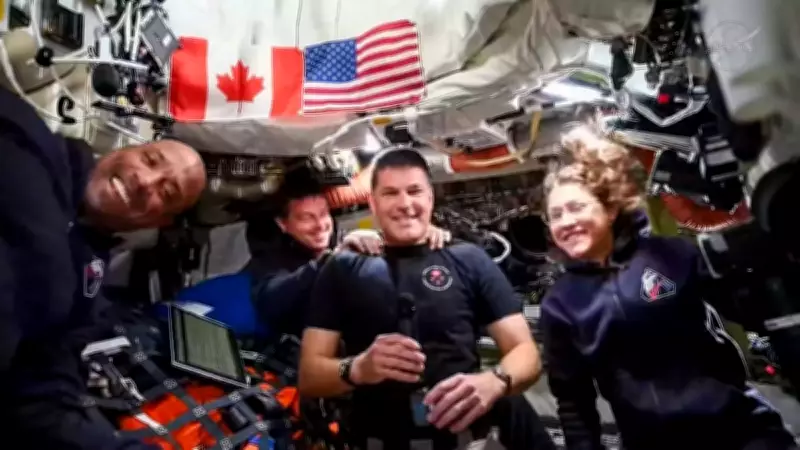
NASA's Artemis II mission, a monumental step in human space exploration, has reached its fourth day, with the Orion spacecraft carrying four astronauts on a historic journey around the moon. This mission represents the first crewed lunar flyby in more than five decades, serving as a critical precursor to NASA's ambitious plans for a sustained return to the lunar surface and eventual crewed missions to Mars.
The Crew and Their Journey
The Artemis II crew comprises NASA commander Reid Wiseman, NASA pilot Victor Glover, NASA mission specialist Christina Koch, and Canadian Space Agency mission specialist Jeremy Hansen. These astronauts are not only conducting vital tests but also documenting their experience through a series of remarkable photographs, offering a rare glimpse into life aboard the spacecraft.
Inside the Orion Spacecraft
Images from inside the Orion spacecraft reveal astronauts Koch and Hansen in a dimly lit cabin, with lights adjusted to enhance visibility of the exterior. The crew has been actively engaging with the public, including a heartwarming call with Canadian children where Wiseman, Hansen, and Koch showcased their space meals, highlighting the human aspect of this technological endeavor.

Breathtaking Views from Space
The mission has yielded stunning visual records, including:
- Earth from Orion: Multiple photographs capture Earth as seen from the spacecraft's windows, with one image by Wiseman emphasizing the planet's nighttime glow and electric lights of human activity against a sunlit limb.
- Lunar Perspectives: The moon has been photographed from Orion on day three, showing its distant beauty as the spacecraft orbits closer.
- Spacecraft Exterior: External shots display the Orion spacecraft against the backdrop of Earth and the moon, with one image taken from a camera on a solar array wing on April 3.
Technical Milestones and Daily Life
Key moments documented include the translunar injection burn, a maneuver that propels the spacecraft toward the moon, with Wiseman capturing Earth views post-burn. The astronauts have also demonstrated zero-gravity conditions, with Koch, Wiseman, and Glover floating inside the cabin, illustrating the unique environment of space travel.
Historical Context and Future Goals
Artemis II builds on the legacy of Apollo missions, aiming to test systems and procedures for future lunar landings. The success of this flyby is essential for NASA's Artemis program, which seeks to establish a long-term human presence on the moon and pave the way for Mars exploration. The images serve not only as scientific records but also as inspiration for global audiences, reigniting interest in space discovery.
As the mission progresses, NASA continues to release updates and visuals, with the crew expected to complete their lunar orbit and return to Earth in the coming days. This mission underscores international collaboration, with contributions from the Canadian Space Agency, and highlights advancements in space technology and photography that bring the cosmos closer to home.