A Devastating Portrayal of Dementia
Alexander Zeldin's characters often inhabit the margins, from zero-hours workers to apparently unremarkable wives and mothers. Here is another community of the socially invisible presented by the writer-director: a cohort of elderly people in a care home. Set in what seems like a locked dementia ward, this play is both an unwavering portrait of what it means to be old, and an indictment of a system that leads to such acute loneliness in this last leg of life.
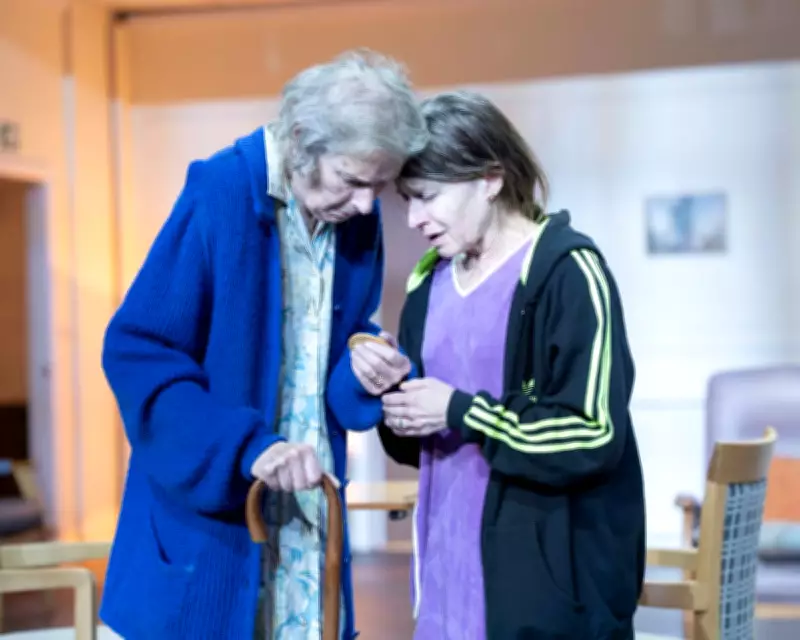
In the book Being Mortal, the writer-surgeon Atul Gawande asks: 'Why, as you become older and sicker, should you give up your autonomy?' Zeldin explores this from the point of view of Joan (Linda Bassett, moving beyond measure), who thinks she has been admitted on a temporary basis. The opening scene shows her disorientation before her put-upon daughter Lynn (Rosie Cavaliero) comes to visit. Lynn's emotions are hard to access, but her sons, both astonishingly portrayed (William Lawlor and Ethan Mahony on press night), blaze with grief and anger.
Life in the Care Home
Beyond this family are the other residents, by turns silent or bearing jumbled up memories of the past, from Agnes (Ann Mitchell) who speaks of her husband and her beloved otter colony, to curmudgeon Paula (Diana Payan), who was once a midwife. Some merely shuffle on and off again. When they die, they join the audience. It is gruelling, intense and true, with darkly sublime performances from actors playing the residents.

Initially, there is an edge of accidental humour as characters have confused, crisscrossing conversations, more with themselves than each other. The audience is amused and it threatens to tip over into laughing 'at' these characters. It sometimes seems like a comic, retirement home version of One Flew Over the Cuckoo's Nest, with the ward's senior carer, Hazel (Llewella Gideon), a kindly version of Nurse Ratched. But it pulls away into a tone that is searing and savage.
Transformative Moments
A transformative moment comes when Joan and a fellow, Lear-like resident, John (Richard Durden), share a hug in which loneliness meets love. He confuses her for his late wife and she, understanding that, does not mind. It is still a hug, needed so badly in this emotional nowhere. They look like Nagg and Nell, the couple from Samuel Beckett's Endgame. Political points are made, but delicately, from the lack of resources to the painful slowness of the days. Characters repeatedly speak of feeling lost or hidden away; the momentary blackouts can be read as blank space in between family visits.
Rosanna Vize's set design gives off the dank air of an inescapably institutionalised space where the love of strangers sustains Joan in the meantime. A scene in which she is given a bed bath by Hazel suggests how the latter's professional care is a kind of love. Joan kisses the woman as she is washed. It unravels in biblical silence.
Urgent Questions
Cumulatively the play makes you feel there has to be another way of looking after our older people, no matter the heroism of carers. 'Someone has to be responsible for what's happening to us,' says rebel-upstart Simone (Hayley Carmichael). The shock, disbelief and sense of sad outrage in that statement hangs heavy. At Young Vic, London, until 11 July.