As the State Library of New South Wales celebrates its 200th anniversary, a new exhibition featuring 200 objects from its vast collection of 6 million items offers a fascinating glimpse into history. Lead curator Elise Edmonds and her team have curated a diverse array of artifacts that span centuries and cultures.
Highlights of the Exhibition
The Smallest Book
The smallest book in the State Library’s collection contains the Lord’s Prayer in six languages: English, French, German, Spanish, Dutch, and Swedish. Measuring just 6mm by 6mm, the minuscule pages were printed with metal plates, then hand-folded, sewn, and bound in leather. The finished book, published by the International Gutenberg Society in Mainz, came in a transparent case with a built-in magnifier.
Lock of Mary Shelley’s Hair (1851)
After the death of Frankenstein author Mary Shelley, a lock of her hair was sent as a memento to Sydney merchant and landholder Alexander Berry, a family friend, by Lady Shelley, Mary’s daughter-in-law. It was presented by a descendant of the Berry family, Alexander Hay, in about 1941.
Bread Wrappers – Fresh and Bright!
Queensland teenager Susan Stephenson started collecting bread wrappers from local bakeries in NSW and Queensland in the 1960s. Before plastic bags, these waxed paper wrappers kept bread fresh and were also a perfect blank canvas for eye-catching designs. This bright and colorful archive, which Stephenson donated to the library in 2024, celebrates many of the bakeries that once stood at the heart of their communities throughout NSW.
The Costume of the Australasians (c. 1817), by Edward Close
Army engineer-turned-artist Edward Close documented colonial Australian society in unusual detail in a sketchbook he started in 1817, acquired by the library in 2009. This drawing reflects the reality of the very male colonial society. Gentlemen and officers in long coats and fine boots mingle with workers and convicts in coarser clothes. Professional portrait painters rarely provided such detail, and they never would have painted convicts. While we see a cross section of NSW society, we know that people are missing from this scene.
Dharawal Wordlist
Of the 250 Indigenous languages spoken in Australia at the time of colonization in 1788, some have left no trace other than the wordlists in the library’s collection. These wordlists are sometimes the only surviving remnants of a language; for others, the lists can be vital evidence for language reclamation. Indigenous communities and the wider public can now find out when ‘billa’ was recorded as ‘river’ in Wiradjuri, or when ‘nurarra’ was noted as the word for ‘sleep’ in Kamilaroi. This language is Dharawal, spoken on what is now the NSW south coast.
The Earliest Surviving Political Cartoon (1808)
Probably Australia’s oldest political cartoon, this satirical work (titled Arrest of Governor Bligh January 26, 1808) was displayed by enemies of Bligh in a Sydney house a few days after the coup against him. William Bligh clashed with NSW Corp officers and settlers over his attempts to curb their power. In what became known as the Rum Rebellion, troops marched on Government House, arrested Bligh and held him for nearly two years. In depicting Bligh as a coward, the drawing implies he is not a gentleman and therefore not fit to govern.
Rum Runners (2018) by Karla Dickens
Wiradjuri artist Karla Dickens transforms historic bottles into vessels that critique the colonial legacy. The bottles draw attention to the destructive part alcohol – rum in particular – in the displacement, abuse and killing of Aboriginal communities. Each bottle represents a white “founding figure”, such as Captain Cook — adorned with fishhooks, which reference the plentiful seafood taken at Kamay/Botany Bay. Some figures are surrounded by sculptural elements resembling human remains, reminding us of their role in the deaths of Aboriginal people.
Schindler’s List (1945)
This document came into the library as part of Thomas Keneally’s literary papers in 1996 for his novel Schindler’s Ark, which became the Oscar-winning film Schindler’s List. This list – an inventory of Jewish male prisoners who were still at the Brünnlitz factory in April 1945 – is one of a number of copies. Their falsified jobs at the factory meant they were classified as protected workers, essential to the German war effort. This kept them safe from being sent to extermination camps or on death marches during the desperate final weeks of the Second World War.
Collectible Cigarette Cards Featuring Australian Jockeys (1906)
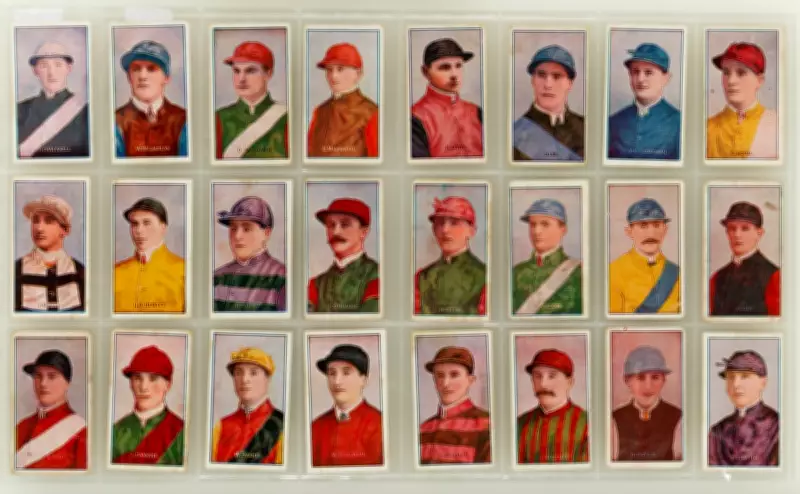
Savvy tobacco firms capitalized on the Australian love of sport with themed sets of footballers, cricketers, tennis players and jockeys. Given the vibrant designs, it’s no surprise that young people loved them. But not everyone was a fan. As far back as 1914, the Sydney Parents & Citizens Association tried to have cigarette cards banned, arguing that they were promoting smoking to children. It would take a few more decades before the cards were phased out, mainly due to paper shortages in the Second World War.
Playbill for The Recruiting Officer and The Virgin Unmasked (1800)
This 226-year-old Australian playbill and another rare specimen were found between the pages of an old copy of the Sydney Gazette. Printed by George Hughes at Government Press, this small flyer is an early example of Australian printing, advertising two plays performed in Sydney’s first theatre on 8 March 1800. Very few of these playbills have survived.
Ladies Purse (1844)
In rowing and horse racing, a ‘ladies purse’ would often be hand-sewn by women connected to the sporting community, and embroidered with details about a specific race. This example – made of cotton, bristol board and cardboard, and embroidered with the words ‘Ladies Purse 1844’, ‘Rome’, ‘25 June’ and ‘Jockey Club’ – was owned by the Scott family. Brothers Helenus and Robert Scott bred racehorses in the 1830s and 1840s; Helenus’s daughter, Rose Scott, a pioneering feminist, treasured these purses and they came to the library after her death in 1925.
Birds of New South Wales, with their Natural History by John Lewin (1770–1819)
This was the first illustrated book printed and published in Australia. Each of its beautifully observed images was hand-colored by Lewin or his wife, Maria. Copies were compiled from test-and-reject prints from his first book, Birds of New Holland (1808), which was printed in England but most copies of which were destroyed while being shipped to Australia. The library has four copies of Birds of New South Wales, out of 13 that survive. No copy is the same. This illustration is of a reed warbler, from 1813.
Tea Leaves from Kamay/Botany Bay, Picked c. 1791
Sweet sarsaparilla leaves were used to make tea in the NSW colony. Convict Mary Bryant took these two leaves with her when she escaped from the colony with her husband, their two young children and seven other convicts in 1791. They left at night in the governor’s boat.
The Library’s First Order of Books (1826)
These are some of the first books purchased for the Australian Subscription Library in 1826. The order, valued at £250, was sent to London. The requested titles reflect a range of interests, from gardening and agriculture (including sheep management) to the classics, history, economics, current affairs and science. No fiction was ordered.
The Holtermann Collection
In 1951, 3,500 19th-century glass plate negatives were discovered in a garden shed in Chatswood. They were the brainchild of German prospector Bernhardt Otto Holtermann, whose mine delivered the world’s largest specimen of reef gold (153kg) on 19 October 1872. He commissioned Henry Beaufoy Merlin and Charles Bayliss to photograph goldmining areas in NSW and Victoria for an international exhibition. Using a portable darkroom, Merlin and Bayliss captured people from every corner of the globe and almost every walk of life, all caught up in the gold rush.
Sarah Cobcroft (1856)
Sarah Cobcroft came to NSW in 1790 as a free woman; her partner, John Cobcroft, was a convict. They didn’t marry until 1842, having farmed land at Wilberforce, on the Hawkesbury River. She signed her will with a cross because she was illiterate. When it came to having her portrait painted in her mid-80s, by then a respectable landowner, she chose the former convict Joseph Backler, who painted his clients as they really looked. She didn’t want to pretend she belonged to a higher class. Cobcroft’s great-great-granddaughter presented this portrait to the library in 1962.
The First Australian International Bestseller (1887)
The Mystery of a Hansom Cab (1886) is an exciting story of murder and scandal in Melbourne. Author Fergus Hume, a trained lawyer and frustrated playwright, turned to crime fiction to make some much-needed cash. The book became Australia’s first international bestseller and sold more than 750,000 copies in his lifetime alone. The book’s success was helped by clever advertising featuring some of the main characters, such as this one from 1887 showing Madge Frettlby, ‘The Australian Beauty’.
The exhibition offers a unique opportunity to explore the rich and diverse history of New South Wales through these extraordinary objects.