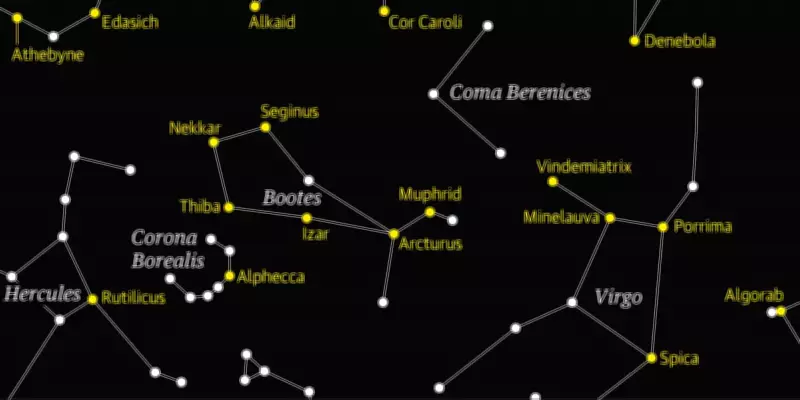
The northern spring constellation of Boötes, known as the herdsman, is currently ascending to a prominent position in the eastern sky after dusk, offering a captivating celestial spectacle for observers. This celestial event occurs several weeks following the equinox, marking a prime opportunity for stargazing enthusiasts to explore the night sky's wonders.
How to Locate Boötes in the Night Sky
For those in London and similar northern latitudes, the optimal viewing time is around 21:00 BST in early April, with the constellation's visibility remaining consistent throughout the week. By this hour, darkness has fully settled, allowing the constellation's brightest star, Arcturus, to shine with remarkable intensity. Arcturus holds the distinction of being the fourth-brightest star visible in the entire night sky, making it a key landmark for identification.
The most straightforward method to find Boötes involves starting with the well-known asterism, the Plough, which is part of the larger Ursa Major constellation. From there, trace the gentle curve of the Plough's handle in a downward arc. This arc naturally leads the eye directly to the distinctive orange glow of Arcturus, serving as the gateway to the broader constellation of Boötes.
Historical and Mythological Significance
Boötes boasts a rich historical lineage, being one of the original 48 constellations catalogued by the ancient astronomer Ptolemy in the second century. However, its origins extend far deeper into antiquity, with roots tracing back thousands of years to ancient Babylonian civilization. In Babylonian astronomy, this constellation was linked to the powerful god Enlil, a deity credited with the monumental act of separating heaven from Earth, thereby rendering the world suitable for habitation.
Within Greek mythological traditions, Boötes is predominantly depicted as a herdsman or ploughman. Numerous tales surround this figure, consistently portraying him as a guardian and protector of rural and agricultural life. These stories highlight the constellation's enduring association with themes of cultivation, stewardship, and the natural world.
Global Observational Perspectives
For observers in the northern hemisphere during this spring period, Boötes begins its ascent during twilight hours, becoming optimally positioned for detailed observation by late evening. Its prominence in the sky provides an excellent chance for both amateur and seasoned astronomers to study its features.
Conversely, from vantage points in the southern hemisphere, Boötes appears relatively low in the northern sky, presenting a different but still observable perspective for stargazers in those regions.
This celestial event underscores the timeless allure of astronomy, connecting modern observers with ancient cultures through shared observations of the stars. Whether you are a casual viewer or a dedicated enthusiast, taking the time to locate Boötes and Arcturus offers a direct link to millennia of human curiosity and storytelling written in the night sky.