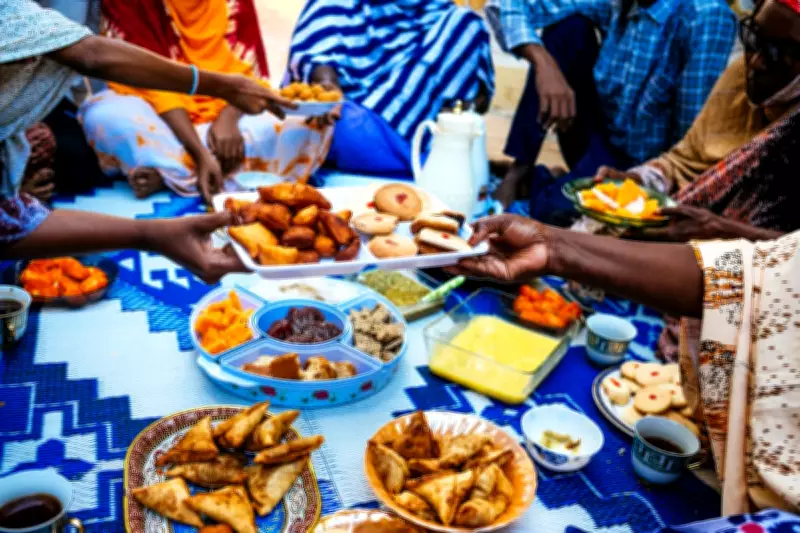
Ifrah F Ahmed’s debut cookbook, Soomaaliya: Food, Memory and Migration, is a heartfelt tribute to Somali cuisine, history, and its people. Released in March, it is one of the few cookbooks to examine Somali food and how decades of conflict have reshaped it across the global diaspora.
On a video call from Brooklyn, between stops on her book tour, Ahmed drinks ginger-root tea, a scent that transports her to her childhood kitchen where her mother baked aromatic cardamom cake. “That’s a core childhood memory for me,” she says. For Ahmed, food is not just sustenance; it is memory, inheritance, and a record—what she calls “Somali history on a plate.”
A Unique Culinary Archive
Part recipe collection, history, and profiles, Soomaaliya expands on Ahmed’s popular Milk and Myrrh pop-ups and her recipes for the New York Times Cooking. Across 75 recipes, she traces Somali cuisine through trade, colonialism, war, and migration. Ancient Somalia was a key stop on the Silk Road, earning the nickname “the land of cinnamon” for its spice production. Pastoral and nomadic traditions emphasized camel milk—often called “white gold”—and meat. Italian colonization introduced pasta, while banana farming under European rule funneled profits into colonial networks rather than local communities.

Despite global influences and growing social media presence, Somali cuisine remains less known than that of neighboring Ethiopia, though they share some dishes. The flow of ingredients created dishes like bariis iskukaris, a spiced rice one-pot meal with roasted meat, vegetables, and banana. However, Ahmed notes, “There’s a tendency to overattribute Somali cuisine to colonial influence. While that influence is there, what we were able to do with it gets ignored. Our pasta is not the same as Italian pasta. It’s something uniquely Somali,” often flavored with xawaash, a spice blend of cumin, coriander, cardamom, cinnamon, cloves, and turmeric.
Researching Across the Diaspora
Ahmed, born in Mogadishu and moved to Seattle in 1996 after the civil war, first conceived the book a decade ago while studying law in New York, noticing the lack of written resources on Somali cuisine. Recipes have been passed down through storytelling and practice rather than writing. Decades of war and displacement have scattered culinary knowledge, making Somali heritage vulnerable to loss, especially as ongoing conflicts and drought have displaced up to 4 million Somalis according to the UN.
To research, Ahmed interviewed elders, family cooks, scoured digital archives, watched years-old YouTube videos, and listened to audio recordings of Somali women discussing recipes. “If I didn’t know how to make a recipe, I’d have my mum call someone over, or find someone in the community who could share that information with me,” she says.
The book spotlights figures like Barlin Ali, author of Somali Cuisine (2007), widely regarded as the last major Somali cookbook before Ahmed’s. Also featured are chef Jamal Hashi of Minneapolis, Hamda Issa-Salwe of London’s Ayeeyo’s Blends tea seasoning, and Liban Ibrahim of London’s Sabiib restaurant. “It’s my name on the cover, but it was such a communal effort,” Ahmed says. “I really wanted to tell other people’s stories through food.”
Challenging Simplifications
The book is both an archive and a challenge to simplification. Ahmed aims to disrupt the idea of a singular Somali cuisine. In the diaspora, a few dishes like bariis iskukaris have come to represent an entire food culture spanning borders. “I wanted to talk about the diversity of Somali food, to have recipes that are representative of all the regions where Somali people are,” she says.
Somali people are reinventing dishes through new techniques and ingredients without losing their essence. For example, the sambusa (similar to an Indian samosa) has variations like tuna sambusa, which is controversial among Somalis, and salmon sambusa in the Pacific Northwest due to local fish abundance. Elsewhere, tortillas replace traditional pastry wrappers. “That’s another example of the way migration impacts food traditions: you’re using the ingredients that are accessible to you to make your traditional food,” Ahmed explains.

Migration and Adaptation
Migration continues to shape Somali foodways. Camel meat and milk, central to pastoral life, are hard to source in Europe and North America, forcing adaptation. Ahmed points to Juba Farms in Kansas City, Missouri, which raises camels and bottles their milk, as evidence of culinary tradition evolving in new landscapes. “Culture is always shifting,” she says. “But I also want us to have a sense of history, a sense of tradition, and a knowledge for how we ate, how we eat.”
Documenting these shifts is inseparable from documenting Somali resilience. The book arrives amid heavy politicization of Somali migration in the US, with attacks from Donald Trump and targeting by immigration officials. Everyday Somali foods have become vehicles of resistance; a recent Guardian report noted protesters in Minneapolis handing out sambusas along with rights pamphlets.
When Ahmed first conceived the project, she didn’t know how urgent it would feel. “I’m completely aware of how timely this book is, and aware of the misconceptions there are around Somali people,” she says. Yet she frames it primarily for Somali people: “This book was made with the intention of being for Somali people. If people want to read it and learn more about us, they’re very much welcome to do so. I don’t really feel the pressure of needing to prove anything to anyone.”
She hopes the book offers younger Somalis a stronger cultural grounding, as food gave her as a child. “It gave me a sense of self to know what the cuisine was in relation to our identity and where we came from,” she says.
For all its historical and political weight, Soomaaliya remains a book about pleasure: fragrant rice, fried fish, spiced tea, and cardamom cake. Its mission is not just to introduce Somali food to outsiders, but to preserve it for those to whom it already belongs.