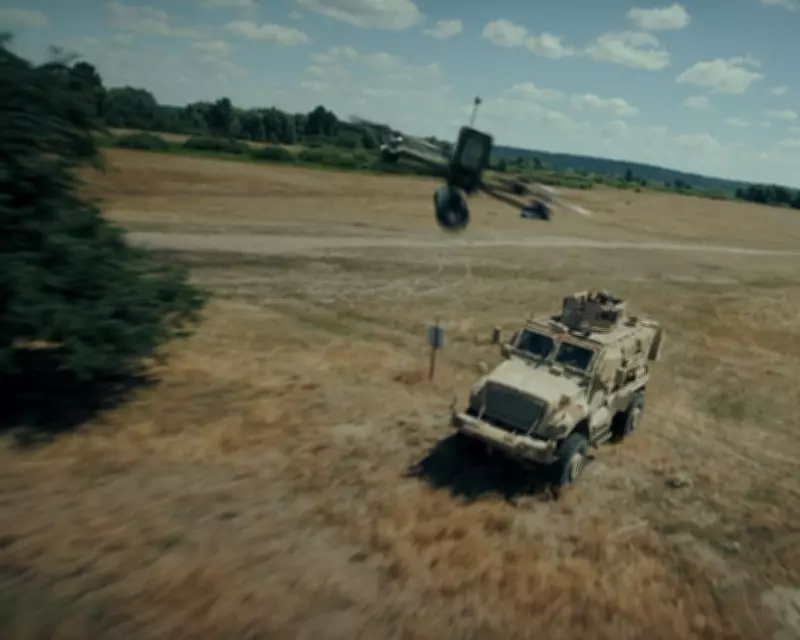
A Ukrainian action thriller billed as 'Saving Private Ryan for the drone age' has been released, showcasing the latest battlefield technology. Titled 'Killhouse,' the film is based on the real-life story of a civilian couple saved from a battlefield by Ukrainian drone operators.
Real-Life Inspiration
Director Liubomyr Levytskyi said he was inspired by a true event where a couple trying to rescue relatives came under Russian attack. The man was badly wounded. A Ukrainian military unit nearby sent in a drone with a piece of paper that read: 'Follow me.' The woman followed the drone, dodging mines and bullets, while Russian soldiers threw her unconscious husband into a trench. Incredibly, he survived.
Levytskyi initially made a 30-minute documentary called 'Follow Me,' which gained wide attention. 'I realised that this story really strikes a chord, and people get it. Drones in general, well, they're something new. And I thought, right, this story needs to be made into a film,' he said.

Plot and Production
The two-and-a-half-hour film was shot last year in the Kyiv region. Levytskyi took artistic licence, adding a 12-year-old girl kidnapped by Russians. Scenes take place in the White House situation room, occupied eastern Ukraine, and a farmhouse in a deadly grey zone. There is a shootout and car chase in downtown Kyiv.
The film features cameos by well-known figures, including former military intelligence chief Kyrylo Budanov. It is set in 2024, when Washington and Kyiv were allies. Notably, Donald Trump is absent.
Challenges During Filming
US journalist Audrey MacAlpine, who plays a version of herself, said filming had to stop on several occasions due to air raid alerts. 'We had to hide. It was a war within a war,' she said. Actor Denis Kapustin added that some cast members would nap in a bomb shelter, waiting for the threat to pass. Of the blurring of fiction and reality, he said: 'The movie is totally meta and postmodern.'
Kapustin said 'Killhouse' captures the complicated multi-level nature of war today. 'It's a race for technological superiority,' he added. Soldiers took part alongside professional actors, with pyrotechnics used to simulate explosions. After filming ended, Kapustin joined the real-life unit in which his character serves, the 3rd Assault Brigade, and is now a drone operator.
Technological Showcase
Ukraine's two main intelligence agencies, the Security Service of Ukraine (SBU) and the Defence Intelligence of Ukraine (DIU), were involved in the production. They provided US Humvee and MaxxPro vehicles as well as a Black Hawk helicopter. The drama showcases Ukraine's latest homemade drones, such as a catapult-launched reconnaissance model known as Shark.
The film's makers say it is the first feature in cinema history to use footage taken by real combat drones. They are preparing an English-language version for US distributors and considering a four-episode version for streaming platforms like Netflix. 'Killhouse' was made without state support and had a $1.1 million budget.
Audience and Critical Reception
The reaction from Ukrainian audiences has been positive. Maria Hlazunova, who worked for the Dovzhenko Centre, Ukraine's film archive, said at the Kyiv premiere: 'It's interesting to see people from the news such as Budanov on screen. It's like fiction mixed with fact. The film is super-patriotic, which is as it should be. There are a few cheesy moments. Overall it does a really good job.'
Like 'Saving Private Ryan,' the story has a moral question at its heart: is it worth sacrificing many lives to save one person, in this case a stolen child? According to Ukraine's army media unit, 'Killhouse' depicts 'something the world often misses in the daily flood of frontline updates.' 'Ukrainian soldiers are not just fighting to hold territory. They are crossing into grey zones to bring civilians home,' it said.
Levytskyi suggested that Russian President Vladimir Putin badly underestimated Ukraine's resilience when he launched the 2022 full-scale invasion. 'The enemy is very afraid when Ukrainians are united. That is a fact,' the director said.