Unraveling Hitchcock's Legacy: How Personal Grudges Shaped a Director's Dark Reputation
Alfred Hitchcock, the master of suspense, is often remembered for his psychological intensity on screen, but recent discoveries shed light on how personal conflicts off-screen have colored his legacy. A newly unearthed transcript from a 1980 interview between biographer Donald Spoto and actor Tippi Hedren reveals a web of misreading, distrust, and personal grievances that have influenced the narrative around the director for decades.
The Spoto Factor: Amplifying Hitchcock's Dark Side
Donald Spoto, author of The Art of Alfred Hitchcock, never enjoyed the camaraderie Hitchcock extended to his authorized biographer, John Russell Taylor. In researching Hitchcock's darker reputation, Spoto leaned toward interpretations that sharpened available evidence, leading to details becoming amplified over time. For instance, Spoto claimed Tippi Hedren's recovery after filming the attic attack in The Birds lasted ten days, though internal memos prove it was only three.
Similarly, Spoto's oft-repeated story about Hitchcock maliciously daring a prop man to remain handcuffed overnight during The 39 Steps is contradicted by camera assistant Dudley Lovell, who recalled Hitchcock allowed the man to return home still wearing the handcuffs. This episode, while uncomfortable, aligns more with the rough humor of London's East End than the ordeal Spoto described. Even claims about Hitchcock's final days have been revised; Spoto stated a priest was turned away, but later testimony from Father Mark Henninger indicates Hitchcock welcomed him.

On-Set Tensions: The Making of The Birds
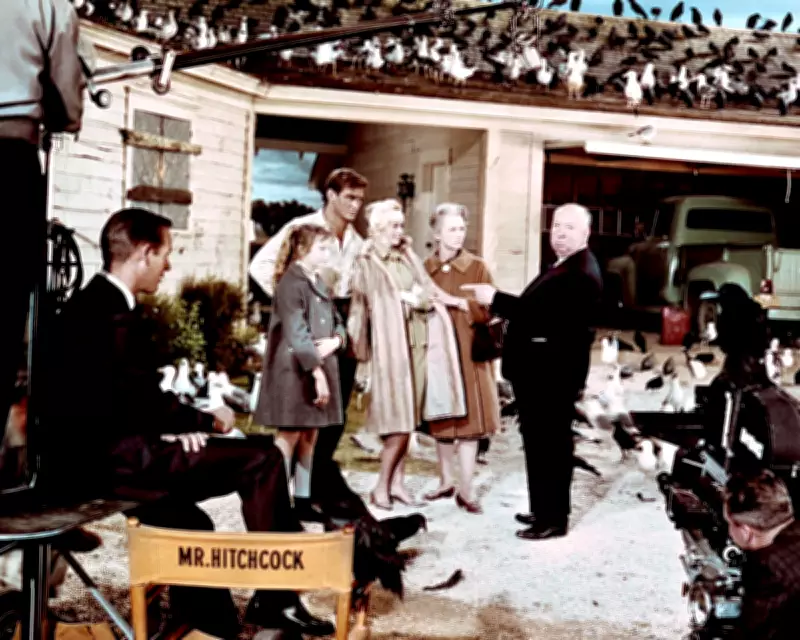
The production of The Birds in 1962 was far from harmonious, highlighting how personal relationships fed into the on-set atmosphere. Australian actor Rod Taylor brought a different energy, leading to friction with Hitchcock. Witnesses recall Hitchcock irritated by Taylor's lack of discipline, while Taylor resisted Hitchcock's authority. In one incident, Hitchcock publicly castigated Taylor for not offering his chair to ladies, nearly resulting in a physical altercation.
During filming in Bodega Bay, Taylor was arrested for driving under the influence, spending a night in jail—an event that could have derailed the production. Hitchcock later admitted to François Truffaut that he had "trouble with the leading man." Simultaneously, Hitchcock maintained tight control over Tippi Hedren, limiting visits from boyfriends to minimize distractions, creating further tension within the cast.
Psychological Provocations: Hitchcock's Performance Techniques
Hedren acknowledged in a 1974 seminar that Hitchcock used tension to draw out stronger performances, a method employed with other actors like Diane Baker, Carole Lombard, and Joan Fontaine. For example, during Rebecca, Fontaine was told co-star Laurence Olivier intensely disliked her, destabilizing her to heighten emotion for the camera. These techniques, while uncomfortable, were part of Hitchcock's precision in shaping psychological intensity on screen.
However, over time, these complex on-set dynamics have been streamlined into a unified narrative of Hitchcock as controlling and abusive. The centenary of his first film, The Pleasure Garden, offers a chance to revisit the evidence, recognize contradictions, and accept that the truth is often more complicated than preferred stories.
Legacy and Interpretation
Hitchcock's modern reputation rests not on a single body of evidence but on layered voices, many partial and retrospective, shaped by personal grievances that have become public narrative. As Tony Lee Moral's A Century of Hitchcock: The Man, the Myths, the Legacy explores, understanding Hitchcock requires questioning assumptions and embracing complexity, ensuring his legacy is about both the films and how they have been interpreted over time.