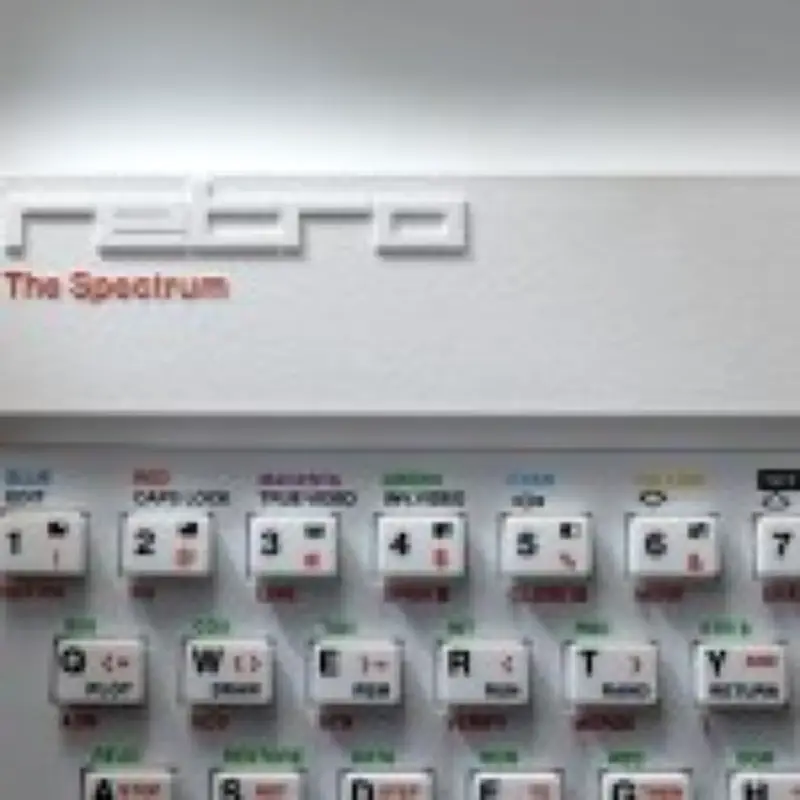
Retro Games has released The Spectrum White Edition, a full-size recreation of the original Sinclair ZX Spectrum in white, referencing a rumoured special edition from the 1980s. The device is functionally identical to the black version released earlier but includes 48 classic games such as Manic Miner, Skool Daze, The Great Escape, The Lords Of Midnight, Head Over Heels, and The Hobbit. According to product designer and CTO Chris Smith, this is not a mini-console but a fully functioning computer that replicates the original hardware, including the famous rubber keyboard. It supports emulation of various Spectrum models (16K, 48K, 128K) and includes a white joystick resembling the Competition Pro 5000, a USB stick for additional games, and a copy of Crash magazine. The White Edition costs £129.00, while a Collector’s Edition with a QuickShot II-style joystick, a joypad, a spiral-bound manual, and a black-and-white printer costs £199.99.
Modern features for classic gaming
The Spectrum White Edition includes modern conveniences such as four save slots per game, rewind functionality, support for more colours than the original, and HDMI output at 720p and 50 or 60Hz. Smith emphasised that the device also allows programming in BASIC, turning it into an educational tool. “You can use it to program in BASIC, just like the original machine, thereby turning it into an educational tool as well, especially for children,” he said. This sets it apart from consoles like the NES or PlayStation 5.
The story behind Retro Games
Retro Games was founded by Chris Smith, Darren Melbourne, and Paul Andrews. Melbourne had previously worked on the C64 Direct-to-TV in 2004. Smith, who wrote a book on the ZX Spectrum’s ULA chip, reverse-engineered the original hardware by having a chip decapped and photographed. The company’s first product was TheC64 Mini, followed by full-size versions of the Commodore 64, VIC-20, Atari 400, Amiga 1200, and now The Spectrum. Smith noted that the team’s unique skills allowed them to recreate these machines accurately, down to millimetre precision.

Challenges in recreating the Spectrum
Smith explained that replicating the Spectrum’s rubber keyboard was particularly difficult. Manufacturers initially used a standard rubber dome process, but it produced inconsistent key feels. “Clive Sinclair did this on a shoestring 40 years ago. Surely in 2024 we can do this,” Smith recalled telling the Chinese manufacturing team. They eventually contracted a company that makes rubber iPad keyboards. The licensing of the ZX Spectrum name is also complex, as it is owned by Comcast, which acquired Sky. Retro Games uses the name “The Spectrum” to avoid legal issues.
Preserving a living format
Smith highlighted that the Spectrum and Commodore 64 communities remain active, with new indie games still being developed. “When we brought out the Mini, it’s safe to say that we really did invigorate the Commodore 64 community that still exists,” he said. The company encourages this by including new indie games in their products. Smith also noted that the Spectrum was most popular in the UK, Spain, Portugal, Italy, and Poland, and that the device aims to evoke the nostalgia of opening a computer on Christmas morning in 1984. “It smells the same as Christmas Day 1984,” he said, describing the sensory experience.
Future plans
Retro Games has a five-year plan and is working on portable versions of the Spectrum and Commodore 64 in collaboration with Blaze. Smith stated that while they may eventually run out of classic computers to recreate, they will continue to innovate. “We’re being pulled in different directions. We’re successful in what we’re doing because the customers want this and nobody’s providing what we’re doing,” he said. The company aims to meet 80% of what 80% of customers want, balancing nostalgia with modern usability.