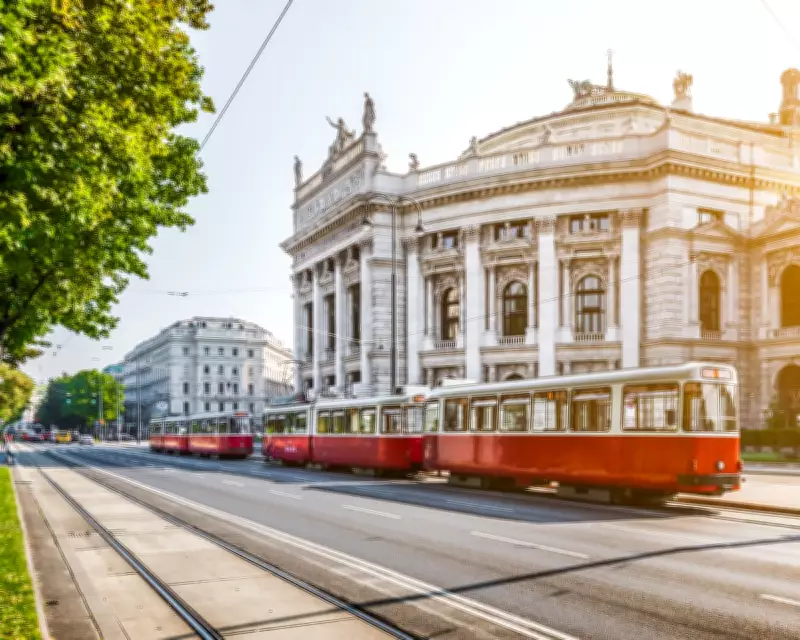
When Leonore Gewessler hops on the underground trains and street-level trams that run like clockwork across the breadth of Vienna, she appreciates the ease, affordability and time she 'gets as a present' instead of idling in traffic. But Austria's former climate and transport minister is also aware that cars still dominate the capital's streets. She says good public transport is just the 'precondition' to changing how people move around the city.
The Limits of Public Transport Improvements
Vienna's network of trains, trams and buses have long been the envy of other European cities – let alone car-centric North American ones – but automobiles are still used for a quarter of journeys. In other capitals famed for world-class public transport, such as London, Paris and Prague, even higher use of cars has frustrated doctors and campaigners demanding cleaner air and safer streets.
Transport scientists suggest it shows the limits of what can be achieved by encouraging clean forms of transport without discouraging polluting ones. Beyond a certain threshold, further improvements to one mode of transport become 'a sort of zero-sum game', according to Giulio Mattioli, a researcher at the Technical University of Dortmund.
Historical Roots and Modern Challenges
Vienna was a pioneer of urban planning that prioritises people over vehicles, but its famous public transport system has its roots in tram lines that were laid when it was still the booming capital of the Austro-Hungarian empire. Unlike most European capitals, its early infrastructure has since then faced little pressure from population growth – the number of inhabitants has not yet returned to its pre-first world war peak – and it kept hold of many of its tram lines even through the car-centric reconstruction that followed the second world war. The system has since been complemented by a large and growing subway network.
Johannes Kehrer, the head of strategic infrastructure at Wiener Linien, the public company that operates the network, says trams are Vienna's 'sleeping superpower'. 'It still has the potential to become faster and expand even more,' he adds.
Ambitious Targets and Policy Measures
Vienna aims to reduce the share of journeys in private cars within the city from 25% to 15% by the end of the decade. While data for other cities is hard to directly compare, only a handful of big European cities have cut car use to below 30% of journeys. Figures in the US are more alarming, analysis of survey data shows, with cars accounting for more than 90% of journeys.
Vienna introduced a €1-a-day yearly ticket in 2012, the price of which was raised for the first time this year to €1.26 a day. It passed a milestone in 2015 when the number of yearly transport tickets in the city surpassed the number of registered cars. Gewessler, the leader of the Green party who served in a coalition with the conservative Austrian People's party (ÖVP) until 2025, introduced a flat-rate 'climate ticket' across the nation in 2021 and shifted federal transport spending from roads to rail.
Free Public Transport: A Limited Solution
Free public transport has become a rallying cry for activists across the continent in the face of climate breakdown and high living costs sparked by imported fossil energy crises. The demand is less controversial than efforts to restrict motorists – such as by turning parking places into greenery or pedestrianising roads – but research from the handful of cities to trial it suggests it has a modest effect on pollution. In a worst-case scenario, experts say, it strains the system by winning over pedestrians and cyclists while failing to get drivers out of their cars.
'The best-used euro is not to reduce the price but to increase the offer,' says Kehrer. 'Because what's the use of a cheap ticket if I still can't travel when I want to?'
Discouraging Driving and Future Plans
Vienna has taken some steps to discourage driving, such as introducing parking fees well before most other European cities, and it has since extended its scheme to cover the full city. The prospect of further restrictions has resulted in some resistance among motorists but they have little desire for the city to regress on its generous public transport offering.
Matthias Nagler, who works for the legal service of the Austrian Automobile, Motorcycle and Touring Club, says the high quality of life the city has long enjoyed – 'despite cars in the city' – shows that the current balance is right and further restrictions are not needed. 'The fact that you can drive well in Vienna if you want, but don't have to, is the most important thing,' he says. 'You're not reliant on a car.'
An outstanding challenge is integrating suburban commuters into the network – particularly those who drive in from Lower Austria, the surrounding state. The city's park-and-ride car parks are near full at rush hour, suggesting an untapped demand that could be served by further expansion of the network.
Investment in Public Transport
Vienna has so far shied away from implementing an ultra-low emissions zone for cars, like that in London, or tackling the rise of SUVs with weight-based parking fees, like Paris. It has also lagged behind Copenhagen and many Dutch cities in giving road space over to bicycles, though it did pedestrianise a major thoroughfare in 2019. Wiener Linien says it is investing about €2m (£1.7m) a year to further accelerate public transport – adapting traffic light systems to prioritise trams, redesigning hotspots where cars often block tracks and removing car lanes on tram tracks to create dedicated rights of way.
'The most cost-effective resource in a city, I am quite convinced, is space,' says Kehrer. 'In the end, it is about distributing these spaces differently.'