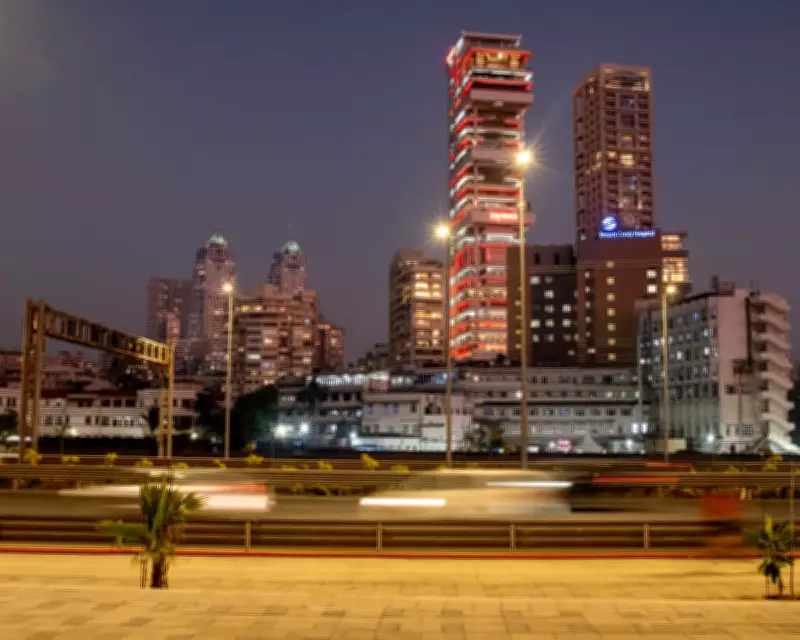
Mumbai's 'Musical Road' Sparks Outrage Among Upscale Breach Candy Residents
Residents of one of India's most exclusive neighborhoods are pleading for respite from what they describe as a nightmare soundtrack created by the country's first "musical road." A stretch of Mumbai's recently opened Coastal Road seafront expressway has been engineered to play the pulsating Oscar-winning tune Jai Ho from the movie Slumdog Millionaire when vehicles drive on it at lower speeds.
Safety Feature or Noise Nuisance?
Civic officials in Mumbai, India's financial center, pitched this innovative project as a unique blend of engineering and entertainment, with the primary goal of encouraging safer driving practices. Engineers have carved precise grooves in the asphalt that function like a giant vinyl record. When vehicles pass over these grooves at speeds between 45 and 50 miles per hour (70 to 80 kilometers per hour), the vibrations produce the iconic tune composed by celebrated Indian musician AR Rahman.
The musical section, which spans approximately 500 meters, was officially inaugurated on February 11 by Maharashtra Chief Minister Devendra Fadnavis, who proudly described it as a showcase of innovation. Authorities have consistently defended this feature, arguing that it helps keep drivers alert while reinforcing crucial speed discipline on the high-speed expressway.

Residents Voice Their Complaints
However, residents of the upscale Breach Candy neighborhood, home to industrialists, Bollywood stars, and other high-profile celebrities, strongly disagree with this assessment. They report that the repetitive refrain of Jai Ho, which roughly translates from Hindi as "let there be victory," plays continuously from 6 a.m. until midnight, creating what they call constant intrusive background noise that has caused significant distress.
More than 650 families have signed a formal complaint urging municipal authorities to stop the music immediately. In their detailed petition, addressed to Mumbai's Municipal Commissioner and copied to the Maharashtra Chief Minister's office, residents describe how the tune penetrates their homes, forcing many households to keep windows permanently shut in an attempt to block out the sound.
Global Context and Local Controversy
While Japan pioneered the concept of musical roads back in 2007, with similar installations appearing in countries including Hungary, South Korea, the United Arab Emirates, and the United States, most of these projects have been implemented in less populated areas. Mumbai's musical road stands out because it runs directly past a densely populated, affluent residential neighborhood.
Residents argue that at a time when many global cities are actively working to reduce noise pollution, Mumbai appears to be moving in the opposite direction. They also raise serious safety concerns, flagging what they describe as an "auditory distraction on a high-speed road" that could potentially create hazardous driving conditions.
Broader Coastal Road Controversy
The musical road controversy represents just one aspect of the broader debate surrounding Mumbai's ambitious Coastal Road project. The eight-lane expressway, which has been controversial since its initial proposal in 2011, represents a $1.6 billion investment built on land reclaimed from the Arabian Sea.
While the project has successfully reduced driving time between Marine Drive and Worli from 45 minutes to approximately 10 minutes, critics argue that this taxpayer-funded motorway primarily benefits wealthier car owners. Meanwhile, the vast majority of Mumbai's 23 million residents continue to rely on overcrowded buses and trains for their daily transportation needs.
Residents have also accused authorities of focusing on what they perceive as a speed-control gimmick while failing to address more urgent concerns, such as high-performance cars roaring along the Coastal Road at dangerous speeds. The musical feature, while innovative, has become a symbol of the disconnect between urban planning initiatives and the daily realities of city residents.