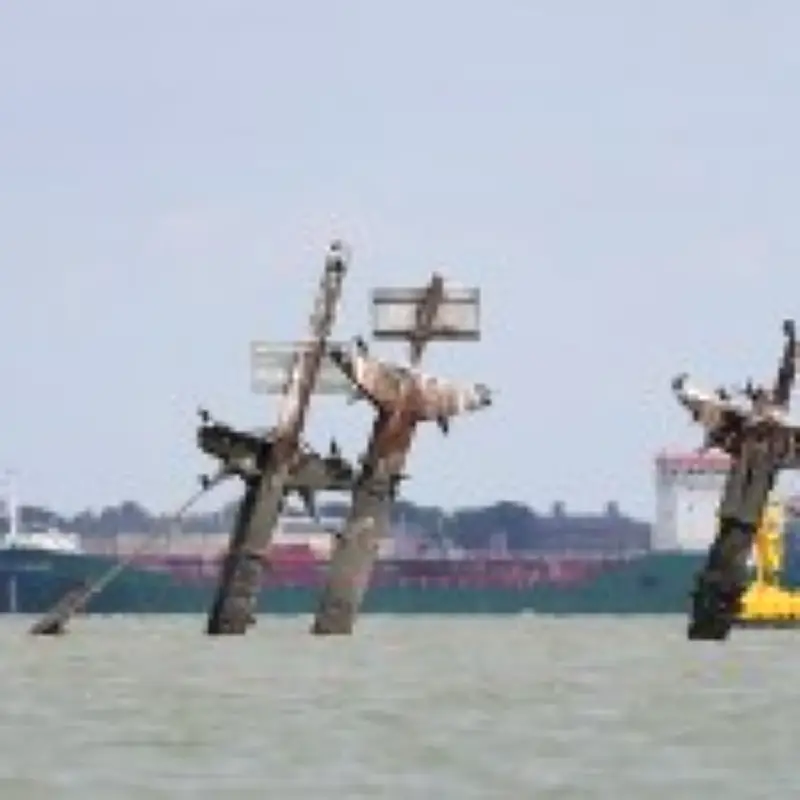
Work to dismantle the three masts of the SS Richard Montgomery, a sunken shipwreck packed with around 1,400 tonnes of wartime explosives, will begin in September, the UK Government has announced. The masts are located in the Thames Estuary, just 1.5 miles off the Kent coast. The vessel, nicknamed the 'doomsday wreck', sank in 1944.
Reducing risk of falling masts
Experts believe reducing the masts' height to below sea level will ease pressure on the wreck's structure and reduce the risk of heavy objects falling onto the munitions below. The masts will be taken to Chatham's Historic Dockyard in Kent for preservation and display. Maritime minister Keir Mather said near the wreck site: 'They've been part of the maritime history of places like Sheerness for decades. And we want to make sure that that continues to happen for decades to come.'
Preservation and community access
After preservation work, teams will 'be able to make a decision about where they are best placed, so that local communities can access them', Mr Mather added. Robin Rickard, providing strategic explosive ordnance advice to the Department for Transport, said a jackup barge—a floating platform on long legs anchored into the seabed—will be used. He explained: 'We're going to put a jackup barge alongside it, both the stern section and the forward section, and then we're going to use a diamond wire saw to chop the masts and recover them.'
Munitions were safe during transport
Rickard noted that the SS Richard Montgomery was carrying 'safe-to-transport munitions' during its doomed voyage from the USA to Great Britain. The munitions weren't armed or fused during transport, which is 'good news'. He added: 'The reason we're doing something about it now is that the masts are in a window where they're likely to fail and the Department for Transport is taking every step reasonable to reduce the hazard of a falling mast onto an explosive cargo.'
International cooperation
Paul Barnard, deputy chief executive at Chatham Historic Dockyard Trust, said the masts 'are a really, really important part of the ship and they're an important part of the story'. To keep the masts in the UK, DfT teams have consulted with their counterparts in Washington. U.S. Ambassador to the UK Warren Stephens last month wrote to Labour MP Kevin McKenna, backing efforts to display the masts.
Exclusion zone and project management
Mr Mather said an exclusion zone will remain around the vessel as long as needed, but the wreck itself is stable. Nolan Conway, project manager at Resolve Marine, the contractor for reducing the masts' height, stated: 'Drawing on our extensive experience in complex marine operations, we are committed to executing this work safely, efficiently and in close collaboration with all stakeholders. This historic project represents a significant milestone in the ongoing management of one of the United Kingdom's most closely monitored wreck sites.'