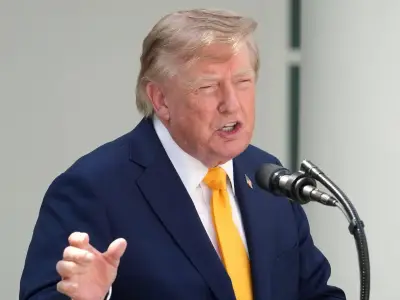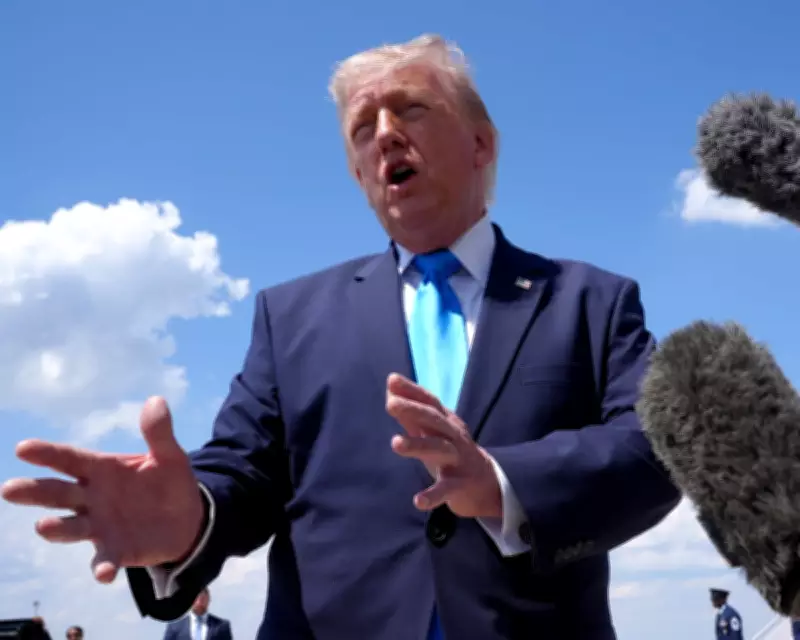
Donald Trump is stealing almost $2bn in taxpayer money and handing it out to his friends. That is the upshot of the president's recent agreement following a $10bn lawsuit he brought in his personal capacity against the IRS, an agency that he oversees. Trump brought the suit over leaks of some documents from his tax returns to the press. To resolve the suit, the justice department will create a fund of nearly $1.8bn – a wildly outsized figure compared with Trump's somewhat flimsily alleged injuries – that can be doled out to Trump allies. The Guardian describes the fund as 'loosely controlled and secretive', but members of the Trump administration have not ruled out January 6 insurrectionists as possible awardees.
The Anti-Weaponization Fund: A Mechanism for Cronyism
The so-called 'Anti-Weaponization Fund' will be administered by four commissioners appointed by Trump's attorney general and one appointed 'in consultation' with congressional leadership – Trump, who can fire the commissioners, will have ultimate control. It will have the authority to issue formal apologies for alleged mistreatment of conservative political actors by previous administrations – ie, those few who were prosecuted or sued during the Biden era. When Trump leaves office, any remaining money will not be available for his successor to use similarly, but will instead be distributed back to the federal government. But I doubt that there will be any remaining money. We may never know either way: there is no requirement that the fund's work be made public, and required reports to the attorney general on its conduct are to be confidential. In addition to the creation of this massive slush fund, the agreement also requires that the IRS drop all audits of Trump and his family.
'The machinery of government should never be weaponized against any American,' said the acting attorney general, Todd Blanche, which is probably news to all those who have been subjected to politically motivated prosecutions by the justice department since Trump returned to power.

Legal Circumvention and Judicial Questions
It is worth stating plainly what happened: the president sued an executive agency over which he claims – and wields – de facto total control. The defendant, the IRS, was represented by lawyers at the justice department – which Trump also controls. Since all the parties were under Trump's personal control, the federal judge in charge of the case questioned whether there could really be a conflict at play – she commissioned an independent group of lawyers to examine the issue, who filed a brief saying that there was 'reason to believe that the president is, in fact, exercising his control over the defendants in this litigation'. The agreement was reached at the 11th hour, just before that judge's 20 May deadline asking the parties to explain how, exactly, they were actually in conflict. The little matter of the law would not be allowed to get in the way of a payout.
It is an extraordinary incident of bald self-dealing, even in an administration where such blatant corruption has become de rigueur. Trump's second administration, even more than his first, has been marked by conflicts of interest and the widespread use of public office for personal enrichment by White House personnel. The interests of the nation are being subverted to the interests of the president and his cronies' finances, as a group of the shameless, the greedy, and those unburdened by principle bend the massive buying and regulatory power of the federal government toward those who pay them off, and take a little off the top for themselves.

Why Has Trump's Corruption Not Dominated Media Coverage?
Why has Trump's corruption not been the preoccupying media story of his second term? Maybe because it is the most technical and least lurid of his schemes, paling in drama and violence to his persistent diminishment of the democratic constitutional order, or his mass deportation ethnic cleansing effort, or his ties to the dead pedophile financier Jeffrey Epstein, or any of his alleged personal sexual assaults on women – all of which he has denied. Or perhaps the Trump administration's widespread self-dealing has simply evaded notice because it is so brazen and unconcealed, benefiting from the press and the public's misguided sense that a cover-up is worse than a crime. But the corruption that Trump has facilitated in Washington is likely to be one of his most enduring legacies. It is setting a precedent for future administrations; degrading the quality of federal projects and federal policy; transferring wealth to Trump's allies and those willing to participate in such dealings at a massive scale; and instilling a profound sense of cynicism in bureaucrats, politicians and voters alike, who increasingly distrust their government as a self-interested scam in which graft is ubiquitous and civic-mindedness is for suckers.
Do Americans Care About Being Scammed?
Do Americans care about being scammed so much? I suspect they would, if the extent of Trump's corruption was made clear to them, and if the issue was made salient. The Democrats have long been bad at messaging, strangely unwilling to aggressively attack Trump when it matters and unable to dictate the terms of the public conversation in an era when much of political media and discourse takes place on the same platforms controlled by Trump's allies and patrons. But the issue is worth seizing on ahead of the midterms, if only for its plain simplicity. Americans are suffering, paying more for all their goods, struggling to find meaningful or fairly compensated work, and being mocked by a president who thinks of them as inconsequential, stupid and worthy of contempt. They do not like being stolen from; they do not like being played for fools.