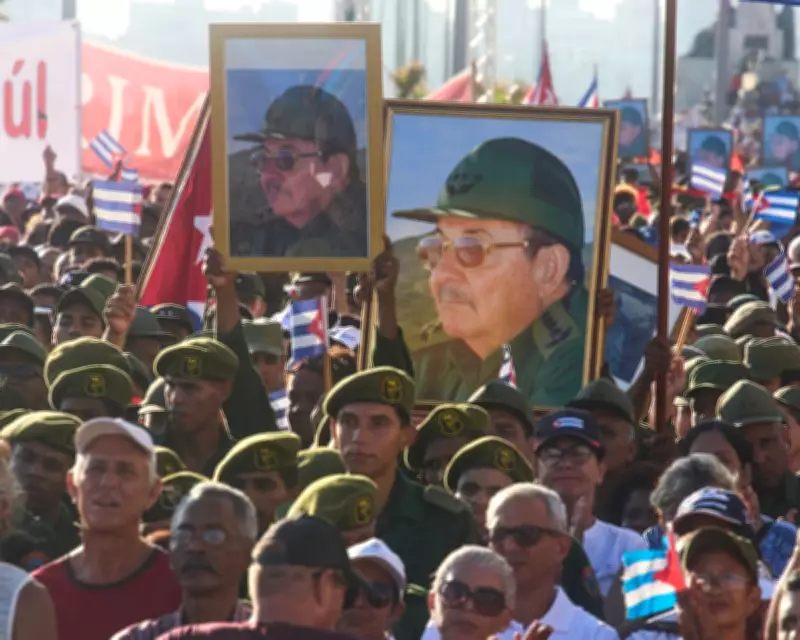
For centuries, the United States has engaged in imperialist intervention in Latin America. The recent indictment of former Cuban President Raúl Castro appears to be its latest move. On 20 May, a federal court in Florida indicted Castro for his alleged involvement in the downing of two civilian planes piloted by US nationals in 1996. At the time, Castro served as Cuba's defense minister, and aircraft from the Cuban armed forces carried out the attacks. The charges include one count of conspiracy to kill US nationals, two counts of destruction of aircraft, and four counts of murder.
Indictment as a Political Tool
On the one hand, the indictment was not a surprise. Following the Trump administration's bombing of Caracas and extraction of Venezuelan President Nicolás Maduro in January—actions supported by a similar indictment against Maduro from a federal district court in New York—numerous indicators suggested that Cuba would be next. The Castro indictment seemingly confirms these suspicions, though questions remain about what comes next. Will US forces carry out a similar bombing and extraction operation in Cuba? Will there be a full-scale invasion? Or will the threat of these actions be enough to force concessions that might satisfy Trump officials in the short term?
What is certain, however, is that this indictment is not actually meant to protect people from state violence. In any of the above scenarios, Cuban civilians will suffer tremendously.

Humanitarian Crisis in Cuba
To be clear, Cuban civilians are already suffering due to US aggression. US policy has long relied on sanctions and embargoes to pressure Cuban leadership—a strategy that falls most heavily on civilians. The Trump administration has intensified these tactics, most notably by cutting off vital oil supplies. Shortages of food, medicine, and other materials were already a major problem on the island, and now Cuba is falling into a full-scale humanitarian crisis.
Historical Context of US Imperialism
Moreover, we can expect impunity for the architects of this suffering because the same legal system has justified more than two centuries of imperial violence as perfectly lawful. US imperialism began on the North American continent with repeated cycles of dispossession, removal, and extermination of Indigenous nations. US forces invaded Mexico in 1846, annexing almost a third of its territory. US naval forces became increasingly aggressive abroad following Thomas Jefferson's early authorization of force against North African states for alleged piracy. The result was a near constant cycle of invading, occupying, or annexing territories throughout Latin America, the Caribbean, and the Pacific.
The Congressional Research Service's official list of "Instances of Use of United States Armed Forces Abroad" includes hundreds of examples, not even counting campaigns against Native American nations. The US has invaded Cuba at least 10 times, including four landings in the 1820s to "suppress piracy" and multiyear occupations in 1906 and 1917 to protect "US interests."
Legal Justifications for Violence
Early US leaders developed numerous legal justifications for state violence abroad, which executive officials still cite today. The piracy justification, for example, recently came up as precedent for the Trump administration's deadly "boat strikes" that started last September. US forces have killed nearly 200 people outside US territory on suspicion of the non-violent crime of carrying drugs. Public statements by prominent Republicans justified the strikes by invoking Jefferson's use of force against the Barbary pirates, and an official Justice Department memo in December reiterated this logic.
Another legal tactic with roots in the 19th century was unilaterally accusing foreign actors of legal transgressions—such as alleging damage to US property or harm to US nationals—and then demanding an indemnity, only to attack when payment was not received. One consequential case occurred in Greytown, Nicaragua, in 1854. A US steamboat captain murdered a local resident. A US foreign minister claimed immunity for the captain, and when townspeople tried to arrest him, the minister wrote to Washington for help. A US warship arrived to demand a massive indemnity, and when payment never came, it leveled the entire town.

A Supreme Court case in 1860, Durand v. Hollins, clarified that such actions were perfectly legal, offering sweeping immunity for accusations of wrongdoing. Twenty-first-century Justice Department memos still cite this case to assert the legality of foreign interventions.
The Castro Indictment in Context
The Castro indictment is best understood as part of this same legal tradition. The violence committed by the US can be easily excused, but the law is full of ways to accuse foreign actors of wrongdoing, justifying even more state violence that inevitably harms civilians.
This forces us to grapple with a deeper problem in society that goes far beyond the Trump presidency. Even if Trump were constrained by law, we still have an imperial legal system that offers impunity for atrocious acts of state violence. Ultimately, we need a legal system that prioritizes human rights over imperial prerogatives. Until we have that, we can expect this to keep happening.
Not a Defense of Castro
I should clarify that the point of this argument is not to defend Castro. The events surrounding the 1996 plane attacks were more complicated than the cherry-picked indictment suggests. For example, the National Security Archive published a report using declassified documents showing that the US nationals behind the flights were intentionally provoking a confrontation with Cuba by repeatedly violating the island's airspace and ignoring numerous warnings from both the US and Cuban governments.
When states kill unarmed civilians, that always horrifies me. From a moral perspective, it is plausible that we should call this murder. If this indictment were a good-faith attempt to ensure that government actors—including our own leaders—cannot kill unarmed civilians without consequences, I would support it. But that is simply not what the Castro indictment is. By all appearances, it is a pretext to enact even more state violence against Cuba, which will fall heavily on civilian populations already suffering from US policies.
Conclusion
Undoing the imperial legal system that enables this violence will be a long-term process. The first step is to refuse normalization. It should not be normal for states to terrorize civilians with impunity. What should be normal is civil society demanding an end to these cycles of violence.