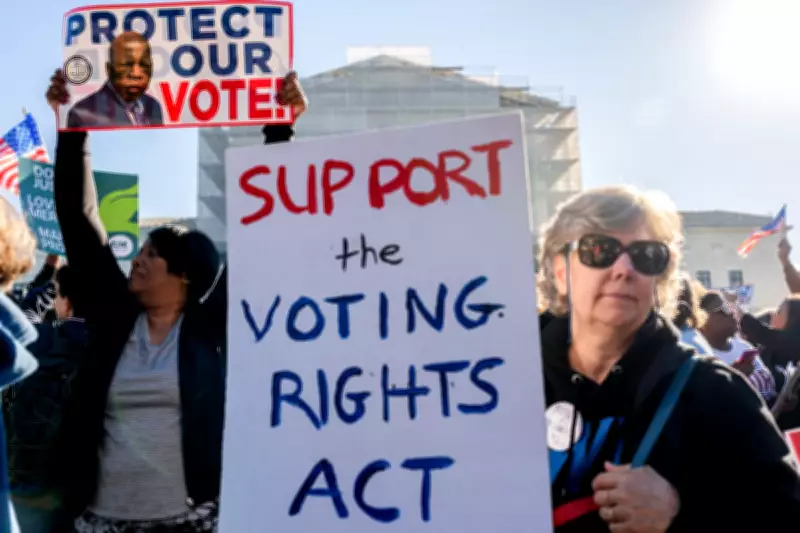
The Supreme Court's voting rights decision is a death knell for American democracy, according to Moira Donegan in a Guardian US column. The ruling in Louisiana v. Callais effectively destroys the Voting Rights Act (VRA), which was the signature achievement of the civil rights movement and ensured equal voting access for minorities.
The End of American Democracy?
America has never been a true democracy, but political scientists argue it became one only after the VRA's passage in 1965. That era ended on Wednesday with the Court's 6-3 decision, authored by Samuel Alito and joined by all Republican appointees. The decision completes a process begun in 2013's Shelby County v. Holder, which struck down Section 5 requiring federal oversight of voting laws in states with a history of discrimination.
Section 2 Now Moot
While the Court claimed Section 2 remained intact, Alito's opinion establishes new standards that virtually no case can meet. The VRA is effectively dead. This will likely represent the greatest withdrawal of voting power from Black Americans since Reconstruction and Jim Crow.

Impact on Elections
Democrats could lose between a dozen and 27 seats in Congress due to Republican redistricting. A New York Times analysis found about a dozen Democratic-leaning seats endangered across the South. Fair Fight Action, led by Stacey Abrams, estimates Republicans could gain up to 27 seats, with some losses occurring as early as November 2026 primaries.
Racial vs. Partisan Gerrymandering
The Court now allows racially discriminatory impacts as long as discriminatory intent is not proven. Alito's opinion overturns the 1982 VRA reauthorization, which required districts to preserve equitable representation based on mere discriminatory impact. The Court claims considering race to ensure equal representation constitutes discrimination against non-Black voters, imposing a facially race-neutral but discriminatory regime.
Racial gerrymanders can now be disguised as partisan gerrymanders, exploiting deep partisan divisions along racial lines. The Court's claim that the 14th Amendment and VRA prohibit any state acknowledgment of race is disingenuous, as these laws were meant to end oppression of Black Americans.
Chief Justice Roberts' Legacy
Longtime observers note that eliminating the VRA has been a decades-long goal of Chief Justice John Roberts, who expressed disdain for the law in the 1980s while in the Reagan White House. Despite presenting himself as an institutionalist, Roberts' true legacy will be hostility to multiracial democracy, valuing it over intellectual honesty and institutional integrity.