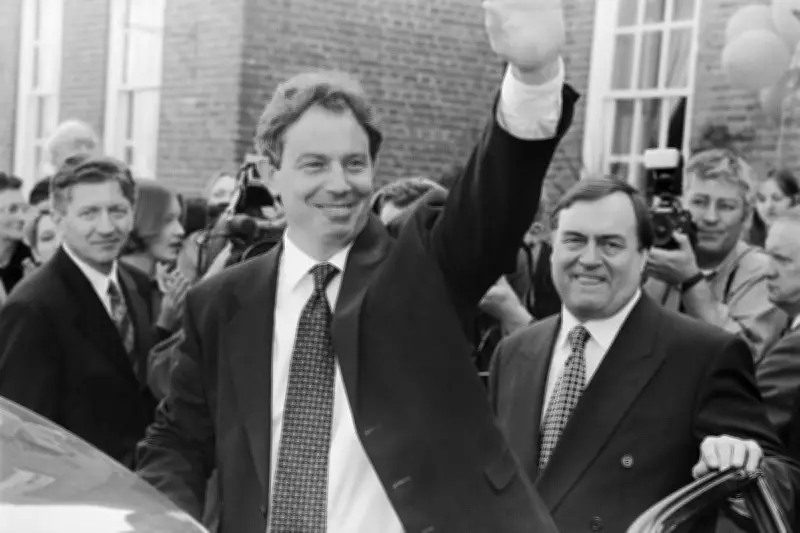
On this day in 1997, a new political dawn broke over Britain. Tony Blair's New Labour party achieved a landslide victory, ending 18 years of Conservative rule and heralding the era of 'Cool Britannia'. The general election on Thursday, 1 May 1997, saw Labour win 418 seats to the Conservatives' 165, giving Blair a majority of 179 – the third-largest single-party advantage since the Great Reform Act.
A Warm Day of Change
London basked in 20°C heat that afternoon. Michael Jackson topped the singles chart with 'Blood on the Dance Floor', while the Star Wars Special Editions drew crowds to cinemas. John Grisham's 'The Partner' dominated bookshop shelves, but a curious buzz surrounded an unknown author's debut about a child wizard – J.K. Rowling's 'Harry Potter and the Philosopher's Stone'.
Of the 43,846,152 registered electors in the UK, about three in four cast their votes. Prime Minister John Major had delayed the election as long as possible, calling it on 17 March with a dissolution of Parliament for 8 April, resulting in an unusually long six-week campaign. Major, a seasoned political streetfighter, hoped an extended campaign would favour experience and pressure the relatively young Leader of the Opposition.

The Rise of Tony Blair
Tony Blair was just 43 and had led Labour for only three years. No major party leader had entered a general election without ministerial experience since Ramsay MacDonald in 1923. Some newspapers dubbed him 'Bambi', but they underestimated the profound societal changes underway. The Conservatives, seeking a fifth consecutive victory, faced a historic challenge.
Conservative Troubles
Major's government was plagued by two major problems. First, the Tories lost every by-election between 1989 and 1997, with 18 contests eroding their majority. In July 1993, Christchurch saw a Conservative majority of 23,105 transformed into a Liberal Democrat advantage of 16,427. Second, Black Wednesday on 16 September 1992 – when Britain was forced out of the European Exchange Rate Mechanism at a cost of over £3 billion – shattered the Conservatives' reputation for economic competence, despite the economy improving by 1997.
Europe further divided the party. The Maastricht Treaty, signed in February 1992, sparked bitter internal battles over European integration. With Major's majority dwindling, Eurosceptic Tory MPs wielded disproportionate influence.
A New Labour Vision
Tony Blair, guided by Peter Mandelson, transformed Labour's image. Unlike his predecessor John Smith, who favoured gradualism, Blair reimagined Labour as a party for social justice and aspiration. The mantra 'tough on crime, tough on the causes of crime' captured this shift. By election day, Labour led in virtually every major opinion poll since Black Wednesday; a 1995 Gallup poll showed a staggering 43.5% advantage.
ITN's exit poll predicted an overwhelming Labour victory, but many thought it exaggerated. As results came in, the scale became clear: Labour held 418 seats, the Conservatives 165, and the Liberal Democrats surged to 46. Seven Conservative Cabinet ministers lost their seats, and the party was wiped out in Scotland and Wales.
Cool Britannia
Britain in 1997 wanted change, but not driven by misery. Surveys showed four out of five people were happy with their lives, in the era of 'Cool Britannia', endorsed by Vanity Fair weeks before the election. Blair, a youthful premier with a young family, former Oxford band member, and fan of King Crimson, embodied this optimism.
At a victory party at the Royal Festival Hall in the early hours of 2 May, Blair declared, 'A new dawn has broken, has it not?' That dawn reshaped British politics for a generation.