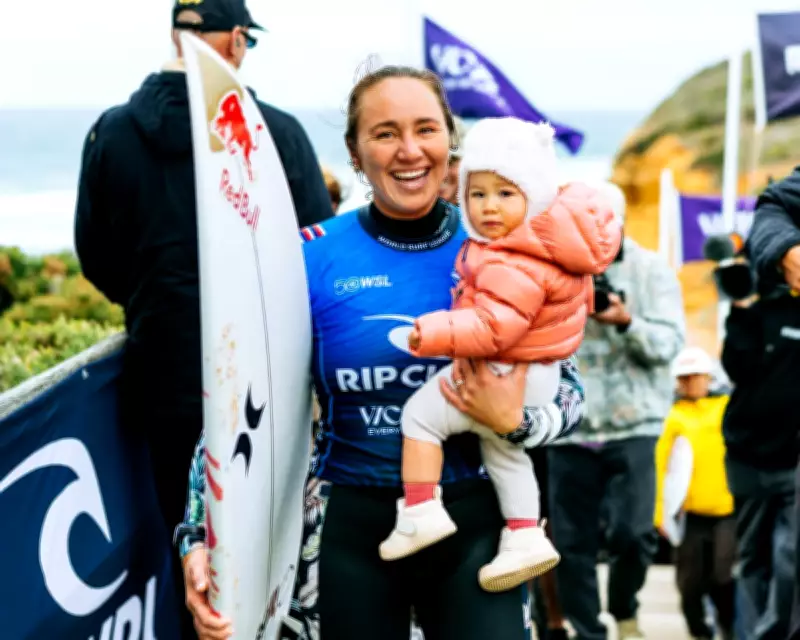
World Surf League Revolutionizes Professional Surfing with Family-Friendly Policies
The World Surf League has taken a monumental step toward creating a more inclusive environment for professional surfers who are parents. With the introduction of maternity wildcards and formal parental leave policies, the organization is breaking new ground in supporting athletes who want to balance elite competition with family life.
Carissa Moore's Triumphant Return to Competition
Five-time world champion Carissa Moore has made an emotional return to the WSL tour after stepping away in 2024 to start a family. The Olympic gold medalist gave birth to her daughter Olena in February 2025 and has been granted a season-long wildcard for the 2026 campaign. "It's literally a dream come true," Moore exclaimed after winning her first heat back at Bells Beach. "Getting to have my family here, coming in to see my husband and daughter on the beach - this represents a huge step in the right direction for women in sport."
Structural Changes Supporting Parent Athletes
The WSL's new maternity wildcard system allows surfers to return to competition up to two years after taking a break to have children. Priority is given based on world titles or tour ranking when multiple surfers apply. French competitor Johanne Defay has already been awarded the 2027 maternity wildcard, while Brazil's Tatiana Weston-Webb will receive a general wildcard to facilitate her return.

For male surfers, the league has introduced paternity leave allowing competitors to request breaks of two events or one calendar month while receiving minimum ranking points during their absence. This represents a significant departure from previous policies where skipping events typically meant forfeiting points entirely.
A Growing Trend of Family Travel on Tour
Australian Japanese surfer Connor O'Leary is experiencing his first WSL campaign with his daughter Romii-Sakura, who will celebrate her first birthday this month. "Seeing her crawling around, playing with Kelly Slater, Steph Gilmore was grabbing her - it makes you appreciate the life that we live," O'Leary shared during the Rip Curl Pro at Bells Beach.
The trend extends across both tours:
- Australian star Jack Robinson travels with toddler Zen and wife Julia Muniz
- South African veteran Jordy Smith increasingly brings his two children
- Past champions like Lisa Andersen won four world titles in the 1990s as a single mother
- Hawaiian star Sunny Garcia was known for globe-trotting with his family
Impact on Performance and Perspective
O'Leary credits fatherhood with providing "an extra bit of motivation" and helping him find greater mental clarity. "It gives you a different perspective," the 32-year-old explained. "Life is not all about competitive surfing. Becoming a father has made me learn how to switch on and off a lot more. I feel like I'm enjoying surfing more because I have less time to think about it."
Smith, who finished third in the world last year, emphasized the importance of having children participate in the tour experience. "It's an awesome thing to have your children travel with you," he said. "It is a big thing to have them a part of your life, not just viewing it from the sidelines."
Historical Context and Future Implications
These parental support initiatives follow other progressive WSL policies including equal pay implementation in 2018 and a fully integrated schedule in 2022. The changes reflect growing recognition that professional athletes are multidimensional individuals with lives beyond competition.
The tour environment has become something of a breeding ground for future talent, with Sierra Kerr - one of Australia's best young female surfers - having grown up on tour with her father, former professional Josh Kerr. During a lay day at the WSL finals in Fiji last year, Robinson shared footage of his toddler Zen riding in the shore break, suggesting the next generation is already getting comfortable in the water.

As more surfers balance parenting with professional competition, the WSL's family-friendly policies represent a significant evolution in how sports organizations support their athletes' complete lives. With champions like Moore returning to competition and a growing number of children in competitors' areas, professional surfing is demonstrating that family and elite performance can successfully coexist.