
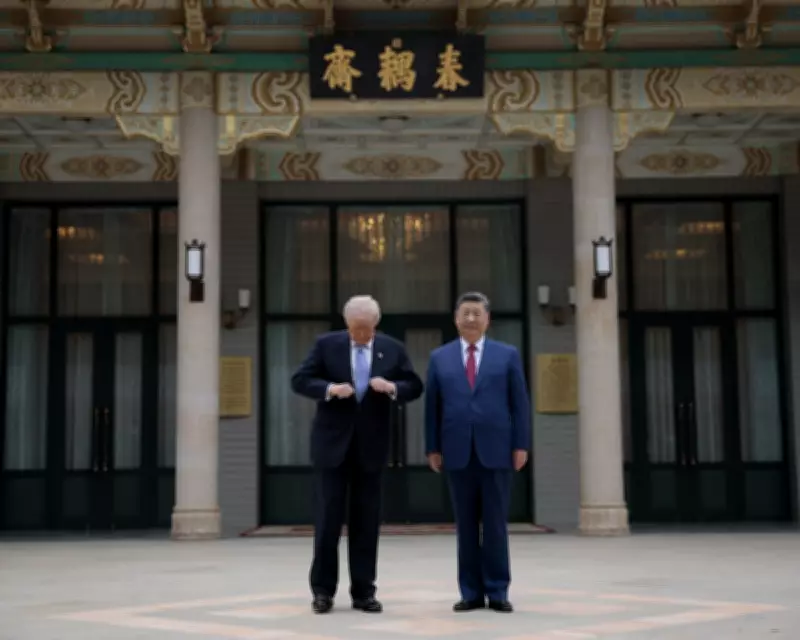
Donald Trump has claimed that the United States and China share a similar stance on ending the war in Iran, but he provided no specifics about a potential breakthrough during his final day of talks with Chinese President Xi Jinping in Beijing.
Talks at Zhongnanhai
Speaking alongside Xi at the Zhongnanhai leadership compound, Trump said, "We did discuss Iran. We feel very similar about how we want it to end. We don't want them to have a nuclear weapon. We want the straits open." He added that the situation in Iran is "a little bit crazy" and must be resolved.
The comments came amid intense speculation about the extent of U.S. pressure on China—the largest buyer of Iranian oil—to leverage its influence with Tehran to reopen the Strait of Hormuz. However, it remains unclear whether Beijing will yield to such demands.
U.S. and Chinese Positions
U.S. Trade Representative Jamieson Greer told Bloomberg TV that China "doesn't want to be on the wrong side" regarding Iran, emphasizing the importance of the Strait of Hormuz for China. Secretary of State Marco Rubio expressed hope that China would play a more active role in persuading Iran to de-escalate, though he later downplayed the need for Beijing's assistance, stating, "We're not asking for China's help."
China's foreign ministry reiterated its call for a ceasefire and urged the reopening of the Strait of Hormuz "as soon as possible." While half of China's crude oil passes through the waterway, the greater risk for the Chinese economy is a potential global recession from the Middle East conflict, which could reduce demand for Chinese exports.
However, many in Beijing view the Iran crisis as not China's responsibility. Retired senior army colonel Zhou Bo remarked, "On Iran, China definitely wants to help, but Rubio seems to shift the burden to us. In China, we say, 'Why should I clean your shit?'"
White House and Chinese Readouts
The White House readout of the over-two-hour talks between Trump and Xi noted an agreement that the Strait of Hormuz must remain open for energy flow, and that Xi opposed the militarization of the strait. Trump raised eyebrows in a Fox News interview when he suggested that finding Iran's enriched uranium was more for public relations than substance, despite Israeli demands.
Chinese state media quickly echoed the term "constructive strategic stability" from the meeting, with Xinhua describing it as "harmony without uniformity and seeking common ground while reserving differences."
Trade and Other Issues
Trump reveled in Chinese hospitality, calling the visit "incredible" and claiming progress on trade deals, including Chinese purchases of U.S. oil, soybeans, and 200 Boeing planes. However, no concrete agreements were reached on key issues like Taiwan.
Julian Gewirtz, a former NSC director for China, said the new Chinese formulation aims to "lock in the current phase of strategic stalemate for the remainder of Trump's term and beyond." Wu Xinbo, a professor at Fudan University, noted that the balance of power between the U.S. and China is "shifting towards greater parity."
On the streets of Beijing, crowds were thinner on Friday, and many residents complained about road closures. When asked about Trump, the recurring word was "unpredictable." One observer noted, "What he says isn't necessarily what it means."




