
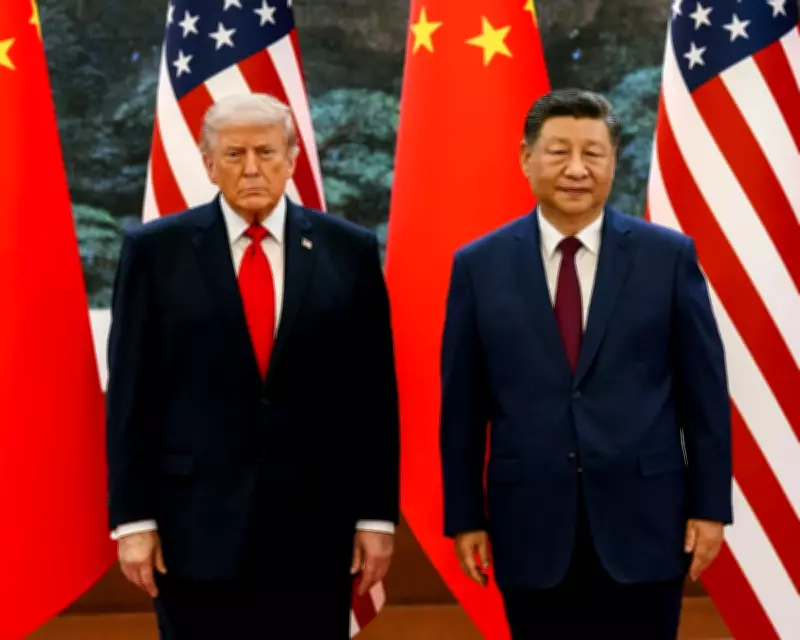
President Donald Trump met with Chinese President Xi Jinping on Friday during an official visit to Beijing aimed at discussing trade and bilateral relations. The meeting, while superficially cordial, appeared to extend a truce borne of necessity rather than achieving substantive progress.
"American strength back on the world stage," crowed the White House social media post, despite video showing US flags beneath Chinese flags and People's Liberation Army soldiers marching in unison. The visit offered style—parading troops, a banquet, and a polite welcome from a strongman Trump called "really a friend"—but little apparent substance.
The public account of the encounter will be partial. Trump's former adviser John Bolton claimed that in previous conversations, the US president begged Xi for help to win re-election and urged him to "go ahead" with internment camps for Uyghurs in Xinjiang. This meeting, however, appeared focused on stabilizing the relationship, not shifting it.
Chaotic US planning for a trip deferred due to the Iran war may have contributed to the lack of tangible outcomes. The overall impression is of a wary stalemate. Just over a year ago, the US imposed 145% tariffs on China. Beijing retaliated with its own tariffs and, critically, curbs on desperately needed rare earths exports, forcing Trump to retreat. The US national security strategy announced a new focus on the western hemisphere. Military assets have been moved from Asia to the Middle East. US hawks have been muted, with China policy appearing directed primarily via Trade Secretary Scott Bessent.
The US hopes to establish alternative sources of rare earths. Deng Xiaoping urged China to "hide its light and bide its time" in foreign policy; now US officials joke of adopting his strategy. Others think the US needs to move fast to tighten controls on exports of advanced technologies and make serious progress in "de-risking" supply chains. They fear Trump, who likes quick wins, is trading long-term national security for short-term economic gain.
For China, its economic, technological, and security progress are inextricably linked. It wants time to surpass the US on all scores. Last month, Beijing ordered Meta to unwind its purchase of Manus, a Chinese-founded AI firm. It also introduced new measures to punish companies compliant in sanctions against Chinese firms.
Xi called the Beijing meeting a "milestone." That is better understood as a marker on a long journey than a major achievement. China believes it is on the path to restored greatness, while Chen Yixin, minister for state security, wrote scathingly in December that US hegemony is "increasingly unsustainable ... At home, its democracy is mutating, its economy decaying, and its society fracturing ... abroad, its credibility is rapidly going bankrupt, its hegemony is crumbling, and its myth is collapsing."
US allies are engaging more with China. But Washington's slide also has complications for Beijing. The China scholar Sam Chetwin George this week delineated its contemplation of a greater security role, arguing: "A country built on an anti-imperial story has arrived at the point in which it must, with some reluctance, assume a greater share of the burdens of empire." Its handling of the Iran war is instructive: it would like it to be over but has no eagerness to act as mediator, wary of expending its own assets or leverage. The two great powers are playing the waiting game. The rest of the world watches.




