
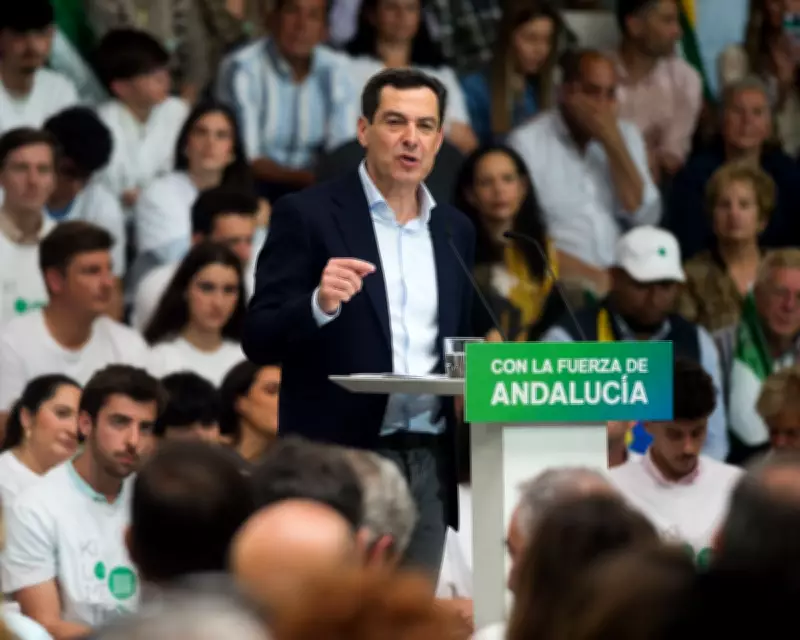
Voters in the southern Spanish region of Andalusia will cast their ballots in an election this weekend that is expected to deliver an absolute majority to the conservative People's Party (PP) and inflict another significant defeat on Prime Minister Pedro Sánchez's Socialist Party in what was once one of its strongest strongholds.
Election as a National Barometer
Sunday's election in Spain's most populous region, the last major poll before next year's general election, will serve as a barometer of wider electoral opinion. It could also reveal whether the popularity of the far-right Vox party is beginning to plateau. The PP, which has governed the former socialist bastion for the past seven years, is framing the election as a referendum on Sánchez, whose inner circle, party, and administration face multiple corruption allegations.
Poll Projections
According to polls, the incumbent PP regional president, Juan Manuel Moreno Bonilla, is on track to nearly replicate his 2022 result, when the conservatives won 58 seats in the 109-seat regional parliament. Meanwhile, the Spanish Socialist Workers' Party (PSOE), which ruled Andalusia from 1982 to 2019, is expected to drop from 30 to 28 seats, its worst-ever result. Vox, which entered mainstream Spanish politics in the 2018 Andalusian regional election, is forecast to gain one or two seats, adding to the 14 it won four years ago.
Moreno hopes another absolute majority will allow him to avoid depending on Vox, which has sought to push the PP further right in regional coalitions by insisting Spaniards receive priority over foreign-born people for housing and public services. The regional president has dismissed Vox's "national priority" policy as "an empty slogan."
National Implications
Both Moreno and the PP's national leader, Alberto Núñez Feijóo, aim to use Sunday's vote to advance the party nationally by capitalizing on scandals engulfing the national government. Moreno has referred to his PSOE opponent, former national minister María Jesús Montero, as "the lady from the past," emphasizing the need to "bury bad politics and leave the past behind." Feijóo has been blunter, saying Andalusian voters must "choose between the conspiracy that Sánchez led and Montero watched over, and Moreno's crack team."
Socialist Woes
Recent events have intensified pressure on the Socialists. Montero faced fierce criticism this week for describing the deaths of two Guardia Civil officers pursuing drug traffickers off the Andalusian coast as a "workplace accident." She later corrected herself, stating the deaths occurred "in the line of duty."
Healthcare Crisis
Moreno has also faced scrutiny. With 42.2% of Andalusian voters citing healthcare as the region's biggest problem, his handling of a cancer-screening scandal has resurfaced. Late last year, the regional government admitted that over 2,300 women were not informed of inconclusive mammogram results, leading to missed follow-up tests and treatments. The delay sparked protests and the resignation of the regional health minister.
Moreno insisted this week that no one died due to the administrative failure, a claim challenged by campaigners. Ángela Claverol, president of breast cancer support association Amama Sevilla, said at least six women died because of the failure. She blamed the scandal on Moreno's privatization of public health services, which she says has caused delays of up to three months for cancer surgery and extended waits for CT scans, MRIs, and GP appointments.
Claverol argued that the public healthcare system has collapsed due to increased reliance on private providers, with funds diverted from the public sector. Moreno, however, claims his government has modernized hospitals and equipment, increasing capacity to reduce waiting times.
Housing and Overtourism
Housing is another major concern. Cities like Seville, Málaga, and Córdoba suffer from overtourism, with soaring rents and housing shortages. Local groups urge the regional government to prioritize residents over tourists. Juan Carlos Benítez of Albayzín Habitable, a residents' association in Granada's Albaicín neighborhood, criticized the government's "strategy of quantitative tourism over qualitative tourism." He warned that Granada risks becoming a "Disneyland-type centre" with no real residents, benefiting only restaurant and shop owners.
Political Analysis
Pablo Simón, a political scientist at Madrid's Carlos III University, said Sunday's results will resonate beyond Andalusia as Spain gears up for the general election. Polls suggest the PP will finish first next year but may need Vox's support to govern. "If Moreno maintains his absolute majority and Vox fails to gain influence, that will confirm Vox is stagnant and the PP is gaining ground," Simón said.
While Vox performed well in recent regional elections in Aragón, Extremadura, and Castilla y León, internal bickering and stalled growth suggest its chances of reaching 20% of the national vote are fading. Currently anchored around 13-14% regionally (17% nationally), Vox's earlier ambitions have backfired. However, scandals in PP-led regions, such as the botched response to deadly floods in Valencia in 2024, could reverse Vox's fortunes.
Simón also predicted a "terrible" result for the Socialists, with one poll showing only 27 seats, a gap of over 20 points between first and second parties.




