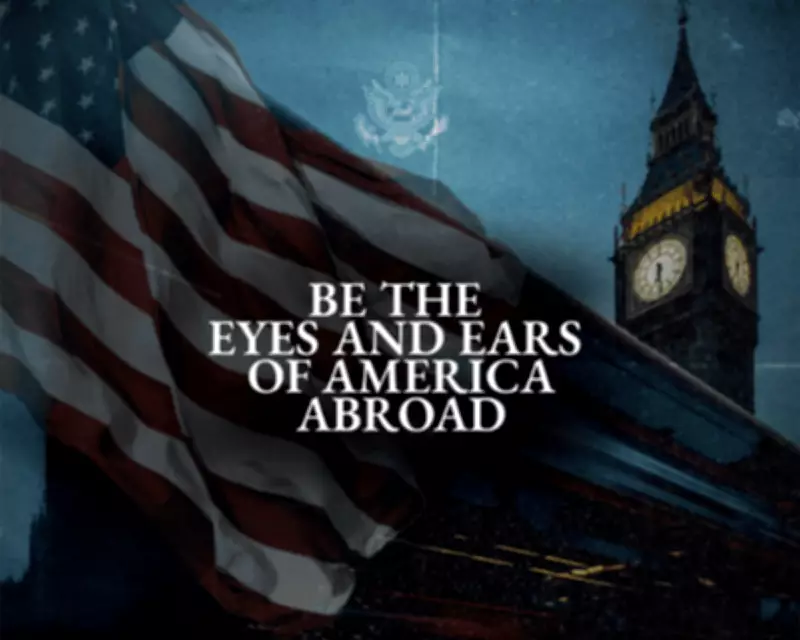
A recent advertisement by the US State Department, which seeks Americans to serve as its 'eyes and ears' abroad and prominently features an image of Big Ben, has stirred unease among diplomats on both sides of the Atlantic. The ad, posted over the weekend, calls on candidates to 'navigate great-power rivalries, defuse global crises, and protect Americans and their interests across the globe.'
Diplomatic Reactions
A former UK diplomat described the imagery as 'awfully spooky, like they're recruiting for the CIA and not the State Department.' The ad shows an American flag against a dark, grainy backdrop of London's iconic clock tower. A former senior US diplomat noted growing uneasiness in Washington about the UK's independence from the US, suggesting the ad might symbolise an overseas post tasked with watching other countries and reporting back. However, they acknowledged that London's charm for foreign service aspirants could also explain the choice.
Innocent or Pointed?
The British diplomat speculated that the selection of Big Ben might be purely innocent, given its recognisability as a foreign landmark. 'You could have had the Eiffel Tower, you could have had the Kremlin,' they said. Yet, in the context of recent US officials lecturing the UK on freedom of speech, the implication could be that 'the US is watching carefully what happens in Britain, and that it's not a coincidence.' They added that those in King Charles Street, the UK Foreign Office, might view it as 'a little bit pointed.'
Recruitment Context
The State Department froze foreign service recruitment in February last year amid massive federal cuts led by Elon Musk's Department of Government Efficiency (Doge). Recruitment resumed earlier this month after overhauling the selection process and curriculum. New selection criteria, announced in April, eliminated questions aligned with 'diversity, equity, and inclusion,' while the curriculum now emphasises 'America First foreign policy.' The American Foreign Service Association expressed 'serious concerns' about introducing ideology into diplomat selection and training.
One former US diplomat warned that the administration is 'changing the face of the US diplomatic corps by going back to the 60s and 70s when US diplomats were 'male, pale and from Yale.'' They argued that recruitment now hinges on a 'correct' understanding of US history and politics, with advancement tied to loyalty to administration policies.
Other Ad Imagery
Another recent foreign service ad featured John Quincy Adams, the sixth US president, with the caption: 'Today, America needs dedicated patriots to continue the legacy of American diplomacy.'
Analysis and Criticism
Orna Blum, a retired US senior diplomat, called the London image 'more a creative choice than a diplomatic one,' but noted it struck an odd note. 'From a recruiting standpoint, there's a disconnect. The job is human – earning trust, managing crises, protecting Americans in complex environments. That reality just isn't coming through here.'
The British diplomat highlighted that the ad's language frames diplomats as 'eyes and ears,' which contrasts with the traditional role of 'interlocutors' who speak on behalf of their country. 'They've always been seen in the past as interlocutors, people who would go out and speak on behalf of a country, and not just passively receive information.'
Kristofer Harrison, a former State Department Russia expert, remarked: 'We need diplomats to be lines of communications to foreign governments, not our eyes and ears. My gut is that this is just Maga incompetence.'
State Department Response
Tommy Pigott, the State Department spokesperson, defended the recruitment efforts. 'US foreign service officers are tasked with representing America abroad, communicating with host governments and providing the State Department with expertise on the regions in which they serve in hundreds of diplomatic postings around the world, including in allied nations like the United Kingdom.' He dismissed claims that the ad suggests a poor relationship with the UK as 'preposterous and conspiratorial,' and noted the upcoming visit of King Charles III and Queen Camilla to Washington DC as a testament to the 'longstanding and special relationship.'