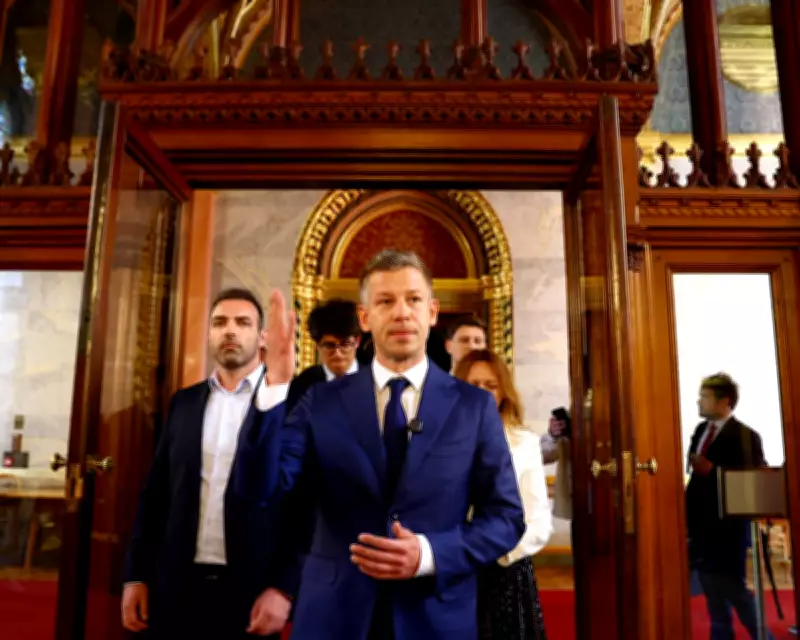
Ukrainians Celebrate Orban's Defeat, Eye New Era Under Magyar
Like many Ukrainians, Oleh Kupchak felt a wave of euphoria when Péter Magyar secured victory in Hungary's election last weekend, bringing an end to Viktor Orbán's 16-year dominance. "We were euphoric. Everyone was following the results closely. There were toasts," said Kupchak, who has visited Budapest multiple times. "We didn't love Orbán," he added, reflecting a sentiment widely shared across Ukraine.
In the aftermath of Orbán's landslide defeat, Ukrainian social media erupted with jokes and memes. Some compared the outgoing prime minister to the Star Wars character Jabba the Hutt, while others shared images depicting Orbán fleeing from a drone or sitting on a bench in Russia alongside pro-Kremlin figures like former Ukrainian president Viktor Yanukovych and Syria's exiled leader Bashar al-Assad.
A Strategic Shift in European Politics
The widespread joy at Orbán's ousting was hardly surprising. As the Kremlin's most disruptive supporter within the European Union, Orbán ran a vociferously anti-Ukrainian campaign, accusing Kyiv of sabotaging energy installations and threatening his family with violence. Recently, relations between Kyiv and Budapest had deteriorated into open hostility, exemplified by Orbán's claims that Volodymyr Zelenskyy deliberately delayed repairs to the Druzhba pipeline to harm Fidesz's re-election chances.
In the lead-up to the poll, Hungarian voters encountered billboards showing Zelenskyy begging for EU funds and posters linking Ukraine's president to Magyar. The opposition leader and his Tisza party were accused of being part of a Brussels-backed "pro-war lobby" aiming to drag Hungary into the conflict.
Cautious Optimism and Key Challenges
Ukrainian politicians and analysts have welcomed Magyar's victory but urge tempered expectations for a rapid thaw in relations. Oleksandr Merezhko, head of the foreign affairs committee in Ukraine's parliament, expressed cautious optimism, stating, "A unique window of opportunity is now opening up for Ukrainian-Hungarian relations." He interpreted the election results as a strategic defeat for Putin, who had hoped to form an anti-Ukrainian coalition in Europe led by Orbán.
Magyar is expected to lift Orbán's veto on €90 billion in EU aid to Ukraine once his government is sworn in early next month, a move Kyiv desperately needs. Additionally, Hungary is likely to drop its opposition to new sanctions against Russia, and Brussels will unlock suspended EU funds for Hungary due to democratic backsliding under Orbán.
Merezhko described Magyar as more "constructively minded" than his pro-Russian predecessor and not anti-European. However, he warned that bilateral issues cannot be resolved "automatically and quickly." Key disputes include Ukraine's EU accession, with Magyar rejecting fast-track membership and advocating for a referendum, and the status of Ukraine's ethnic Hungarian minority in the Zakarpattia region.
Diplomatic Gestures and Realistic Expectations
Last month, Budapest impounded two Ukrainian armoured bank vehicles carrying millions of euros and gold bars, a move Merezhko called a provocative scandal. He suggested that returning these funds would be a significant step showing Magyar's willingness to engage in dialogue.
Zelenskyy has congratulated Magyar and his Tisza party, emphasizing the importance of a constructive approach and expressing readiness to develop cooperation. Unlike some international stances, Magyar has acknowledged Ukraine as a victim of Russia's invasion and opposes forcing territorial concessions.
However, Ukrainian commentators caution against viewing Magyar as a pro-Ukrainian booster. Serhiy Sydorenko, editor of European Pravda, noted, "Magyar is not a pro-Ukrainian politician. He is pro-Hungarian." He suggested Zelenskyy might reluctantly complete repairs to the Druzhba pipeline as a goodwill gesture.
Observers point out that Hungarian society, after 16 years of Orbán's propaganda, has grown accustomed to anti-Ukrainian narratives and will take time to shift views. Political analyst Marianna Prysiazhniuk advised that Zelenskyy should behave "very delicately" towards Budapest, considering its internal context. "We shouldn't expect Magyar to shout: 'Glory to Ukraine'. The priority is for Hungary to become a reliable European partner," she said.
The two leaders are likely to hold talks next month in Romania at a meeting of the "Bucharest Nine," a gathering of NATO's formerly communist East European member states. Meanwhile, Kupchak reflected on his travels to Hungary, hoping that under Magyar, historical tensions rooted in imperial mentalities might ease, fostering a new era of cooperation.