Spanish Leader Stands Firm Against US Trade Threats Over Iran Policy
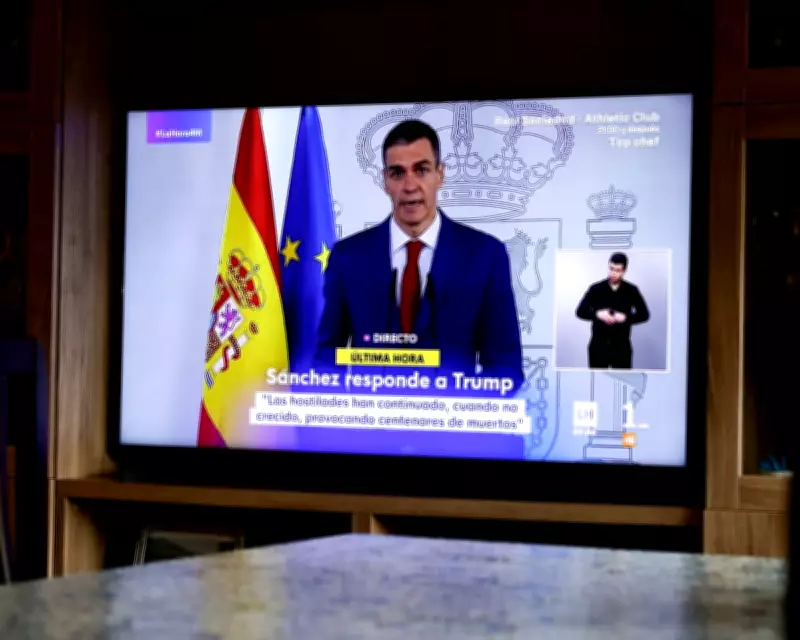
Spanish Prime Minister Pedro Sánchez has delivered a forceful response to former US President Donald Trump's extraordinary threat to sever all trade relations with Spain, declaring his nation will not participate in Middle East military actions "simply out of fear of reprisals from someone." The confrontation emerged after Spain refused American requests to utilize jointly operated military bases in southern Spain for ongoing attacks against Iran.
'No to War' as Guiding Principle
In a nationally televised address, Sánchez, who has been among Europe's most vocal critics of Israel's conduct in Gaza, distilled his government's position on the escalating Middle East instability to three definitive words: "No to war." The prime minister emphasized that Spain would not become complicit in actions "that are bad for the world - and that are also contrary to our values and interests" merely to avoid economic retaliation.
"You can't respond to one illegality with another because that's how humanity's great disasters begin," Sánchez warned, directly addressing the growing tensions between the United States, Israel, and Iran. "You can't play Russian roulette with the destiny of millions."
Trump's Criticism and Merz's Intervention
The diplomatic clash intensified when Trump, during a meeting with German Chancellor Friedrich Merz, labeled Spain "terrible" for its refusal to permit US use of Spanish bases and instructed Treasury Secretary Scott Bessent to "cut off all dealings" with the European nation. Trump further criticized Spain for rejecting NATO's proposal for member states to increase defense spending to 5% of GDP, claiming "everybody was enthusiastic about it - Germany, everybody - and Spain didn't do it."
Merz later revealed he had privately informed Trump that Spain could not be excluded from the trade agreement reached between Brussels and Washington last year. "I said that Spain is a member of the European Union and we negotiate about tariffs with the United States only together or not at all," Merz stated. "There is no way to treat Spain particularly badly."
Historical Parallels and Economic Warnings
Sánchez pointedly invoked the 2003 invasion of Iraq - supported by his conservative predecessor José María Aznar - as a cautionary tale about the dangers of military intervention. While that war was ostensibly launched "to eliminate Saddam Hussein's weapons of mass destruction, to bring democracy, and to guarantee global security," Sánchez noted it instead "unleashed the greatest wave of insecurity our continent has suffered since the fall of the Berlin Wall."
The Spanish leader warned of potentially severe economic consequences from prolonged conflict, stating: "Nobody knows for sure what will happen now. Even the objectives of those who launched the first attack are unclear. But we must be prepared, as the proponents say, for the possibility that this will be a long war, with numerous casualties and, therefore, with serious economic consequences on a global scale."
European Solidarity and Institutional Support
The European Commission has firmly backed Spain's position, declaring: "The commission will ensure that the interests of the European Union are fully protected. We stand in full solidarity with all member states and all its citizens and, through our common trade policy, stand ready to act if necessary to safeguard EU interests."
Teresa Ribera, former Spanish deputy prime minister and current EU green transition chief, emphasized that the EU's external trade is negotiated as a bloc, with the commission serving as the relevant authority. "At this moment, it isn't possible to establish trade reprisals or separate trade relations," Ribera told Spain's Cadena Ser radio. "I think the most surprising thing about this fact is that the American federal government is aware of this."
Broader Implications for International Relations
Sánchez framed the confrontation within larger questions of governmental responsibility, arguing that a government's primary duty is "to protect and improve the lives of its citizens - and not to use geopolitics to cynical ends or to profit from war." He condemned leaders who use "the smokescreen of war to hide their failure and, in the process, line the pockets of a select few - the same ones as always; the only ones who profit when the world stops building hospitals and starts building missiles."
The standoff highlights growing tensions within transatlantic relations and raises significant questions about trade policy enforcement, military cooperation protocols, and the European Union's collective bargaining power in international disputes. As Middle East hostilities continue to escalate, Spain's firm stance against military involvement and willingness to confront economic threats from a major trading partner establishes a notable precedent for European nations navigating complex global conflicts.