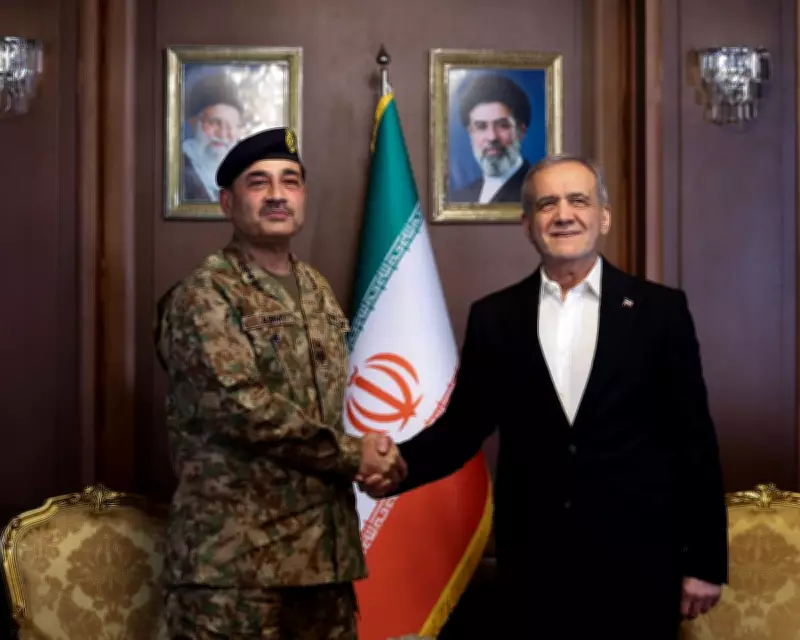
Pakistan's Military Leader Steps Into Diplomatic Spotlight
Field Marshal Asim Munir, Pakistan's powerful army chief, has unexpectedly emerged as a central diplomatic figure in efforts to resolve the escalating conflict between the United States and Iran. Dressed in full military fatigues, Munir arrived in Tehran this week to personally deliver a new proposal from Washington for renewed talks, marking his transformation from domestic power broker to international mediator.
The Unlikely Peacemaker
Munir's diplomatic intervention comes at a critical juncture, following the collapse of previous negotiations between US Vice President JD Vance and Iranian officials in Islamabad. Despite President Donald Trump's simultaneous imposition of a naval blockade on the Strait of Hormuz, which threatened to escalate hostilities, the American leader praised Munir's "fantastic" efforts to maintain communication channels between the adversarial nations.
Pakistan has positioned itself as an improbable intermediary in one of the world's most volatile geopolitical standoffs, with Munir serving as the primary conduit between Washington and Tehran. The army chief's unique access to leadership on both sides has enabled him to facilitate dialogue when traditional diplomatic channels have faltered.
Military-Led Diplomacy
Analysts note that Pakistan's foreign policy has long been shaped by its military establishment, with unelected army chiefs frequently overshadowing civilian governments in international engagements. "Field Marshal Munir is the driving force – without him this would not work," stated Maleeha Lodhi, Pakistan's former ambassador to the UN, US, and UK. "Countries like Iran and the US have this confidence in Asim Munir. Our government ministers are really an adjunct."
The negotiations have been coordinated from Rawalpindi, the headquarters of Pakistan's military, rather than from the civilian government's seat in Islamabad. This military-led approach reflects historical patterns where US administrations have preferred dealing directly with Pakistan's military leadership rather than its elected officials.
Building International Credibility
Munir's emergence as a diplomatic heavyweight represents a significant evolution from his initial focus on domestic consolidation of power following his 2022 appointment. Over the past eighteen months, he has cultivated strategic relationships across global capitals, visiting the White House twice, overseeing US-Pakistani agreements on cryptocurrency and mineral mining, and signing a defense pact with Saudi Arabia.
His rapport with the Trump administration proved particularly crucial, developed through a combination of strategic concessions, lobbying efforts, and personal diplomacy. Munir delivered early victories to Trump by facilitating the extradition of high-profile terrorists to the United States and later orchestrated Pakistan's nomination of the American president for the Nobel Peace Prize following US intervention in India-Pakistan tensions.
Regional Dynamics and Personal Diplomacy
The Pakistani military chief has also navigated complex regional relationships, rebuilding ties with Tehran after cross-border tensions in early 2024. Pakistan's unequivocal condemnation of Israel's actions in Gaza and subsequent bombing of Iran helped restore goodwill, with public sentiment in Pakistan remaining overwhelmingly supportive of Iran across religious lines.
"Munir had been dealt a bad hand but played it very well," observed Avinash Paliwal, an international relations expert at SOAS University of London. "The personalized, centralized system under the command of Field Marshal Munir allows Pakistan that degree of flexibility to play the role of mediator here with a degree of credibility."
High-Stakes Negotiations
Munir's diplomatic activism reached its peak during frantic negotiations last week, when his direct intervention helped secure a last-minute ceasefire agreement following Trump's threat that Iran's civilization would "die" without a deal. The army chief participated as the third party in Saturday's Islamabad meetings between US and Iranian delegations, solidifying his role as essential intermediary.
This week's mission to Tehran comes as Prime Minister Shehbaz Sharif travels to Saudi Arabia to bolster regional support for Pakistan's peacemaking initiative. The coordinated diplomatic push represents a comprehensive effort to position Pakistan as a credible international actor capable of resolving seemingly intractable conflicts.
Future Implications
The success of these negotiations carries significant implications for both Munir's personal legacy and Pakistan's international standing. A successful mediation could establish Pakistan as a major operational player in maintaining Gulf and Middle Eastern security architectures for years to come.
"This is a man who feels that, moving forward, he will have a much stronger role to play in whatever security architecture develops in the Middle East," Paliwal noted. "Pakistan now is absolutely central to peace-building. For Munir, this is about building a global story."
Despite the focus on Munir's individual role, analysts emphasize the collective nature of Pakistan's diplomatic campaign, with government ministers engaging China, Turkey, and Saudi Arabia to advance peace efforts from multiple angles. The urgent need to prevent further economic and security devastation from prolonged conflict adds pressing motivation to these high-stakes diplomatic maneuvers.