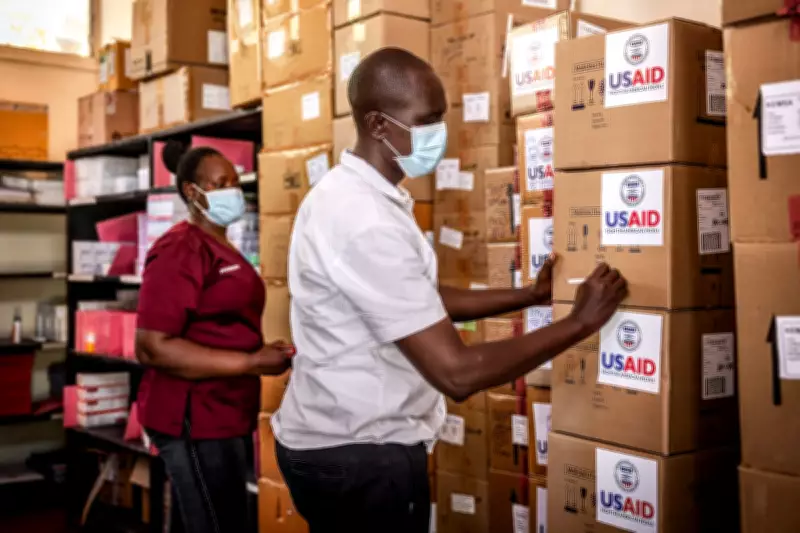
Former USAID Official Chronicles 'Ignorance and Cruelty' of Trump-Era Agency Dismantling
In a stark new account, former USAID official Nicholas Enrich details the systematic dismantling of the United States Agency for International Development during the Trump administration, describing the process as marked by "ignorance and cruelty." Enrich, who served as acting assistant administrator for global health, witnessed firsthand the rapid dissolution of an agency that had been a cornerstone of American foreign policy since its establishment by President John F. Kennedy in 1961.
The Beginning of the End
Enrich's journey with USAID began in Kenya in 2003, during what he describes as the peak of the HIV epidemic. He recalls the moment President George W. Bush signed a landmark $15 billion, five-year commitment to combat HIV—the largest international health commitment by any nation to fight a single disease. "It clicked that my government was ready to join the fight against HIV and I was excited to be a part of that," Enrich says.
More than two decades later, his new book, Into the Wood Chipper—a phrase borrowed from Elon Musk's comments about Doge cuts at the agency—documents the Trump administration's aggressive restructuring of USAID. Within days of taking office in January, Donald Trump issued a temporary pause on USAID funding. By March, a formal dissolution was announced, and by July, with over 80% of programs canceled, the agency was officially merged into the State Department.
Political Interference and Misinformation
Enrich describes a chaotic environment where political appointees with little understanding of global development took control. He recounts how Trump appointees voiced concerns that USAID was providing abortions, despite strict legal prohibitions against such activities. "I didn't know whether to laugh or cry," Enrich says. "USAID didn't provide abortions to anyone. But it was one of the concerns of Republican members of Congress."
The situation escalated when Enrich recognized that administration officials were frequently lying about USAID's operations. He cites Elon Musk visiting the White House to claim Ebola activities had been restarted on the same day his Doge team had canceled the contracts. "This was not an attempt to realign foreign aid in a way that made sense," Enrich writes. "This was a group of people who did not know what the agency did but really did not know or care what it was they were tearing apart."
Global Health Consequences
The human cost of these cuts has been devastating. According to Oxfam estimates, at least 23 million children stand to lose access to education, and as many as 95 million people would lose access to basic healthcare, potentially leading to more than 3 million preventable deaths annually. Enrich emphasizes that the abrupt termination of programs created immediate national security threats, particularly through the suspension of drug trials for drug-resistant tuberculosis.
"Outbreaks that start abroad do not respect international borders," Enrich warns. "USAID had invested hundreds of millions of dollars in early-warning systems to detect potential outbreaks of diseases in countries where they originate and to deal with them before they are able to spread. But that was immediately torn down, leaving us blind to what might be developing."
Personal Grievances and Petty Politics
Enrich reveals that some Trump appointees were motivated by personal grievances rather than policy objectives. He writes that Mark Lloyd, who led USAID's bureau for conflict prevention and stabilization, claimed career staff had killed his dog during the first Trump administration. "He was excited to get rid of USAID staff because he really considered them to be pet murderers," Enrich claims.
The atmosphere within the agency became increasingly toxic. Adam Korzeniewski, the White House liaison to USAID, acted like a "vindictive landlord throwing a farewell party for a tenant," according to Enrich. When agency officials tried to explain the risks of interrupting tuberculosis clinical trials, Korzeniewski suggested they create "Barney-style" slides to catch the political leadership's attention.
The 'Trade Over Aid' Doctrine
Enrich's account comes amid a broader shift in U.S. foreign policy toward a "trade over aid" approach. Last week, Devex reported that the State Department had sent cable memos to U.S. embassies urging host nations to sign a declaration explicitly rejecting America's role as the top provider of humanitarian assistance in favor of business relationships that create opportunities for U.S. companies.
Secretary of State Marco Rubio defended the cuts on social media in March, writing: "The 5200 contracts that are now cancelled spent tens of billions of dollars in ways that did not serve, (and in some cases even harmed), the core national interests of the United States." The remaining 1,000 or so contracts would be administered by the State Department.
Broader Implications for U.S. Foreign Policy
Enrich warns that the dismantling of USAID has far-reaching consequences beyond immediate health impacts. "When we turn our backs on the world, and break the promises we made to millions of people, it erodes the soft power partnerships that the U.S. had built over the years and drives them into partnerships with adversaries like Russia and China," he says.
He acknowledges that Kennedy's original vision for USAID wasn't purely altruistic—it was designed to counter Soviet influence during the Cold War. However, Enrich argues that the Trump administration's transactional approach is "naked and unproven." He believes USAID can and should be reinstated, though he acknowledges the agency might need reforms.
"To show the world that we have an agency that says 'from the American people' was the embodiment of American generosity and soft power," Enrich concludes. "The folks who say it's gone and can't be brought back lack boldness and imagination."
Enrich's book serves as both a memoir of a turbulent period in American foreign policy and a cautionary tale about the consequences of political ideology overriding expertise in government institutions. As debates continue about America's role in the world, his account provides crucial insight into how quickly decades of development work can be undone by administrative fiat.