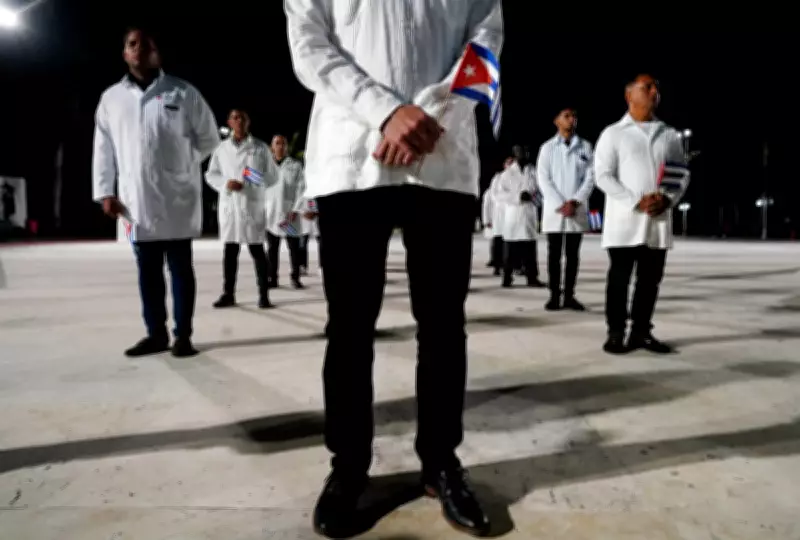
Cuban doctors participated in a farewell ceremony in Havana on February 10, 2023, before departing for Turkey to assist in earthquake relief efforts, as captured in a photograph by Alexandre Meneghini of Reuters. This scene highlights the ongoing international medical missions that have become a cornerstone of Cuba's foreign policy and economy.
US Accused of Pressuring Latin America to Sever Ties with Cuban Doctors Program
Cuba has launched a sharp accusation against the United States, claiming it is "extorting" Latin American nations by coercing them to terminate long-standing agreements with Havana for the supply of medical professionals. Foreign Minister Bruno Rodríguez asserted that the US is attempting to "strangle" the economy of the communist island, which relies heavily on billions in earnings from these foreign medical missions. This comes after several countries have halted their deployment of Cuban doctors.
Washington's Stance and Economic Impact
Washington contends that the program, a source of immense pride and income for Cuba since the 1960s, constitutes forced labor. This position is part of a broader campaign of maximum pressure on the Cuban regime initiated under former President Donald Trump. Trump has previously made threats regarding "taking" the island, following actions against Venezuela and Iran, influencing countries to align with US demands.
As a result, nations like Guatemala, Honduras, Jamaica, and Guyana have all canceled their agreements with Cuba. The island is currently teetering on the brink of economic collapse, exacerbated by a US energy blockade. Rodríguez emphasized on social media platform X that "the US government is persecuting, pressuring, and extorting other governments to end the presence of Cuban Medical Brigades in various countries, under false pretenses."
Scale and Allegations of the Medical Missions
Official figures indicate that approximately 24,000 Cuban doctors and healthcare professionals were deployed across 56 countries in 2025, with most assigned to remote and underserved areas. Half of these professionals were sent to Venezuela, Cuba's top ally for a quarter-century until President Nicolás Maduro was abducted by US forces in January. The program was projected to generate $7 billion in earnings for the cash-strapped island last year, underscoring its critical economic role.
However, the Inter-American Commission on Human Rights recently published a report condemning serious human rights violations within these missions. The report accused Cuba of withholding doctors' wages, confiscating passports, and threatening medics with up to eight years in prison if they defected from their assignments abroad. IACHR President Edgar Stuardo Ralón, in an interview with AFP, suggested that some practices could be classified as "forced labor" and "human trafficking."
According to official Cuban statistics cited in the report, doctors receive only between 2.5% and 25% of the payments that countries make to Cuba for their services. Despite these allegations, Cuba defends the program as an act of "solidarity" aimed at providing health services to "hard-to-reach places," framing it as a humanitarian effort rather than an economic enterprise.