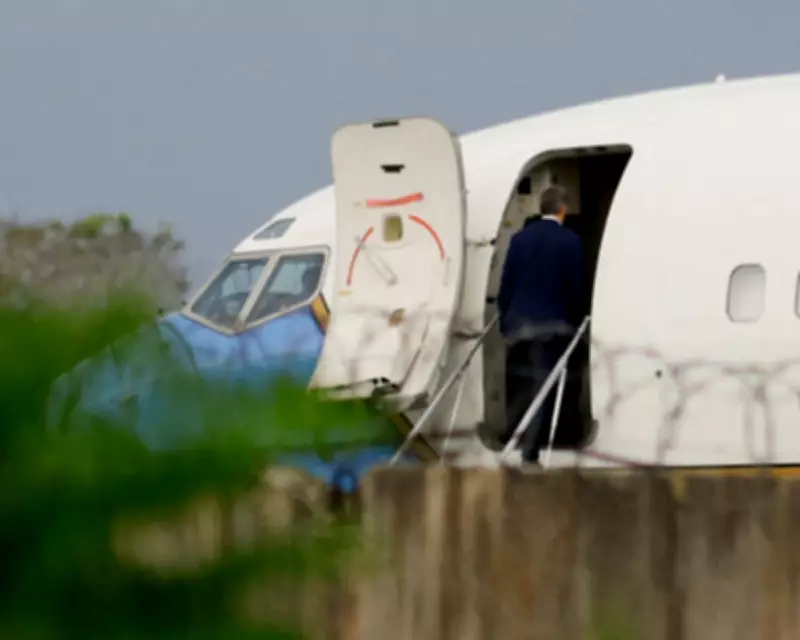
The director of the Central Intelligence Agency, John Ratcliffe, met with Cuban officials in Havana on Thursday, according to the Cuban government. The meeting was intended to enhance dialogue between the United States and the communist-run island nation, amid a severe fuel crisis that has left Cuba without diesel or fuel oil.
The Cuban government issued a statement saying the meeting occurred “in a context marked by the complexity of bilateral relations, with the aim of contributing to the political dialogue between both nations.” The CIA did not immediately respond to requests for comment.
The meeting came just one day after protests erupted across Havana following an announcement by Cuba’s energy minister, Vicente de la O Levy, that the country had completely exhausted its supplies of diesel and fuel oil. Speaking on state media, Levy declared, “We have absolutely no fuel [oil] and absolutely no diesel,” adding that the national grid was in a “critical” state and that “we have no reserves.” Fuel oil, a product derived from crude oil distillation, is essential for generating heat and power.
Residents took to the streets late Wednesday, shouting “turn on the lights,” banging pots and pans, and setting fire to piles of rubbish to express their frustration with blackouts that can last 22 hours or more. The situation has worsened due to a US blockade that has strangled the island’s energy imports.
In its statement, the Cuban government emphasized that the exchanges with the US “made it possible to demonstrate categorically that Cuba does not constitute a threat to US national security, nor are there any legitimate reasons to include it on the list of countries that allegedly sponsor terrorism.” Havana “has never supported any hostile activity against the United States, nor will it permit actions against any other nation to be carried out from Cuba,” the statement added, referring to allegations of a Chinese presence on the island.
US-Cuba relations have deteriorated significantly in recent years. Washington imposed a fuel blockade in January, and President Donald Trump has slapped sanctions on the island and even mused about taking it over. Conditions on the island were already poor before the latest fuel announcement, with regular power outages and supply shortages becoming the norm.
US Secretary of State Marco Rubio has renewed an offer of $100 million in aid, but with the condition that it be distributed by the Catholic Church, bypassing the Cuban government. In response, Cuban President Miguel Diaz-Canel urged the US to lift its blockade instead. “The damage could be eased in a much simpler and faster way by lifting or relaxing the blockade, since it is known that the humanitarian situation is coldly calculated and induced,” he wrote on X. However, he added that if Washington showed “true willingness” to provide aid, “it will encounter no obstacles or ingratitude from Cuba.”
Despite the tensions, intergovernmental talks are ongoing. A high-level diplomatic meeting took place in Havana on April 10, marking the first time a US government plane had landed in the Cuban capital since 2016.