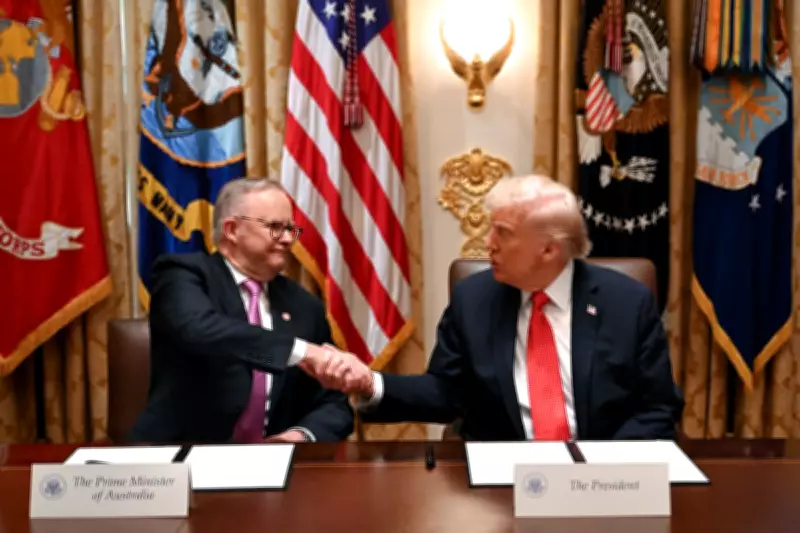
Australia's Foreign Policy at a Crossroads Amid US Election Uncertainty
As the United States approaches a pivotal election, Australia finds itself navigating a complex geopolitical landscape, with its longstanding alliance with the US under renewed scrutiny. The potential return of Donald Trump to the White House raises significant questions for Australian policymakers, who must balance strategic interests with diplomatic pragmatism.
The AUKUS Agreement and Its Strategic Implications
The AUKUS pact, a trilateral security partnership between Australia, the United Kingdom, and the United States, represents a cornerstone of Australia's defense strategy. This agreement, aimed at enhancing military cooperation and technology sharing, particularly in nuclear-powered submarines, underscores Australia's commitment to regional security in the Indo-Pacific. However, the stability of this arrangement could be tested by shifts in US political leadership.
Under a potential Trump administration, the focus on alliances might shift towards a more transactional approach, challenging the traditional norms of US foreign policy. Australia has historically relied on US support for its defense and economic interests, making any uncertainty in this relationship a matter of national concern.
Historical Context and Future Projections
Australia's alliance with the US dates back to World War II, evolving through conflicts like the Korean War and the War on Terror. This partnership has been characterized by mutual defense commitments and intelligence sharing, as seen in agreements like ANZUS. In recent years, the rise of China has further cemented the importance of this alliance for Australia's security posture.
Looking ahead, analysts suggest that Australia may need to diversify its diplomatic engagements, strengthening ties with other regional partners to mitigate risks. The country's foreign policy must adapt to potential changes in US priorities, which could include reduced involvement in international agreements or a reevaluation of defense spending.
Economic and Diplomatic Considerations
Beyond military aspects, the US-Australia alliance encompasses significant economic ties, with trade and investment flows supporting both economies. A shift in US policy under Trump could impact sectors like technology and resources, where collaboration has been robust. Australian leaders are urged to engage in proactive dialogue with US counterparts, regardless of election outcomes, to safeguard shared interests.
In conclusion, as Australia watches the US election unfold, the nation faces a critical juncture in its foreign policy. The enduring alliance with the US remains vital, but adaptability and strategic foresight will be key to navigating the uncertainties ahead. By fostering resilience in its international relationships, Australia can continue to play a pivotal role in global affairs.