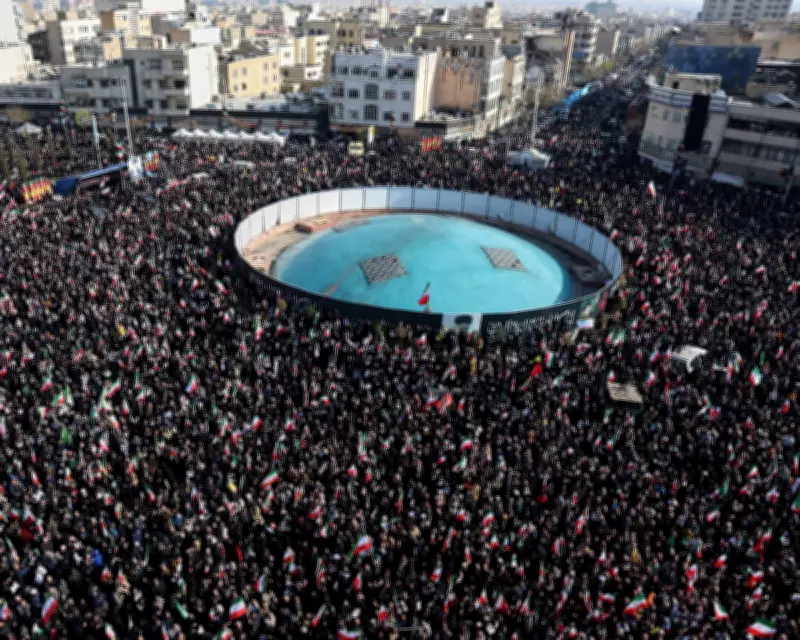
US and Israel Intensify Military Strikes Across Iran Amid Tehran Rally for New Supreme Leader
On Monday, US and Israeli warplanes launched fresh waves of strikes targeting locations across Iran, as thousands of supporters gathered in Tehran's Enghelab Square in a defiant show of allegiance to newly appointed Supreme Leader Ayatollah Mojtaba Khamenei. The conflict, now entering its second week, continues to escalate rapidly, with Iranian missile and drone attacks reported against Israel, US bases throughout the Middle East, and critical energy infrastructure in the Gulf region.
Regional Escalation and International Response
In Lebanon, Israel advanced its offensive against Hezbollah with ground raids in the south and airstrikes in Beirut, while a ballistic missile from Iran was intercepted over Turkish airspace. Drone strikes were also reported in Bahrain, the United Arab Emirates, and Saudi Arabia, prompting French President Emmanuel Macron to announce that France and its allies are preparing a defensive naval mission to the Gulf to safeguard oil supplies. Macron emphasized the goal of gradually reopening the Strait of Hormuz, a key shipping lane currently blocked due to Iranian attacks that have halted tanker traffic, carrying a fifth of the world's oil.
Tehran Rally and Defiant Rhetoric
During the rally in Tehran, crowds chanted "Death to America, Death to Israel" and waved Iranian flags alongside banners bearing the portrait of Ayatollah Ali Khamenei, the new leader's father, who was killed by an Israeli airstrike at the war's onset. Armoured vehicles and security personnel were deployed throughout the area. Hosseinali Eshkevari, a member of Iran's assembly of experts, declared, "The path of the martyred Imam Khamenei will carry on under the name of Khamenei." Analysts view Mojtaba Khamenei as a hardliner with close ties to the Revolutionary Guards, intensifying fears that the conflict could prolong for weeks or months, causing deep regional instability.
Economic and Humanitarian Impact
The ongoing violence has driven oil prices above $100 per barrel for the first time since 2022, leading to sharp declines in global stock markets. Iran's strategy appears aimed at restricting oil flow to force US concessions, but Gulf states have shown little willingness to yield. Kuwait's emir condemned Iranian strikes as "a brutal attack by a neighbouring Muslim country," while Saudi Arabia warned Tehran would be the "biggest loser" if attacks persist. In the UAE, authorities reported two injuries from shrapnel and detailed that 15 ballistic missiles and 18 drones were fired on Monday alone, with cumulative totals since the war began reaching 253 missiles and 1,440 drones, resulting in four foreign nationals killed and 117 wounded.
Humanitarian Crisis and Casualties
The conflict has inflicted severe humanitarian tolls, with at least 1,230 people killed in Iran, 397 in Lebanon, and 11 in Israel, according to official reports. Israel reported its first military deaths on Sunday, with two combat engineers killed in southern Lebanon. UNICEF regional director Edouard Beigbeder highlighted the displacement of nearly 700,000 people in Lebanon, including 200,000 children, who are now sheltering in cold and overcrowded conditions. In Bahrain, an attack on a residential area wounded 32 people, including children, and caused a fire at the country's only oil refinery, while desalination plants were also damaged, raising concerns over water supplies in arid regions.
As the war expands, Turkey intercepted a ballistic missile in its airspace, with President Tayyip Erdoğan stating Turkey's aim is to avoid being drawn into the conflict. The situation remains volatile, with no immediate signs of de-escalation from involved parties.