Life in Fragments: Tehran's Resilience Amidst Escalating Conflict
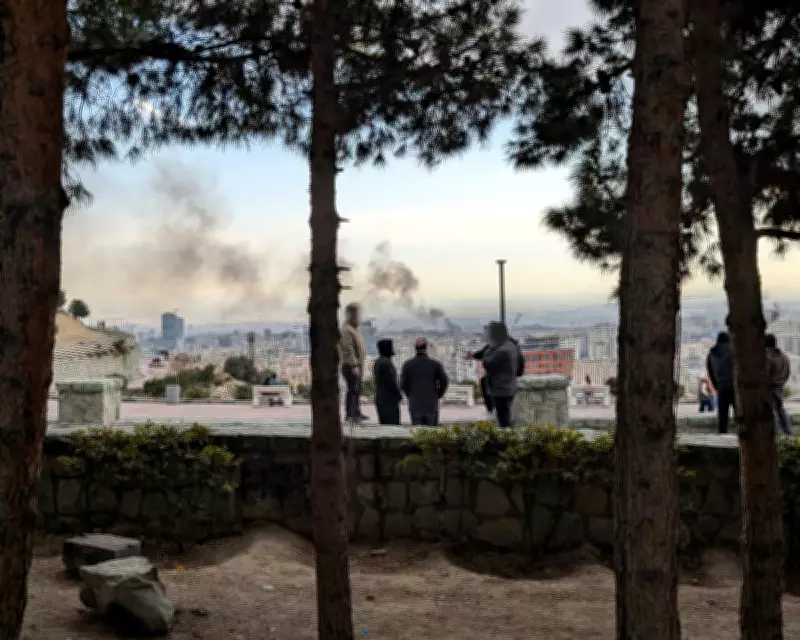
In a park overlooking Tehran, a group of young people gathered recently, chatting and joking amidst the distant rumblings of explosions. This scene, captured in a photograph supplied by the writer, encapsulates the paradoxical reality of life in Iran's capital as it faces renewed military aggression. The phrase "Don't die," uttered as a farewell, has become a stark mantra for survival in a city where normalcy is rapidly unraveling.
The New Normal of Urban Warfare
Last Saturday, a sudden blast disrupted the workday for many Tehran residents, including the author, who rushed to pick up their child from school. The metro carriage was filled with anxious commuters, their faces etched with melancholy as they called loved ones and scrolled through news updates on their phones. This marks the second time within a year that Israel has initiated a war of choice with Iran, signaling a disturbing shift in regional dynamics. Israel's historical impunity in harassing Palestinians now appears to extend to broader aggression, with strikes targeting schools, hospitals, police stations, and urban amenities indiscriminately. The pretence of precision has vanished, replaced by a demolition-focused might aimed at flattening the city.
The concept of "Beirutification" emerges as a chilling descriptor for this phenomenon—the slow normalization of periodic attacks by a capricious state, weaving blasts and death into the urban fabric. This process suffocates imagination, thwarts civil progress, and leads to gradual national dilapidation, mirroring Beirut's fate after years of conflict. Now, Tehran faces a similar unfolding tragedy, with residents trapped at home or fleeing the capital as explosions become routine.
Fragments of Life in a Thinning City
Despite the exodus and fear, fragments of life persist in Tehran's thinning urban landscape. In parks, shopping centers, and small gathering spaces, people continue to connect, seeking solace in community. The author's encounter with youngsters in a park highlights this resilience; their banter and humor, born from suffering, offer a temporary reprieve from anxiety. This ability to find laughter in misery is a testament to Iranian cultural endurance, even as the war, once perceived as a distant "Arabic" phenomenon, becomes terrifyingly real.
The aftermath of an Israel-US strike on a police station in Tehran, documented by Reuters photographer Majid Khahi, underscores the brutality of these attacks. Yet, in the face of such devastation, the simple plea "Don't die" resonates with brutal honesty, encapsulating the daily conundrum of survival. The author emphasizes that this story is not a call for pity or to fuel European sympathy, rejecting the victim narrative and critiques of so-called "humanitarian wars" that have justified interventions in Iraq, Afghanistan, and Libya—often at the cost of ordinary lives.
Criticism and Hope in a Darker Era
As a long-time critic of the Iranian state, the author clarifies that opposing one's government does not equate to welcoming societal destruction. Across borders, many envision an order free from imperialism and grounded in peace. The current era may see diplomacy receding and bullets replacing words, but there is a growing awareness of the war machinery and its accompanying democracy-making industry. Hope lies in those who refuse to accept endless conflict as inevitable, challenging the narratives that brand dissenters as "regime supporters" or "terrorist sympathizers."
In conclusion, Tehran's experience reflects a broader crisis in the Middle East, where urban life is fragmented by violence yet sustained by human connection. As the conflict escalates, the resilience of its people offers a glimmer of possibility amidst the darkness, urging a reevaluation of war's justifications and a pursuit of genuine peace.