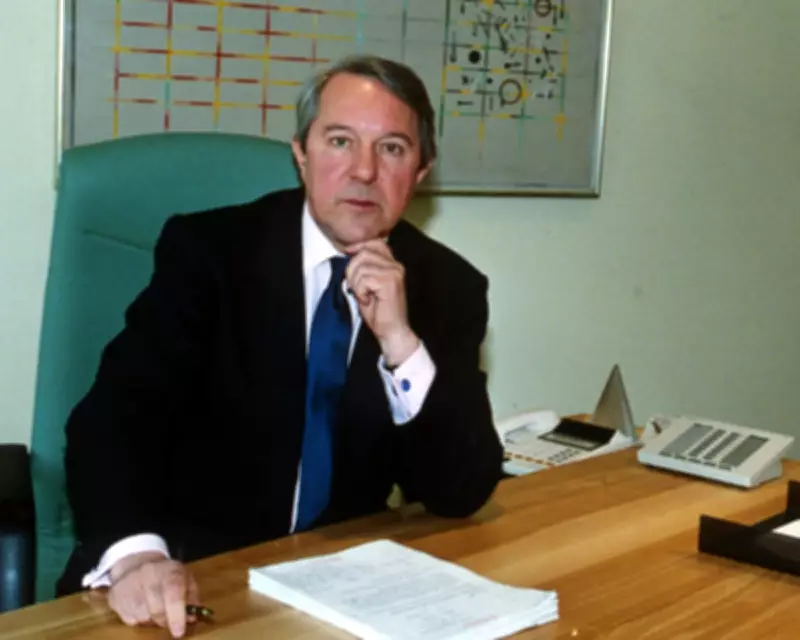
Sir Hayden Phillips: The Mandarin's Mandarin Who Shaped Modern Britain
Sir Hayden Phillips, the senior civil servant renowned as the 'mandarin's mandarin,' has passed away at the age of 83. His remarkable career spanned over three decades, during which he tackled some of the most complex challenges in British governance, from managing the aftermath of Princess Diana's death to establishing the National Lottery.
A Master of Diplomacy and Compromise
Phillips was celebrated for his exceptional ability to forge friendships across a vast array of interests, making him highly sought after beyond the confines of Whitehall. He served as chair of the National Theatre for six years, from 2004 to 2010, and held numerous other prestigious roles, including charities consultant to the then Prince of Wales and a lifelong involvement with Salisbury Cathedral.
His career began in the civil service fast track in 1967, and he quickly rose through the ranks, holding key positions in the Home Office, the Cabinet Office, the Treasury, and at the European Commission. One of his most significant professional relationships was with Roy Jenkins, the home secretary, which began in 1974 during a period dominated by IRA terrorism. This friendship endured throughout his life and significantly influenced his career trajectory.

Key Achievements and Controversial Decisions
In 1992, Phillips took on the role of permanent secretary for what initially was the Department for National Heritage, later becoming the Department for Culture, Media and Sport under the Blair government. This position required him to integrate fragments from various departments, a task that demanded his renowned sinuous negotiating skills. During his tenure, he oversaw the creation of the National Lottery in 1994, ensuring that its funds were protected from being used as a substitute for government grants.
His time in this role also included managing high-profile events such as the fire at Windsor Castle in 1992 and the death of Princess Diana in 1997. In the latter case, his department had to make critical decisions about crowd management and the handling of floral tributes that posed a fire hazard, ultimately resolving the issue by composting the flowers and donating soft toys to children's charities.
Constitutional Reforms and Legacy
In 1998, Phillips missed out on the top job of cabinet secretary but later moved to the Lord Chancellor's Department, where he played a pivotal role in a tumultuous period of constitutional change. Despite having no legal background, he oversaw the abolition of the right of hereditary peers to sit in the House of Lords and designed the arcane electoral system for their replacement, a testament to his capacity for finding compromises.
He worked closely with Lord Chancellor Charlie Falconer, serving as a human shield against judicial opposition to radical reforms. In his memoir, Boy on a Bicycle (2023), Phillips expressed concerns that Downing Street failed to grasp the impact of these changes, some of which, like the formal abolition of the lord chancellor, had to be reworked. He retired in July 2004 after extending his service to ensure the reforms were properly implemented.
Personal Life and Passions
Born in Luton on February 9, 1943, Phillips was the first child of Gerald and Dorothy Phillips. He benefited from postwar educational opportunities, attending Clare College as a chorister and later as a scholar, and earning a master's degree at Yale on a Mellon fellowship. An enthusiastic amateur actor, he had a cameo role in the 2021 Bond film No Time to Die and played Sir Humphrey in a charity review based on Yes Minister.
He married twice, first to Ann Watkins in 1967, with whom he had two children, and then to Laura Grenfell in 1980, with whom he had three children. From 1997, the family lived on a farm near Salisbury, where Phillips enjoyed rearing pigs and driving tractors. He was a proud and devoted father, survived by Laura and his five children.
Sir Hayden Phillips' legacy is one of unwavering loyalty, diplomatic skill, and a profound impact on British public life, from cultural institutions to constitutional frameworks. His ability to navigate the corridors of power with charm and effectiveness ensured his place as one of the most influential civil servants of his generation.