Cubans Self-Medicate as Crisis Takes Toll on Mental Health: ‘There Is No Idea to Hold On To’
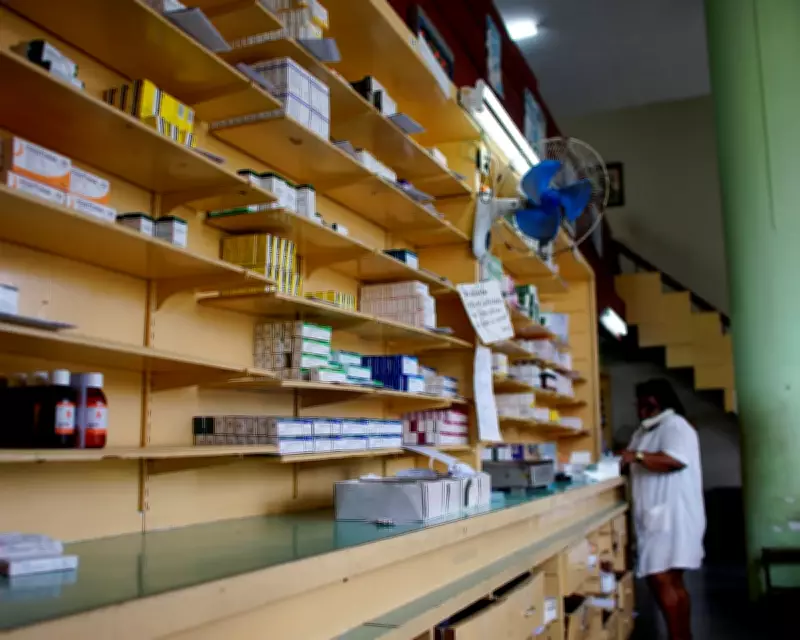
An employee talks on the phone inside a pharmacy in Havana, Cuba, a scene that has become emblematic of the island's growing reliance on self-medication amid a profound mental health crisis. Many Cubans are turning to prescription drugs, herbal remedies, and even hard drugs as the outlook feels bleaker than the collapse of the Soviet Union, driven by economic decline and US sanctions.
Returning to Care, Facing Strain
Cris Sánchez believed he had left Cuba for good when he moved to London in 1994, but concerns for his ailing parents brought him back in 2018. Since then, the strain of life in Havana has caused him to turn to prescription drugs, stating, "Just to take the edge off things." He is not alone. Currently under a US-imposed oil blockade and following years of economic decline, Cubans are self-administering regulated drugs in growing numbers as a mental health crisis envelops the island.
There are few official statistics, as the Cuban government emphasizes its people's "resilience," but healthcare professionals across the island report that most families include at least one member turning to the black market to buy antidepressants, mood stabilizers, or stimulants. Sánchez, who trained as a linguist and taught at University College London, noted his mother's penchant for prescription drugs due to Alzheimer's, and he worked to help her break the habit, only to find himself using antidepressants. He is not an addict but highlights how easy it is to slip into regular use, expressing dissatisfaction with life in Cuba compared to his time in London.
Economic Stress and Psychological Impact
A reliance on prescription medication is not new in Cuba, but recent events have led to a surge. A professor of psychology in Santiago, who requested anonymity, explained, "We are experiencing an economic situation that has repercussions whether we like it or not. On a daily basis, someone might wake up without electricity, without the certainty of breakfast, or without knowing how they will get to work. This generates a great deal of stress, accompanied by numerous psychological manifestations: depression, intense anxiety, and mental fatigue. As a result, mental health issues have increased tremendously."
A senior aid worker in Havana confirmed witnessing this daily. Following US tariffs on fuel supplies to Cuba, blackouts have worsened, petrol stations are shuttered, and transport is scarce. Most state offices, employing 50% of the workforce, are closed, leaving people focused on survival and an uncertain future. President Miguel Díaz-Canel recently told foreign supporters, including former UK Labour leader Jeremy Corbyn, that Cubans prefer to "die standing than living on their knees," but many struggle to get out of bed.
Black Market and Historical Context
With Cuba's GDP contracting by 17% since 2019 and state pharmacies empty, people seek relief on the black market. The psychology professor noted an increase in psychotropic medication consumption without prescriptions, often delivered via electric bikes from packages with Cyrillic, Indian, or Chinese script, but at a high cost. This reliance dates back to the early 1990s when the Soviet Union collapsed, a period known as the "Special period in the time of peace," which saw the economy contract by at least 35%. During that time, doctors prescribed freely, and state pharmacies provided, with some suggesting the government encouraged psychoactive drug use to keep people calm.
When tourism and Venezuelan support eased the situation, drug use receded, but hopes were extinguished by stalled economic reforms, US maximum pressure policies under Donald Trump, Covid-19, hyperinflation, and protests in 2021. Up to 20% of the population has fled in the last five years, adding to the psychological load on those remaining. Stress manifests in hair loss and concentration issues, with the professor noting tasks taking much longer than before.
Regional Variations and Illicit Trends
In rural areas, high costs drive reliance on herbal remedies like mint, chamomile, and lemongrass infusions, as reported by Rosangela Reyes in El Cobre. In cities, especially among youth, there is a swing towards illicit drugs like "el químico," a synthetic cannabinoid, which the government blames on the US. However, most users turn to benzodiazepines or antidepressants like Xanax and sertraline.
Cuba's wealth disparities are now stark, with revolutionary-era pensions under $10 a month while private business owners drive Mercedes. Gabriel Menéndez, a teacher in Santa Clara, finds this crisis harder than the special period, stating, "This time there is no idea to hold on to, only the need to accept the cruel reality of what is coming." Many elderly are lonely, with children and grandchildren abroad, exacerbating their mental health struggles.
Uncertain Future and Ongoing Struggle
The psychology professor emphasized that uncertainty aggravates the crisis, saying, "If you know a problem will last seven days, you might think, 'I can handle it.' But we are living through a situation where the end is unknown." As Cubans grapple with economic hardship and mental health challenges, self-medication remains a coping mechanism in a nation where resilience is tested daily.