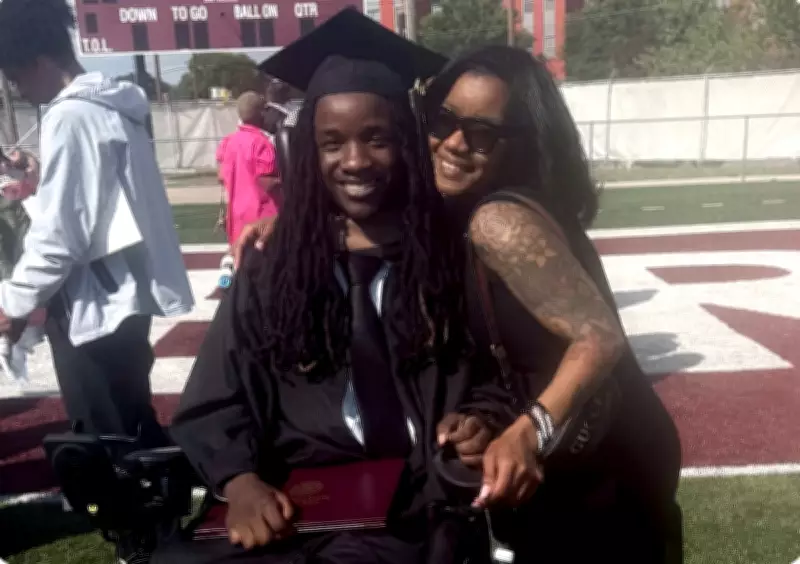
Jaiden Picot, who was paralyzed in 2024 after a truck hit him, never imagined that video of him recently walking across Virginia Union University's graduation stage in a futuristic robotic suit would go viral. But since it did, he says he wants the world to know that he intends to spend his professional career trying to help make the place more accessible to people who – like him – use a wheelchair to get around.
A Life Changed in an Instant
Picot, 23 and a native of Portsmouth, Virginia, was riding an electric scooter in August 2024 when a cargo truck struck him. The impact inflicted a spinal cord injury at Picot's fourth cervical vertebra, paralyzing him from the chest down. He didn't mince words when discussing the nature of the injury that has forced him to live with paraplegia. "My life has been so hard ever since that day," Picot said. Recalling daily workouts and frequent social excursions, he added, "I was an independent person before my accident."
Rehabilitation and Determination
Picot committed himself to gaining back as much of that independence. He began participating in rehabilitation at Sheltering Arms Institute in Richmond, Virginia, practicing self-care tasks, walking inside what are known as robotic exoskeletons, and driving his power wheelchair, as his caretakers there recounted in a December 2024 news release. He also began mastering voice-controlled devices to operate his television; set alarms and reminders; and play music, games or sleep sounds in his room at the institute. Meanwhile, Picot completed his bachelor's degree at VUU in Richmond on time in the spring of 2025. He immediately embarked on his graduate studies and earned an executive master's in business administration.
The Viral Graduation Moment
Picot's mother, his girlfriend and two of his rehabilitation therapists were among his supporters at his commencement ceremony on 9 May. In a moment from the graduation that achieved digital virality, Picot donned one of the robotic exoskeletons with which he had trained walking at Sheltering Arms Institute. And with his two therapists aiding him, Picot strolled across the ceremonial stage to get his degree, with the exoskeleton responding essentially to his swaying, as he put it. "Oh, wow – I did it," he told a cheering audience while on the stage. "My life – it took a really, really big turn. I could have easily put myself in a closet, gave up on life, but I decided not to let my situation control and stop me from achieving my goals." Picot later invoked the name of a sci-fi film franchise about battling robot factions to explain the exoskeleton, saying, "I like to call it a big Transformers suit."
Widespread Support and Recognition
Video of Picot's stage walk and the wild applause it merited spread quickly on social media as well as across news platforms. A reaction that was typical of the dialogue inspired by the footage of Picot and news coverage of his story came in an X post from nationally renowned civil rights attorney Ben Crump, who wrote in part: "POWERFUL resilience in the face of adversity!" A statement from VUU – a historically Black university – concurrently hailed Picot as "a testament to what is possible when purpose meets preparation."
Ongoing Challenges and Advocacy
Yet none of that is to say Picot has been spared significant impediments as he adjusted to life among the estimated 300,000 or so people in the US who are living with traumatic spinal cord injuries, the vast majority of which result in paraplegia or quadriplegia. Though the federal Americans With Disabilities Act has required reasonable accessibility accommodations for businesses serving the public since 1990, Picot described how calling ahead to restaurants and event venues to ensure there is a ramp and enough space for his wheelchair has been a fact of life. He said he had been unable to attend gatherings at places where there is neither. Picot said he had learned "it's plenty" where that is the case. Picot and his family furthermore have been soliciting financial support online for an accessible van that they say would make it easier and safer for him to get to and from his daily activities and commitments.
Future Goals
Asked what he envisions for his budding professional career, Picot said he wants to combine pursuing a name for himself in real estate with alleviating at least some of the accessibility problems which he has encountered. He said he planned to seek meetings with his state's civic leaders over the issue to get started. "I'm trying to reach for the stars and help us get to a point where every place has some type of accommodation for wheelchair-using people," Picot remarked. "I'm mentally ready to reach my goals and also advocate for people like myself."