
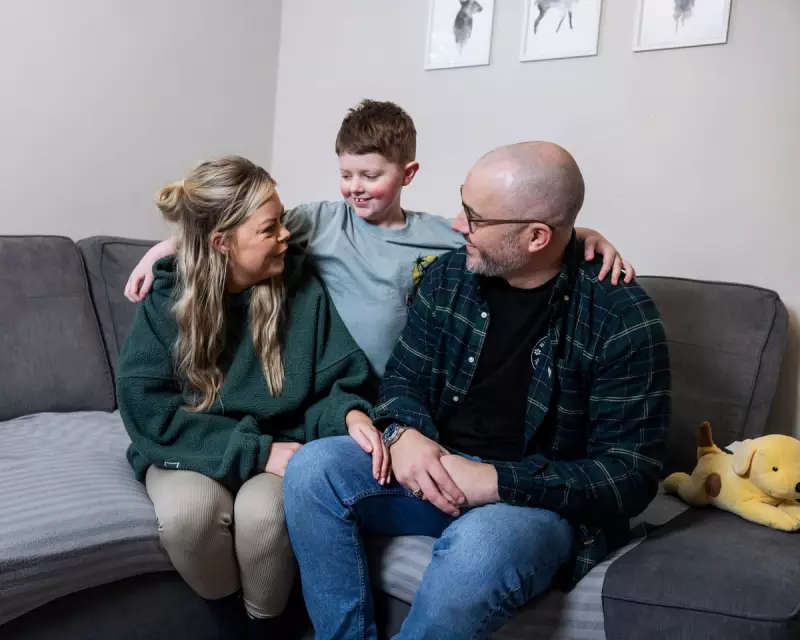
When Alison Gaffney and Andy Hinde received the devastating news that their 17-month-old son Fraser had a rare form of leukaemia in 2018, their world turned upside down. What followed was two years of gruelling treatment including chemotherapy, radiotherapy, immunotherapy and ultimately a stem cell transplant.
A Mother's Search for Answers
After Fraser made what his family describes as a "miraculous recovery" from the surgery and doctors declared the cancer in remission, Gaffney began her quest for answers. The 36-year-old mother couldn't forget comments made by hospital staff at the time of her son's diagnosis.
"It keeps us up at night wondering how Fraser got his cancer," a consultant had told her, planting the seed that would grow into a full-scale campaign for truth.
Gaffney's mind turned to Corby's industrial history, specifically the botched disposal of millions of tonnes of contaminated waste after the closure of Europe's largest steelworks in 1979. This wasn't just speculation - a 2009 civil case had already linked the council's negligent clean-up of the site to birth defects in local children during the 1980s and 1990s.
Building a Campaign for Justice
"[Fraser's cancer is] not genetic," Gaffney stated firmly. "So what are the reasons? ... It's got to be down to the town. All these kids [with] cancer. Everybody in this town knows somebody who's got a child [with] cancer. That's not normal."
Gaffney and Hinde began connecting with other Corby families facing similar battles, including some of Gaffney's former classmates from Brooke Weston Academy. Together, they started compiling detailed records of those affected, eventually forming a campaign representing approximately 130 families with cases of childhood cancer dating back to 1988.
The group has been pressing the local authority to investigate potential links between childhood cancer cases in Corby and the decommissioning of the steel plant. At the end of this month, public health officials are scheduled to publish their analysis examining whether the town of 70,000 people has experienced a disproportionate number of childhood cancer cases.
Historic Contamination and New Investigations
The 2009 civil judgment confirmed that between 1983 and 1997, millions of tonnes of contaminated materials from the steel plant were transported "almost invariably" from southern Corby to Deene Quarry in the north. The operation saw "large quantities" of toxic waste carried and dropped on public roads, creating "substantial quantities" of dust.
However, Gaffney believes waste was dumped at multiple locations beyond Deene Quarry. In a significant development, North Northamptonshire council recently agreed to test potentially contaminated land and investigate where toxic waste was actually dumped.
Gaffney described a revealing meeting with council staff who admitted: "We don't know where these sites are. We have no documentation, we have nothing on it."
The council has since stated they're "thoroughly reviewing historic records" to determine if disposal occurred elsewhere, acknowledging this work "will take time."
Personal Stories Behind the Statistics
The campaign has brought together numerous families affected by childhood cancer in Corby. Tonia Shalgosky, a pastoral lead at a primary school, welcomed the council's investigation after her nine-year-old daughter Bella was diagnosed with blood cancer in June this year.
"I had to shave my nine-year-old daughter's head because her hair was falling out from the drugs she had to take to kill her cancer," Shalgosky shared. "So actually it's in our interest, it's in Bella's interest [for the council] to share that information."
Meg Lyons, whose 11-year-old sister Eve died in June 2017 after being diagnosed with a rare bone cancer at age nine, emphasised the need for "complete and utter truth and transparency" from the council.
Lyons recalled her mother's memories of the steel plant closure: "She said you couldn't put your hand in front of your face because [of] the red ash."
Whistleblowers and Legal Support
The campaign group has received information from whistleblowers involved in the original waste dumping operations, including Gaffney's own father.
"He drove the lorry and dumped [the waste in a] pond," Gaffney revealed. "At the time, everyone had lost their jobs so everyone took on any job that you could. He wasn't even licensed to drive a lorry."
Des Collins, the lawyer who represented families in the 2009 civil claim, is now supporting Gaffney and the cancer families. He argues that only a statutory public inquiry can ensure the full truth emerges.
"Environmental testing, in order to rule out causation, is a highly complex process requiring stringent parameters and oversight to allow for reliance on its findings," Collins explained.
Moving Forward Together
Council leader Martin Griffiths described the meeting with Gaffney and Hinde as "the start of the parties' commitment to work together in an open, positive and constructive way for the benefit of Corby residents."
The council has committed to full transparency and will establish a working group including Gaffney to examine public health and contamination issues in Corby.
For Gaffney and the 130 families she represents, the fight continues. "Now, every family that comes through, I'm listening to their stories and it's so hard. If anything, it just gives us that further fight," she said.
"Each time it just chips away and then makes your fight stronger, because you're thinking: 'We've got to find answers for these children.'"




