
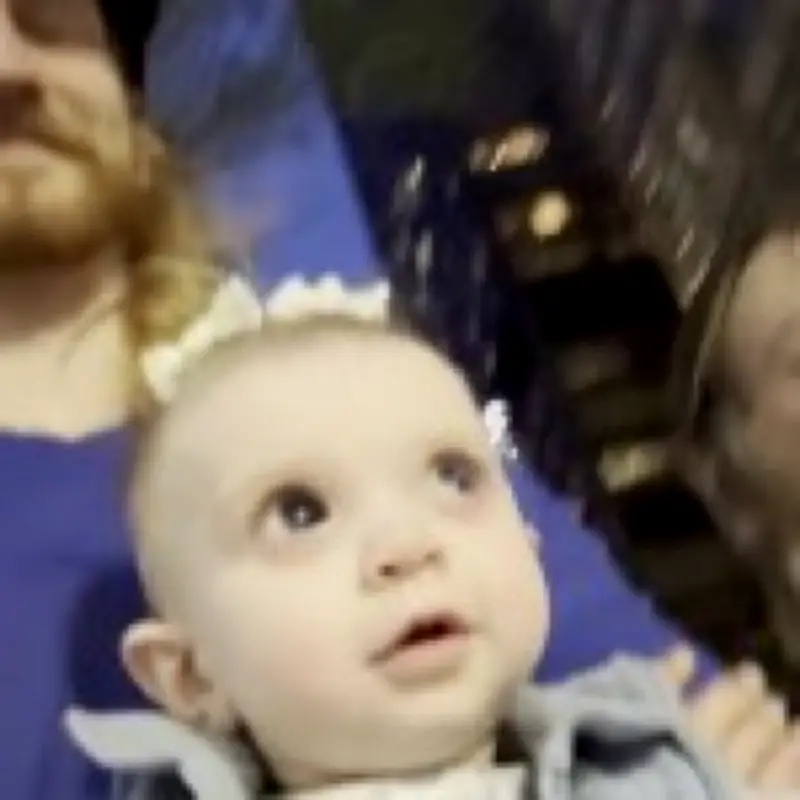
Violet Paul, a one-year-old girl from the Midwest, has experienced a medical miracle: after undergoing eye surgery at just two weeks old, she has seen city lights for the first time. Born with a rare FOXC1 gene mutation that left her without irises, Violet’s world was initially one of darkness and extreme light sensitivity.
A Rare Condition and a Determined Family
Violet’s condition, known as Aniridia, affects approximately one in 50,000 people, according to Sight Research UK. The absence of irises means her pupils cannot regulate light properly, causing her eyes to be completely black and overly sensitive. Additionally, Violet was born with congenital glaucoma, a condition where high pressure damages the optic nerve, clouding her corneas even before birth.
Her parents, Madison Mitchell, 24, and Steven Paul, 30, faced grim predictions from doctors, who said Violet would be fortunate to see a ceiling light. Determined to help, they sought treatment at the University of Iowa, where Violet underwent trabeculectomy surgery, a procedure typically used for glaucoma patients to drain fluid from the eye.
A Nighttime Stroll That Changed Everything
The surgery was a success, gradually introducing Violet to a world of light. To celebrate, the family took her on a nighttime stroll through St. Louis, Missouri, on April 6. In a video posted to Madison’s TikTok, Violet can be seen gazing upward, smiling, and kicking her feet in joy as her father carries her under the glow of streetlights.
Madison described the moment as overwhelming: “She was so happy and awestruck that she began kicking her feet, squealing happily, smiling, and shaking her head out of happiness. It’s a moment Violet’s father and I will cherish forever.” She added, “It was such a reassuring moment where we both knew as her parents that we were doing right by our daughter in trusting her team of doctors and making sure to follow her treatment plan.”
Milestones: From Fireworks to a First Birthday
Violet’s progress has been remarkable. She celebrated her first birthday on July 4, watching a fireworks display—something doctors thought she would never see. Madison shared the emotional experience on TikTok: “It was hard not to get emotional watching Violet be enamoured by fireworks. Knowing that she is truly seeing them brings me unexplainable joy. Being Violet’s mom has made me appreciate all of life’s joy more than I ever did before.”
Her glaucoma has been under control since her first and only surgery, and her vision is the best it can be without irises. Madison noted, “Her doctors have told us that it’s not often they get to be surprised in this way with their patients.”
Understanding FOXC1 and Its Implications
FOXC1 is a gene that researchers have linked to numerous eye-related conditions. Mfazo Hove, a consultant surgeon in ophthalmology at Blue Fin Vision, explained, “When FOXC1 does not function normally, the front of the eye may not develop as it should before birth. Some children are born with abnormalities of the iris or the eye’s drainage channels.”
Hove emphasized the primary concern: “The biggest concern is glaucoma because, if the drainage system is underdeveloped, pressure inside the eye can rise and gradually damage the optic nerve.” He also noted that FOXC1 can cause photophobia, reduced vision, and glare, but added, “The good news is that with regular monitoring, modern glaucoma treatments and appropriate visual rehabilitation, many people retain useful vision throughout their lives.”
Madison continues to share Violet’s story on social media to raise awareness about Aniridia and congenital glaucoma, hoping to inspire other families facing similar challenges. “We are forever grateful to be raising a living miracle and will never stop sharing her story,” she said.




