
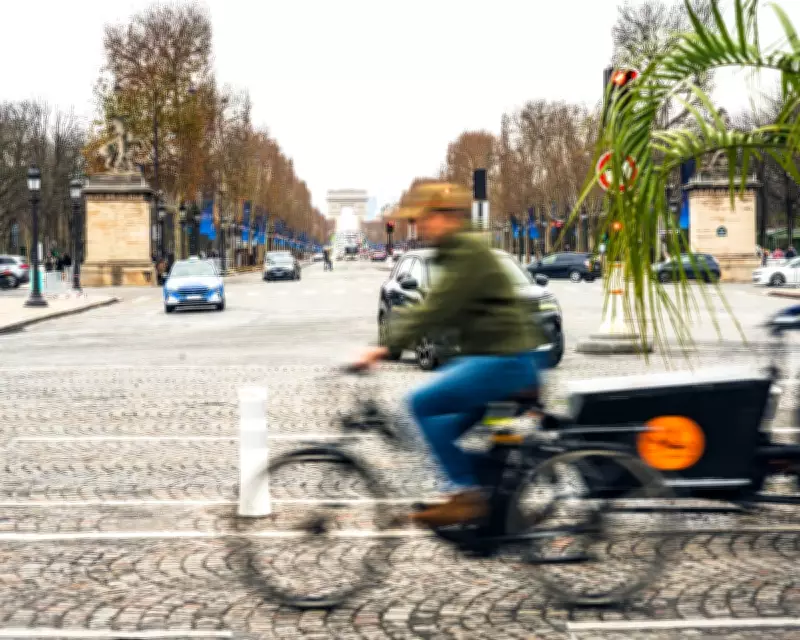
Paris Undergoes Radical Shift from Car Dominance to Cycling Culture
Paris has fundamentally transformed its urban landscape over the past decade, shedding its long-standing reputation as a car-centric metropolis while making significant strides in improving air quality. Under the leadership of outgoing Mayor Anne Hidalgo, who served from 2014 to 2024, the French capital has implemented sweeping changes that have redefined how residents and visitors navigate the city.
The Personal Impact of Infrastructure Changes
Corentin Roudaut, an IT developer who moved to Paris ten years ago, initially found the city too intimidating for cycling despite being an avid cyclist during his student years in Rennes. "Cars were everywhere," Roudaut recalled. "Cyclists had almost no protection." This changed dramatically when authorities installed segregated bike lanes on Boulevard Voltaire near his home in the 11th arrondissement. Roudaut now volunteers with Paris en Selle, a cycling advocacy group, and has witnessed the city's remarkable evolution firsthand.
"It was a process that started slow and really accelerated in the last 10 years," Roudaut observed. "At least in some parts of the city, we have a cycle network that is starting to be safe and pretty much complete."
Hidalgo's Comprehensive Urban Transformation
During her twelve-year tenure, Mayor Hidalgo implemented an ambitious agenda that included:
- Adding several hundred kilometers of protected bike lanes throughout the city
- Pedestrianizing 300 school streets to enhance child safety
- Banning cars from the historic banks of the Seine River
- Converting thousands of parking spaces into green areas and café terraces
- Planting 155,000 trees to improve urban biodiversity and air quality
These changes have fundamentally altered daily life in Paris, with fewer parents fearing for their children's safety during school commutes and more residents embracing active transportation options.
Political Resistance and Public Response
Despite the progress, Hidalgo's policies faced significant opposition. Motorists protested the reduction of car space, while referendums on measures like increased parking fees for SUVs and additional school street pedestrianizations saw troublingly low voter turnout. Rachida Dati, the mayoral candidate for the rightwing Les Républicains, criticized what she called "anxiety-inducing" chaos in public spaces during the recent municipal elections, though she stopped short of proposing to reverse central policies.
In a recent interview, Hidalgo reflected on her tenure, noting that pedestrianizing the Seine riverbanks had been "a tough battle" but that public sentiment had shifted. "Today there are generations of children who have not known cars there," she said. "People say 'wow!' when you tell them."
Comparative Analysis with Other European Cities
Paris is one of nineteen global cities that achieved remarkable reductions in toxic air pollutants between 2010 and 2024, according to recent research. However, the city's progress must be viewed in context. Fine-particle pollution decreased more rapidly in Brussels and Warsaw during the same period, while nitrogen dioxide levels fell faster in London. Berlin, despite recent decisions to expand motorways and remove speed limits on certain streets, still maintains a higher percentage of cyclists than Paris.
Transport researcher Giulio Mattioli from the Technical University of Dortmund, who previously lived in Paris, offered perspective: "The conditions were there already, you just needed to make some bike lanes and people would use them." He suggested Paris had caught up with other cities from a lower starting point rather than becoming exceptional.
Structural Advantages and Remaining Challenges
Experts note that Paris benefited from unusually tight administrative boundaries that gave commuter suburbs less influence over transport policies compared to other capitals. This structural advantage, combined with groundwork laid by previous mayors, facilitated the transition. However, significant challenges remain, particularly regarding the city's relationship with its extensive suburbs.
While central Paris has embraced the "15-minute city" concept—where residents can access most amenities within a short walk or bike ride—the suburbs remain dominated by cars and separated by the busy Boulevard Périphérique ring road. Jean-Louis Missika, a former deputy mayor who served under Hidalgo and her predecessor, emphasized in analysis for thinktank Terra Nova that transforming this 35-kilometer motorway is essential for creating a truly post-car metropolis.
"As long as this 35km motorway continues to encircle Paris," Missika wrote, "the Greater Paris metropolis will remain a figment of the imagination, an administrative construct devoid of urban reality. Because a metropolis cannot be built by erecting walls between its inhabitants."
Broader European Context and Future Implications
Paris's transformation occurs against a complex European backdrop. While many cities experienced cycling booms and infrastructure improvements during the COVID-19 pandemic, recent political shifts to the right and the emergence of conspiracy theories targeting concepts like 15-minute cities have created setbacks elsewhere.
Environmental epidemiologist Audrey de Nazelle, who grew up in Paris and now works at Imperial College London, remembers when cycling was so rare that encountering another cyclist was an occasion to stop for coffee. She praised the changes as "fabulous" while noting that "what's missing in the rest of the world is courage."
"Mayors could say: 'This is my opportunity to leave a legacy,'" de Nazelle observed, "but most will not dare."
As Hidalgo leaves office, her urban transformation stands as both an inspiration and a case study for cities worldwide grappling with similar challenges of sustainability, mobility, and quality of life in increasingly dense urban environments.



