
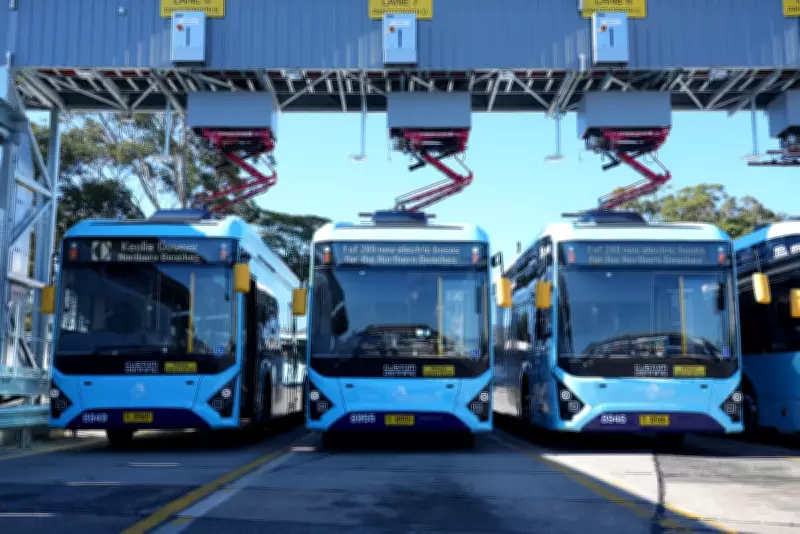
Australia Urged to Swap Diesel for Electric Buses as Fuel Costs Soar
As diesel prices climb past $3 per liter amid growing fuel security concerns, transport advocates are intensifying calls for Australia to prioritize the rollout of electric buses. Currently, just 1% of Australia's bus fleet is electric, a stark contrast to 80% in urban China, a quarter in the Netherlands, and 12% in the United Kingdom.
While metro trams and trains in Australia predominantly run on electricity, buses—a core component of the public transport system—remain heavily reliant on diesel, consuming approximately 530 million liters annually. This dependency highlights a critical gap in the nation's transition to sustainable transport.
Fuel Security and Social Equity at Stake
The Bus Industry Confederation, a key industry body, is advocating for buses to be prioritized in fuel security planning. Varenya Mohan‑Ram, the confederation's executive director, emphasized that fuel security extends beyond operational matters to issues of social equity and community resilience.
"Buses carry more than half of Australia's public transport passengers," Mohan‑Ram stated. "We're taking kids to school, we're getting people to work, and we are the lifeblood of regional Australia in keeping people connected. We just don't have enough electric buses to carry Australians every day."
Government data reveals that in 2025, nearly 42,800 diesel buses were registered in Australia, compared to only 629 battery-electric buses, accounting for about 1% of the heavy bus fleet.
State and Territory Transition Targets
Most Australian states and territories have established targets to transition their bus fleets to electric. For instance, Canberra and greater Sydney aim to achieve fully electric fleets by 2040. The Australian Capital Territory (ACT) is already leading with electric buses making up approximately 24% of its fleet.
Chris Steel, the ACT transport minister, highlighted the benefits: "Each electric bus is powered by 100% renewable electricity produced in Australia, they are cheaper to operate and not reliant on foreign fuels."
Other regions are making progress as well:
- South Australia will have 81 electric buses this year, representing about 8% of its fleet.
- Western Australia has rolled out its 100th electric bus.
- Victoria mandates that all new bus purchases be electric.
Environmental and Health Benefits
Cameron Rimington, a senior policy officer at the Electric Vehicle Council, noted that electric buses are the most impactful way to cut emissions from public transport. "The benefits of electric buses aren't contained to carbon emissions," he explained. "Every bus running on Australian-made electricity is a bus that isn't dependent on the Strait of Hormuz, isn't spewing exhaust into our communities, isn't contributing to lung cancer or childhood asthma, and they're so much quieter—for commuters and communities alike."
Helen Rowe, the transport lead at Climateworks Centre, added that buses running on electricity offer resilience against fuel shocks, making public transport a more reliable critical service.
Infrastructure and Regional Initiatives
Beyond purchasing vehicles, governments must plan for charging infrastructure. In Victoria, bus company Kinetic recently opened a purpose-built depot with overhead charging infrastructure in Preston, Melbourne's north. New South Wales has completed the first of 11 planned electric depot conversions.
Prof Jago Dodson from RMIT University pointed out that Australia has been slower than other countries in adopting electric buses, but the current crisis could shift the cost-benefit calculation. "From a simple security point of view, there's probably a premium to be paid—to know that no matter what happens outside of Australia, we can still run our bus fleets on electricity," he said.
Dodson also emphasized the flexibility of buses, which can fill gaps between fixed-line services and be rolled out quickly to improve coverage in underserved areas. "It's hard to roll out a rail line quickly," he noted.
Community Advocacy and Pilot Programs
In Melbourne's west, communities have long campaigned for better bus access, seeking to convert winding routes into efficient grids. Elyse Cunningham, sustainable cities community organiser at Friends of the Earth Melbourne, stated: "We know the government needs to make public transport more accessible as fuel prices go up. Buses are the fastest and the cheapest public transport solution that the government can provide."
A community-run electric bus pilot in Gippsland, Victoria, demonstrates potential even in regional areas. Since 2024, two mini e-buses, nicknamed Sandy and Sunny, have provided inclusive local transport, reducing social isolation. Dr. Magda Szypielewicz from La Trobe University noted that this volunteer-run service has improved wellbeing for hundreds of passengers.
Dodson concluded that the fuel crisis adds impetus for change, underscoring the need to transition to zero-carbon transport. "Let's hope that we can learn some lessons from this time around," he said. "Actually use this to recognise that we do need to change and that the security of our transport systems is a core national security question."



