Australia's Recycling Dilemma: Can More Bins Match Japan's 40 Categories?
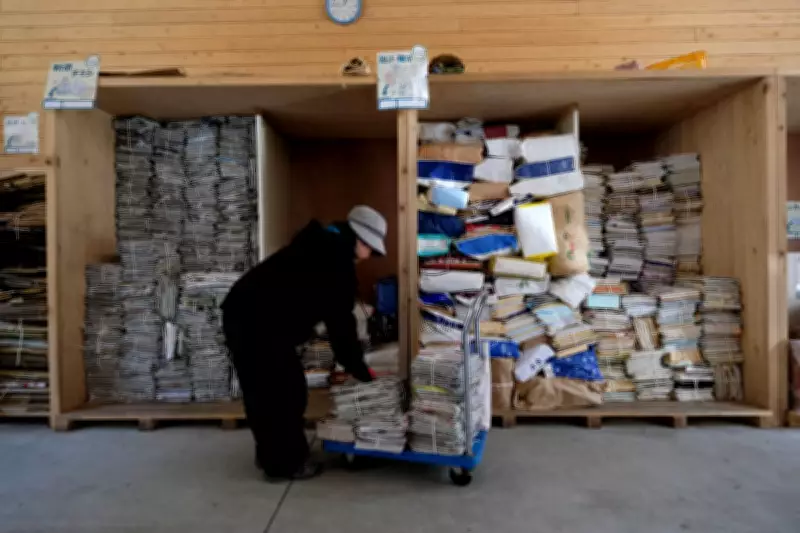
In the Japanese town of Kamikatsu, residents meticulously sort their waste into 40 distinct categories at a local recycling center, achieving an impressive 80% recycling rate. This system includes specialized bins for items like toothbrushes, wooden chopsticks, and mercury thermometers, with reusable goods available at a community shop. While this approach may seem extreme, it highlights a global contrast as Australian households, particularly in Victoria, adapt to sorting waste into four kerbside bins—the highest number in the country.
Global Comparisons: From Germany to Wales
Australia's recycling rate for municipal solid waste remains stagnant at 44%, significantly lower than Japan's 79% and Germany's 69%. In Germany, households separate waste into five main streams: organic materials, paper and cardboard, colored glass, metal and plastic, and residual waste. This is complemented by a highly effective deposit return system for drink containers, achieving a 98% return rate. Similarly, Wales has seen its recycling rate soar from 5% in 1999 to 68% in 2025, with some homes using up to 10 separate bins as part of a zero-waste goal by 2050.
Kerbside wheelie bins have been a fixture in Australia since the 1980s, with additions like yellow lids for commingled recycling, green for organics, purple for glass in Victoria, and blue for paper and cardboard in select councils. Annually, local governments collect approximately 9.9 million tonnes of waste through these bins, including 6 million tonnes of rubbish, 1.8 million tonnes of recycling, and 2 million tonnes of organics. However, experts like Amelia Leavesley from the University of Melbourne emphasize that effective recycling requires more than just bins; it depends on recyclable materials, proper infrastructure, and market demand for recycled products.

The Trade-Offs of Increased Sorting
Introducing more recycling streams can enhance material quality and reduce contamination, but it comes with challenges. Joe Pickin, director of Blue Environment, notes that additional bins may lead to extra collections, more trucks on the road, and higher costs, especially in rural areas where transport expenses are significant. Factors such as neighborhood density, demand for recycled materials, and disposal methods like landfill or incineration also influence kerbside collection designs. Pickin describes the transition as a "generational change," requiring time for public adaptation.
Beyond bins, Australia has implemented container deposit schemes, with South Australia pioneering the initiative in 1977 and Tasmania set to join in 2025. These programs offer financial incentives for returning drink containers, complementing kerbside efforts. Yet, as Victorians adjust to four bins and Cardiff residents in Wales prepare for eight streams, the question remains: are more bins truly better for the environment?
Upstream Solutions: Reducing Waste at the Source
Cip Hamilton, plastics campaign manager at the Australian Marine Conservation Society, argues that recycling alone cannot solve the waste crisis. With over 2 billion tonnes of municipal solid waste generated globally each year, according to a UN report, the focus should shift to reducing production and simplifying packaging. Hamilton stresses that plastic pollution threatens marine life and occurs at every stage of the product lifecycle, from extraction to disposal. "We cannot recycle our way out of a crisis driven by overproduction," she asserts, calling for less packaging and clearer material guidelines to ease consumer confusion.
In summary, while advanced sorting systems in countries like Japan and Germany demonstrate high recycling success, Australia's journey involves balancing bin additions with broader strategies. As communities worldwide strive for zero waste, the path forward may require not just more bins, but a fundamental reduction in waste generation and enhanced public education on sustainable practices.