
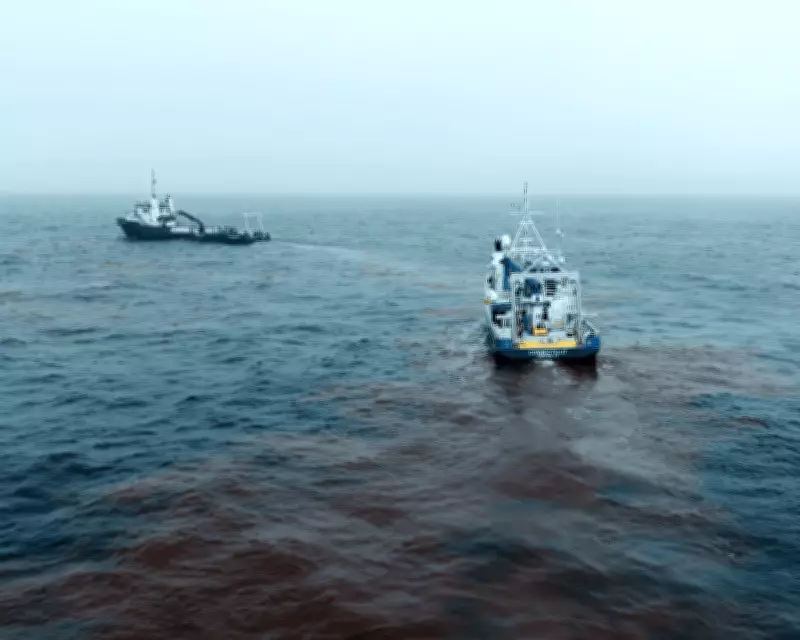
Ocean Alkalinity Enhancement Experiment Conducted in Gulf of Maine
In a groundbreaking environmental research trial, scientists have conducted an ocean alkalinity enhancement (OAE) experiment in the Gulf of Maine as part of the Loc-ness project. The study involved pumping 65,000 liters of sodium hydroxide, tagged with red dye, into ocean waters to test whether this approach could help mitigate global heating and ocean acidification.
The Science Behind Ocean Alkalinity Enhancement
Ocean alkalinity enhancement works by mimicking natural weathering processes but on human timescales rather than geological ones. The ocean already contains approximately 38,000 billion tonnes of carbon stored as dissolved bicarbonate. By boosting this natural alkalinity with chemical antacids, scientists theorize the ocean could absorb additional carbon dioxide from the atmosphere.
"The ocean is already incredibly alkaline," explains Adam Subhas, lead oceanographer of the research team that presented early results at the AGU Ocean Sciences Meeting in Glasgow. "What we're testing is whether we can enhance this natural process to help address climate challenges."
Experimental Details and Preliminary Findings
The experiment, licensed by the US Environmental Protection Agency and overseen by scientists from Woods Hole Oceanographic Institution, took place 50 miles off the Massachusetts coast in an area commonly fished for cod, haddock, and lobster. Over five days at sea, researchers used advanced technology including autonomous gliders, long-range autonomous underwater vehicles, and shipboard sensors to trace the chemical dispersal.
Preliminary results, which have yet to undergo peer review, showed promising outcomes:
- Measurement of up to 10 tonnes of carbon entering the ocean during the observation period
- Increase in local pH at the deployment site from 7.95 to 8.3, representing a return to preindustrial alkalinity levels
- No significant harm observed to plankton, fish larvae, or lobster larvae during initial monitoring
Environmental Concerns and Scientific Debate
The experiment has sparked debate within environmental circles. Benjamin Day, a senior campaigner on climate and energy justice at Friends of the Earth US, expresses "profound concern" about the environmental impacts of scaling up OAE technology.
"What we're seeing is a push to exert more precise control over natural systems," says Day. "There's a risk of catastrophic unforeseen consequences when we intervene in complex marine ecosystems."
However, scientists involved in the research argue that humanity is already conducting uncontrolled experiments with the climate through carbon emissions. Phil Renforth, an expert in carbon dioxide removal at Heriot-Watt University in Edinburgh, emphasizes the need for proactive climate management.
"We're adding CO2 to the atmosphere every year," Renforth notes. "A large proportion of that is going into the oceans. The real question is whether we can be proactive about how we manage it."
Historical Precedents and Commercial Applications
The concept of alkalinity enhancement has historical precedents. Greek farmers used liming to neutralize acidic fields 2,000 years ago, and Scandinavian rivers were treated with alkaline lime in the 1980s to combat acid rain effects on fish populations.
Today, several OAE startups have been verified to sell carbon credits through international registry Isometric. These credits are purchased by companies seeking to achieve net-zero emissions claims. The US National Oceanic and Atmospheric Administration estimates OAE could potentially remove between 1 billion and 15 billion tonnes of CO2 annually at costs up to $160 per tonne.
Community Engagement and Future Research
The research team conducted extensive community engagement before the field trial, holding 50 meetings with fishers, tribal leaders, and stakeholders along the Massachusetts coastline. Sarah Schumann, a commercial fisher who joined the research team as an observer, participated in five of these meetings.
"There was concern this could become a Trojan horse that allows commercial operators to get their foot in the door," Schumann acknowledges, referring to companies eager to demonstrate OAE effectiveness for carbon credit eligibility.
Despite these concerns, Schumann notes that local fishers generally trust the science and have experience collaborating with researchers. The research team plans to continue modeling how the chemical plume absorbs CO2 over time, estimating that in the best-case scenario, their dispersal could lead to uptake of approximately 50 tonnes of carbon dioxide from the atmosphere into seawater over one year.
For context, 50 tonnes of carbon represents the annual emissions of approximately five UK citizens. While this scale may seem modest, researchers emphasize they began with small-scale experiments to establish best practices in this rapidly evolving field.
The debate continues about whether ocean alkalinity enhancement represents a promising climate solution or a risky environmental intervention. As research progresses, scientists stress the importance of transparent, objective studies conducted by respected institutions to properly evaluate this technology's potential benefits and risks.



