
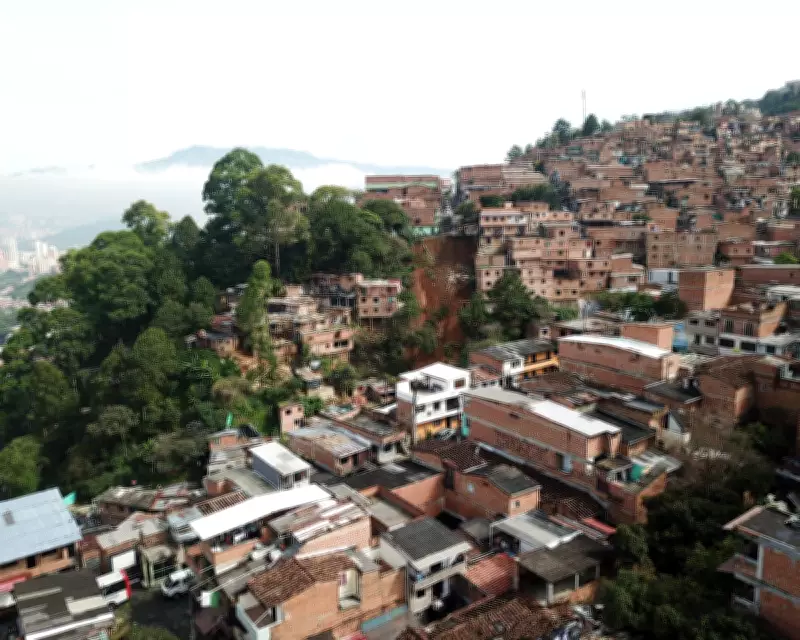
Medellín's Informal Hillside Communities Face Growing Climate Threats
Informal hillside settlements throughout Medellín are confronting escalating risks of flooding and landslides as climate patterns continue to shift dramatically. These densely populated neighborhoods, where brick houses with corrugated metal roofs cluster precariously on unstable terrain, represent some of the most vulnerable urban areas in Colombia's second-largest city.
Community-Driven Solutions Emerge from Crisis
In the Golondrinas neighborhood of Comuna 8, community leader Róbinson Velásquez Cartagena demonstrates a practical response to these environmental challenges. Standing proudly beside two large water tanks he designed and constructed, Velásquez Cartagena explains how his rainwater harvesting system helps mitigate flood risks while providing practical water resources for daily use.
"I started the rainwater harvesting system because I wanted to prove that it can reduce the risk of disasters by reducing the water that runs on to the streets, which can flood when it rains," says Velásquez Cartagena, who is simultaneously pursuing a master's degree in environmental engineering at the University of Antioquia.
His innovative system captures water from rooftop drainage channels, storing it in containers for use in washing machines and toilets. This approach represents just one of several nature-based solutions developed through community collaboration.
From Tragedy to Transformation
The urgency of these initiatives becomes starkly apparent when considering Medellín's history with weather-related disasters. In 1987, a catastrophic landslide claimed 500 lives in the area, highlighting the deadly consequences of inadequate engineering and planning in these informal settlements.
This tragic event, combined with more recent flooding incidents, has galvanized community action. Organizations and residents like Velásquez Cartagena began developing the Local Agreement for Inclusive Climate Action in 2020, aligning with Medellín's broader Climate Action Plan established by city authorities.
A Comprehensive Climate Resilience Framework
After three years of intensive debate and groundwork, the community-driven plan formally launched in August 2023 through collaboration between multiple stakeholders:
- Medellín's disaster risk management department (DAGRD)
- The housing and habitat committee for Comuna 8
- Heriot-Watt University in the United Kingdom
This comprehensive framework now serves as a model for Medellín's entire population of 4 million residents. The plan incorporates eight specific measures to address climate vulnerabilities:
- Advanced rainwater management systems
- Reforestation initiatives to control hillside erosion
- Sedimentation control in ravines and waterways
- Establishment of community eco-gardens
- Development of agroforestry systems
- Community tree nurseries for local reforestation
- Ecological restoration projects
- Land stabilization through natural means
Grassroots Innovation in Action
In the El Pacifico neighborhood, Nancy Elena Quiros Correa oversees a modest 9 by 3 meter community tree nursery established just last year. "The nursery will prevent rocks from falling, soak up water when it rains, and increase biodiversity," she explains while pointing to a yellow-painted wall that has twice collapsed under rock impacts.
Quiros Correa has witnessed Medellín's changing climate firsthand. "It used to be much cooler. Now we have high temperatures, but also more rain," she observes, recalling a severe 2020 flood that damaged numerous buildings and homes in her community.
Other implemented projects include a rainwater-harvesting system at a local community center and an ecological restoration garden designed to stabilize vulnerable land. According to Harry Smith, a professor in global urbanism at Heriot-Watt University who has collaborated with Comuna 8 for a decade, these gardens serve multiple purposes: "The garden will restore nature and stabilise the land. But it also stops one of the problems they have there, which is land invasion as people continue to build new homes on land that has been sold illegally by armed groups."
From Local Pilot to Citywide Model
The Comuna 8 initiative has evolved from a disaster-management scheme into a comprehensive climate adaptation framework that now informs planning for all 21 comunas across Medellín. Juan David Moreno, head of the technical team at DAGRD, confirms this expansion: "The work in Comuna 8 was a pilot, and we developed it for the rest of the communities."
However, adaptation requires customization. "In some communities, you have different needs," Moreno acknowledges. "We assessed the terrain, the community needs and the different hazards." The planning process revealed a crucial insight: "The main lesson from Comuna 8 was that we needed to work closely with the people, as they live in the territories and know the local hazards."
Challenges and Future Directions
Despite significant progress, substantial challenges remain. Securing consistent government support and adequate funding for grassroots initiatives continues to be difficult. Quiros Correa expresses tempered optimism: "I now have a more realistic view of the local government actions. Everything that we have achieved here has involved fighting and negotiating with the local government."
Implementation represents the next major hurdle. Moreno identifies this clearly: "Every actor, including every department of the local government, as well as the community, needs to implement the proposals. This is the biggest challenge."
Meanwhile, community leaders like Velásquez Cartagena are working to disseminate their model more broadly. He's collaborating with fellow leaders to create user-friendly guides with engaging graphics that can be printed and shared across social media platforms. His vision extends beyond Medellín: "We want the municipality to acknowledge it financially. We hope they put effort into implementing it, as these small actions make a real difference."
Ultimately, the Comuna 8 initiative demonstrates how vulnerable communities can develop practical, nature-based solutions to climate threats through collaboration, innovation, and persistent advocacy. As Medellín works to expand this model citywide, the experience offers valuable lessons for informal settlements throughout Latin America facing similar climate challenges.



