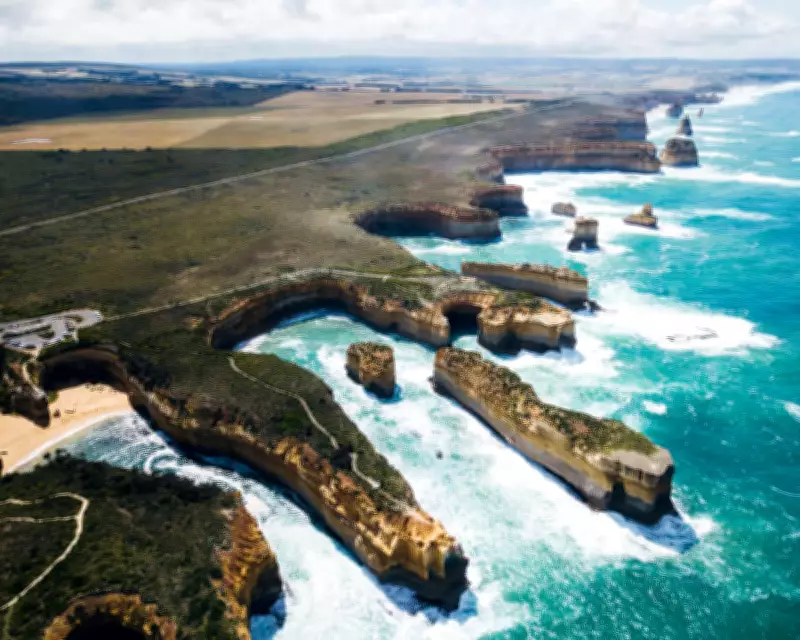
The Twelve Apostles, the iconic limestone sea stacks along Victoria's Great Ocean Road, have been precisely dated for the first time. A new study published in the Australian Journal of Earth Sciences reveals that these towering formations are between 8.6 and 14 million years old, far older than previously estimated.
How scientists determined the age
Researchers from the University of Melbourne used microscopic fossils called foraminifera, along with gamma radiation measurements and digital mapping, to date the rock layers. These single-celled organisms evolved and went extinct at specific times, allowing scientists to pinpoint the age of each layer.
Associate Professor Stephen Gallagher explained that the Apostles are composed of Port Campbell limestone, formed during the mid-Miocene period, atop older Gellibrand marl. Tectonic plate movements over millions of years lifted and tilted these layers, creating the tilted strata visible today.

Geological significance
Dr. Erich Fitzgerald, senior curator at Museums Victoria Research Institute, noted that the rocks formed during a period of major climate change known as the Middle Miocene Climatic Transition. This era marked a shift toward global cooling, eventually leading to the Ice Ages. During this time, seas were higher and teeming with marine life, including the giant shark Megalodon.
The study also highlights that the sea stacks themselves are relatively young, forming only in the last few thousand years as cliffs eroded. Twenty thousand years ago, the area was dry land, and Bass Strait was a lake.
Importance of the research
Dr. Matthew McCurry, curator of palaeontology at the Australian Museum, praised the use of microfossils for dating, calling it a valuable technique. The findings underscore how much remains to be learned about even the most famous natural landmarks.
The Twelve Apostles attract 2.8 million tourists annually, but for geologists, they represent a window into Earth's deep history. As Gallagher said, “We see layers, we see time, we see a history of the Earth.”