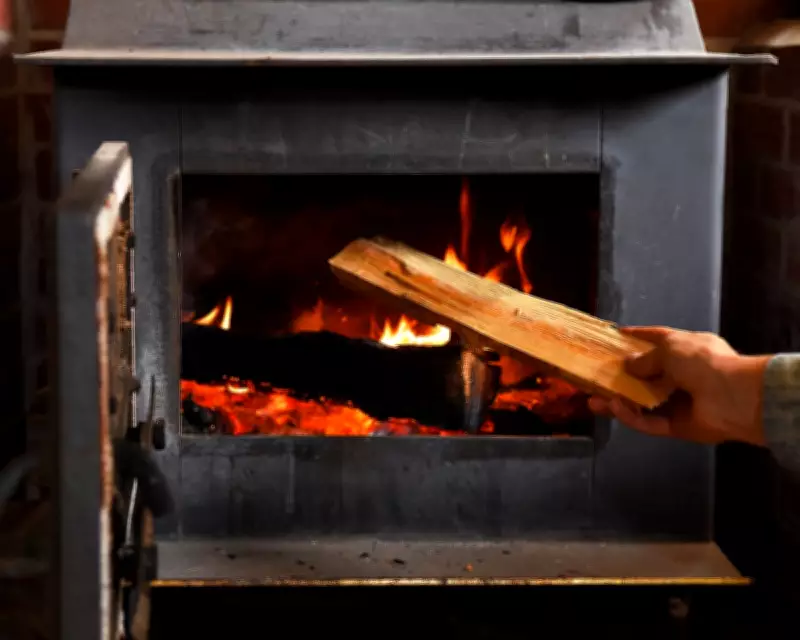
A groundbreaking study has uncovered that air pollution from residential wood burning is far from a rural issue, heavily affecting populations in many major US cities and leading to an estimated 8,600 premature deaths each year.
Shocking Impact of Wood Burning
While only 2% of US homes rely on wood as their primary heating source, and an additional 8% burn wood for pleasure or supplementary heating, this combined activity produces a staggering 21% of the country's wintertime particle pollution. Professor Daniel Horton of Northwestern University, who led the research, emphasized, "We frequently hear about the negative health impacts of wildfire smoke, but we rarely consider the consequences of burning wood to heat our homes."
Urban and Suburban Exposure
Kyan Shlipak, the first author of the study, expressed surprise at the findings, stating, "I was shocked by the percentage of particle pollution coming from residential wood burning. We had the preconceived notion that it was predominantly a rural phenomenon, but we found that it has a substantial impact on urban and suburban populations in and around many of the US's largest cities." The research team analyzed the continental US by dividing it into 839,000 grid squares, calculating hourly pollution levels with and without residential wood combustion.

Cold night-time temperatures drive wood burning even in regions with warm climates, such as Los Angeles. Pollution is often trapped locally by geographical features like valleys and mountains, including the Rocky Mountains west of Denver, the Cascade Range east of Seattle, and the San Gabriel mountains north of Los Angeles.
Environmental Justice Concerns
The study also examined who is responsible for the burning and who suffers the most. Particle pollution from residential wood combustion spreads from suburbs with high burning rates to densely populated urban areas, raising significant environmental justice issues. Shlipak noted, "Although people of colour burn less wood, they experienced higher exposure and greater harms from wood-burning pollution." This disparity is compounded by existing health inequalities, making communities of colour more vulnerable.
Potential Solutions and UK Parallels
Professor Horton suggested a path forward, saying, "Only a small number of homes rely on wood burning for heat. Facilitating a home-heating appliance transition to cleaner burning or non-burning heat sources could lead to outsized improvements in air quality." This issue is not confined to the US; the UK also faces negative health effects from residential wood and coal burning.
In the UK, air pollution from homes burning wood or coal contributes to nearly 2,500 avoidable deaths annually. A recent study in Wales found that heating with a wood stove or fireplace triples the particle pollution inhaled by children at home. Analysis of 26 million home energy performance certificates revealed that 10.4% of homes in England and Wales had wood heating in 2024, with numbers increasing. The charity Global Action Plan estimates that if current trends continue, nearly 1 million wood-burning stoves could be installed in the UK during the current parliament.
The highest density of wood stoves and fireplaces is in urban areas outside major cities, including councils in Worthing, Norwich, Reading, Cambridge, and Hastings. This heating is predominantly in wealthier neighborhoods but spreads to affect larger areas, further highlighting environmental justice concerns. The UK government is now consulting on health warnings for new stoves and solid fuels.