The 2026 Venice Biennale has opened with a bang, featuring performances that have drawn police attention, banned artists, and even a nesting gull that became an accidental attraction. Here are the highlights not to miss.
Florentina Holzinger’s Skinny Dippers
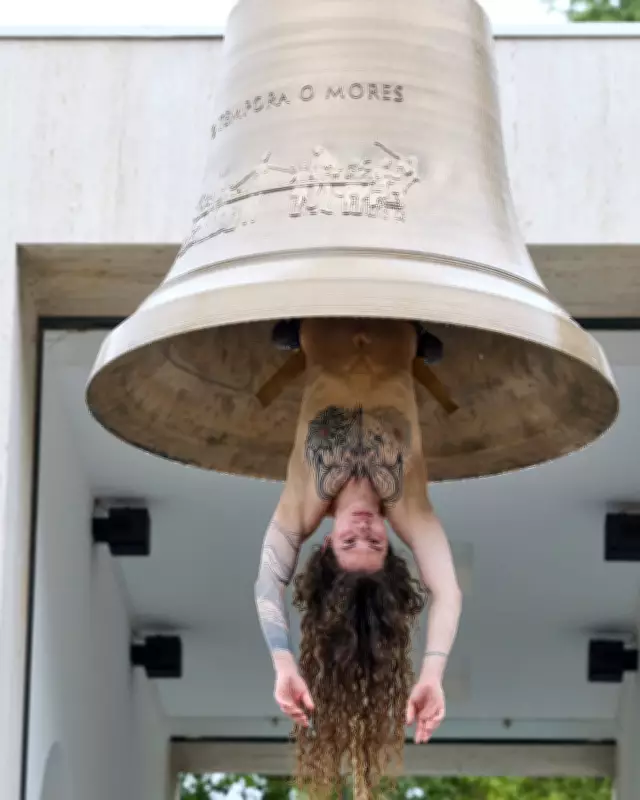
Florentina Holzinger, known for extreme performances, has outdone herself with a postapocalyptic Austrian pavilion. She opened suspended upside down from a bell’s clappers, while inside, a woman rode a speedboat in circles, two others hung from a pole, and another sat submerged in a tank—all nude. Viewers were invited to use two toilets to purify urine for the tank, but a sewage-like mess elsewhere suggested the project nearly went awry. Four police officers arrived to investigate. The pavilion quickly became the talk of the town.
Sanya Kantarovsky’s Eerie Seances
Sanya Kantarovsky, 44, a Moscow-born painter now based in the US, presents paintings like stills from intense films. One shows a naked man crouching in despair at the foot of a bed while a dog sits on the pillow. The works are displayed in book-lined rooms with Murano glass chandeliers, culminating in a detailed Murano glass sculpture of a boy’s head. The atmosphere feels like a seance between centuries.

Gabrielle Goliath’s Hypnotic Mourners
Gabrielle Goliath was banned by the South African government from appearing at the Biennale because her piece Elegy was deemed a “highly divisive” tribute to a Palestinian poet. She staged the work anyway at the Chiesa di Sant’Antonin, in partnership with London’s Ibraaz arts centre. The performance features operatically trained female performers holding a single high note, then stepping down as their voices fade, replaced by another singer. Conceived in 2015, it is a ritual of mourning for women killed in sexualised or racialised violence.
Carrie Schneider’s Photographic Curls
In the main In Minor Keys show, Carrie Schneider’s 1.5km-long photographic curls repeat a still from Chris Marker’s 1962 film La Jetée. The work grabs hold in the vast Arsenale caverns, standing out among other highlights like Akinbode Akinbiyi’s street scenes, Guadalupe Rosales’ Chicano archive, and Avi Mograbi’s directory of lost businesses and lives in Gaza.
Lydia Ourahmane’s Coin-Slot Art
British-Algerian artist Lydia Ourahmane created a delicate sculptural show drawn entirely from Venice. A new wooden pier will be handed over to a local cooperative; a bead curtain of Murano glass was threaded by inmates of the Giudecca women’s prison; and a church contraption once used to illuminate a Bellini now turns on the show’s lights when you insert a euro coin. It is a touching, thoughtful piece that works with the grain of the world.
Lawrence Abu Hamdan’s Audio Detective Work
Lawrence Abu Hamdan’s 450XL: the Story of a Fugitive Sound investigates human rights abuses through sound. He gathers testimony from Serbian demonstrators who were dispersed from a peaceful, silent protest by a sonic weapon. Installed in the hospital’s old music room, surrounded by frescoes of musicians, 15 screens resemble protest placards.
Zhanna Kadyrova’s Origami Deer
A huge concrete deer dangling from a crane on a flatbed truck near the Giardini entrance traveled from Pokrovsk, Donetsk region, Ukraine. Originally made for a park in 2018, it was evacuated in 2024 on the fourth attempt. In the Ukrainian pavilion, footage shows the deer’s journey, greeted by refugees from Pokrovsk, now under Russian control.
Zhang Zhoujie’s Digital Chairs
At the end of the Arsenale, the Chinese pavilion offers a different take. Ten artists present proposals for merging human and artificial intelligence. Highlights include Jiang Suxuan’s sculptured landscapes, Nie Shichang’s robot calligraphy, and a video game by Game Science. Best of all, Zhang Zhoujie’s lawn of “digital chairs” provides a welcome seat after the long walk.
The Gull
Outside the Polish pavilion, a nesting gull surrounded by a white fence caused confusion during the press preview. Was it art? Ornithological provocation? No, just a bird that chose the Giardini as a nesting spot. Selfies with the artist are essential.