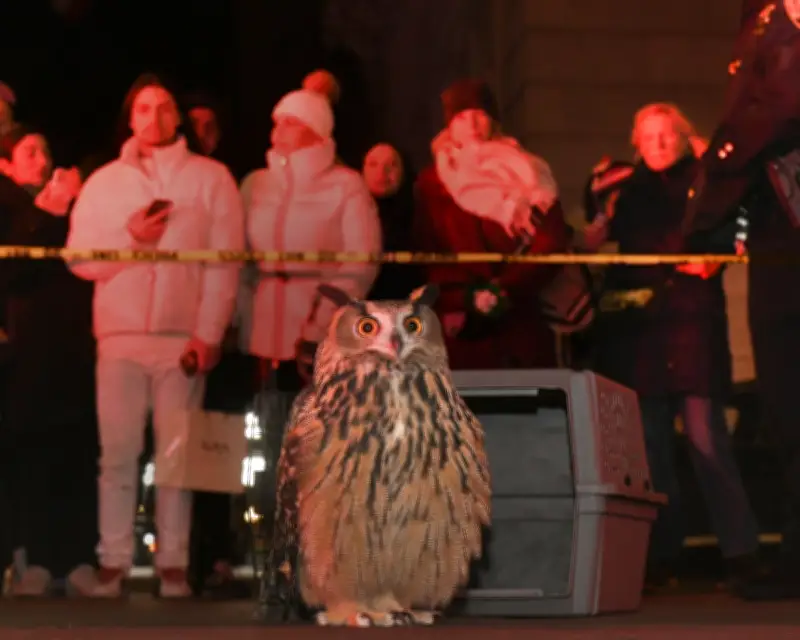
Flaco the Eurasian eagle-owl gained a cult following after escaping captivity at the Central Park Zoo in 2023 and surviving for over a year as a free bird in Manhattan. Birdwatchers tracked his every move, fans got tattoos in his honor, and now the documentary Wild Inside chronicles his incredible journey. The film premieres this week in New York and at over 40 theaters nationwide.
A Fairytale in the City
Director Penny Lane said she felt compelled to tell Flaco's story because she, like many New Yorkers, was swept up in his magic. 'Owls are uniquely magical creatures,' she said. 'They're associated with other worlds, these mystical realms. So the appearance of a creature like that in New York City … it feels like kind of a fairytale.'
Flaco escaped from the zoo in February 2023 after someone deliberately cut the mesh of his enclosure, where he had lived for 13 years. Zoo staff and birdwatchers feared for his wellbeing; he did not know how to hunt and had trouble flying. Attempts to lure him back with live lab rats failed.

Learning to Be Wild
Eventually, Flaco figured out how to hunt, successfully preying on the city's abundant rats. After two weeks, zoo officials suspended recapture efforts. Flaco had learned to be wild again in the concrete jungle of New York City. 'As the saying goes, if you can make it here, you'll make it anywhere,' a news anchor quipped.
Lane's film captures Flaco's wild fairytale magic with whimsical music and dreamy visuals, featuring interviews with New Yorkers who projected their own experiences onto the owl. They called him a survivor and an immigrant success story. 'Every New Yorker dreams of moving out of their tiny shitty apartment into a nicer neighborhood and Flaco did it,' Seth Meyers joked.
Questions of Wildness
'New Yorkers, we love an underdog,' Lane said. For the birding community, Flaco's story went deeper. 'We were watching a zoo animal transform into a wild animal before our eyes,' she noted. Flaco's ability to revert to instincts he never used raised questions about the nature of wildness. 'He was born in captivity. His parents were born in captivity. His grandparents were born in captivity. … But he showed pretty quickly that he was not a domesticated animal,' Lane said.
A Tragic End
Flaco's story does not have a fairytale ending. Just over a year after his escape, he crashed into a building on West 89th Street and died. A necropsy found he had been weakened by pigeon herpes virus from eating pigeons and had four kinds of anticoagulants from rodenticide, a common cause of death for wild birds in New York City.
'I was devastated,' Lane said. She had planned to film Flaco for at least 10 more years. The film grapples with whether Flaco would have been better off never escaping. 'You can't help but feel guilty and implicated,' Lane said. 'You loved seeing him so much, but you knew in the back of your mind all the while that this was not a safe place for him.'
Flaco's Legacy
Months after his death, the city council approved 'Flaco's law,' a pilot scheme using rat contraceptives instead of poison to curb the rat population. Flaco's year of hooting from water towers and peeking into windows brought the natural world into Manhattan's hustle and bustle. 'There are certain places in New York City that will forever be changed for me by his existence in those places,' Lane said. 'Everywhere he went, he left that place like a little more magical, and that magic is still there.'