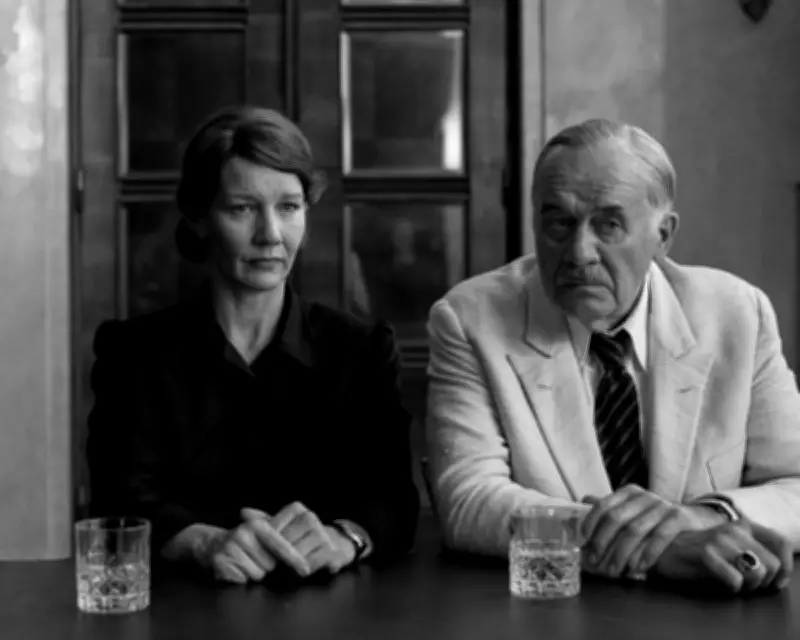
A Masterful Return to Form
Paweł Pawlikowski's Fatherland is an impossibly elegant, poised historical vignette whose brevity and control can hardly contain its characters' personal and historical pain. Directed and co-written by the Polish film-maker, and shot in lustrous monochrome by Lukasz Zal, the film explores exile and betrayal, the impossibility of going home, and the challenge of reconciling an artist's children to their secondary importance.
The Setting: Thomas Mann's 1949 German Tour
The year is 1949. The celebrated German novelist and Nobel laureate Thomas Mann, who fled the Nazis for California exile and US citizenship, returns home. He first visits Frankfurt in West Germany to receive an award named after Goethe, whose birthplace this is. In his many elaborate speeches, Mann pointedly evokes Goethe's enlightened civilised wisdom and apolitical artistry.
Mann, played with withdrawn politeness by Hanns Zischler, is accompanied by his long-suffering grownup daughter Erika, portrayed by Sandra Hüller. He is received with rapturous acclaim and, given his importance, assigned a CIA liaison. But he disconcerts his hosts by expressing his intention to accept a second award in Weimar, where Goethe lived, now in the communist East and perhaps tainted by its association with the chaotic Weimar republic that ushered in the Nazis. Mann greets the communist apparatchiks' acclaim with the same diplomatically opaque withdrawal.

Erika's Anguish and Klaus's Tragedy
While Mann aspires to float free from history and straddle Europe's west and east, Erika is an anguish. Played with the usual bayonet of intelligence by Hüller, she deeply misses her adored brother Klaus (August Diehl), a writer in American exile suffering from depression and drug dependency. The film begins with a bleak, prose-poetic duet of loneliness between Erika and Klaus as they speak on the phone. Later, halfway through Thomas Mann's visit, he and Erika receive terrible news about Klaus—news that Thomas grimly intends to ignore and carry on with his triumphal tour.
Klaus takes centre stage unexpectedly. His novel Mephisto is about a vain actor who sells out to the Nazis, arguably bolder in political engagement than Thomas ever cared to be, and was based on Erika's ex-husband, the actor and Göring courtier Gustaf Gründgens (Joachim Meyerhoff). Gründgens brazenly shows up to the Frankfurt party to celebrate Thomas with a self-pitying tale about his brief stay in a Soviet prison. He presumes to attempt banter with Erika, who slaps his face, just as Thomas in another part of the room tells Wagner's oleaginous grandchildren that he has no intention of supporting the return of the Bayreuth festival, saying its theatre should be burned to the ground.
The Mephisto Crisis
This rare flash of political temper cannot erase what becomes the growing Mephisto crisis in Thomas's own life. It isn't simply that he might now feel he neglected Klaus, or that his own colossal prestige eroded Klaus's writerly self-belief; it is that Klaus's great creation reproaches him. Able to move freely across the iron curtain, Thomas feels above any Mephisto-type sellout to the Americans or the Soviets, but then where is his commitment? To Germany, of course, but the Germany that was the root of his greatness (and that of Goethe) is gone. Germany is dead, and perhaps Mann himself, with his American passport, is now a ghost.
At a Frankfurt press conference, Mann is reproached by a German correspondent for not having chosen the martyred path of internal emigration within Germany—mutely enduring the tyranny—rather than leaving the country. Mann does not reply that internal emigration is Germany's convenient postwar myth, but crisply says that without leaving he would not have survived. Yet the film's pathos, brought into sharper focus by his son's heartbreaking fate, is that survival itself is called into question. Perhaps Mann senses that Germany's national spirit has not survived—compromised by geopolitical division, partisan politics, cold war acrimony, and the terrible memory of the Holocaust—and that its language and culture have been contaminated.

Redemption Through Music
It is the music of Bach that brings some measure of redemption and emotional release for both father and daughter, but Pawlikowski does not offer anything emollient or elegiac in this taut, literate picture. Fatherland screened at the Cannes film festival.