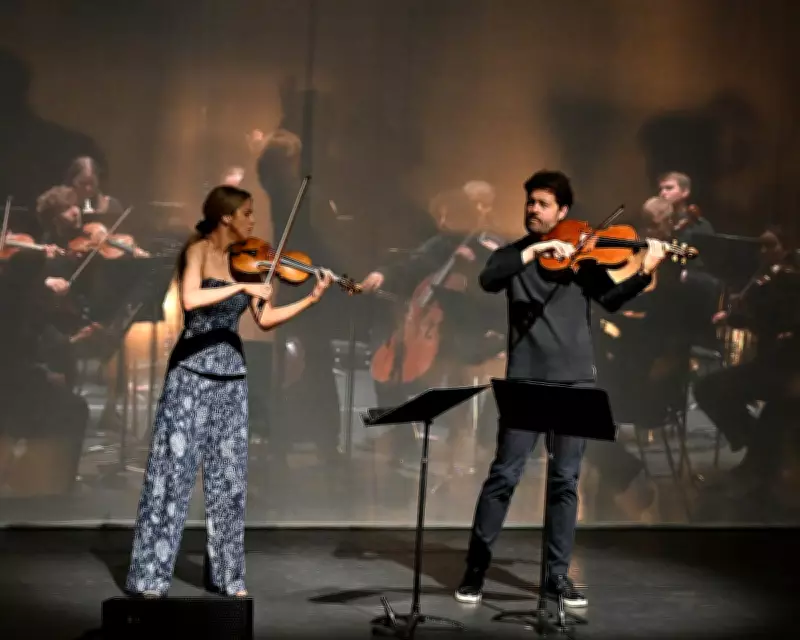
While the Southbank Centre marked its 75th anniversary with a Danny Boyle spectacular that overlooked classical music in favor of grime, techno, and drum'n'bass, the Barbican quietly got on with the business of imagining a concert hall for the 21st century. Darkness Visible – a collaboration between violist Lawrence Power and film director Jessie Rodger, who together form creative studio Âme, along with a host of starry musical friends – isn't a flawless show. But as an experiment in thinking through sound, in testing digital limits and amplifying the live concert experience, it has a lot going for it: the start of a longer conversation about how we experience music in a multimedia, post-internet age.
A Journey Through the City After Dark
The title comes from Milton's Paradise Lost: infernal flames that generate, “No light, but rather darkness visible.” It’s a vision of the horror that comes after the forbidden fruit, of knowing things that cannot be unknown. We cannot unknow screens and hyperlinks, so why not use them, Âme asks, to our advantage? And so Power and his collaborators invite the audience on “a journey through the city after dark.” A scrim covers the stage, now opaque, now translucent – playing games with sight and blindness. Behind it sit Collegium Orchestra and conductor Simon Crawford-Phillips; onto it are projected Rodger’s images of London – when we’re allowed to see them. Blindness may be thematically interesting, but over 90 minutes it proves less so visually.
Blending Live and Filmed Performance
The effects are mirrored in sound. We follow Power with a handheld camera, Ivo van Hove-style, as he leaves the stage after Anders Hillborg’s spiderweb-delicate arrangement of Bach’s chorale Ich ruf zu dir, Herr Jesu Christ and wanders out into the City of London. We meet digital Power with vocalist Maddie Ashman for a skeletal performance of John Dowland’s In Darkness Let Me Dwell in St Bart’s Great Hall; Power encounters violinist Vilde Frang in the Guildhall art gallery, before they drift back onto stage in time for Mozart’s Sinfonia Concertante.

Gently Magical Moments
It doesn’t all work, but when it does it’s gently magical. Best of all is the closer – Cassandra Miller’s Simone Weil-inspired viola concerto I Cannot Love Without Trembling. An extended lament, it plays with the in-between spaces: between notes, soloist and ensemble, people. Power bends time and pitch, sometimes in dialogue with the cloudy, slow-phase blocks of orchestral sound, at others in a strange duet for one – his answering voice reduced to a single repeatedly plucked pitch. It’s mesmerising, and not a digital effect in sight.